Is Dental SEO Worth It? A Guide for UK Practice Owners
For most UK dental practices, yes, dental SEO is worth it, especially those offering high-value treatments like implants or Invisalign. Because a single high-value patient can be worth thousands of pounds, SEO often pays for itself with one or two extra bookings a month. It is less worth it for practices that are already fully booked with no capacity, or that need patients this week rather than over the coming months. The value depends on your treatments, competition and goals, not on price alone.
Introduction
Every practice owner asks the same question before spending on marketing: will this actually make me money, or is it another cost that disappears? For dental SEO, the honest answer is that it depends on your situation, not on a fixed rule.
This guide helps you decide whether dental SEO is worth it for your practice. It covers what makes it a strong investment, when it pays off, when it does not, and how to think about the return without getting lost in numbers. It does not quote prices. For actual costs, see the dedicated dental SEO pricing page. This is about value, not price.
Is Dental SEO Worth It?
For the majority of UK practices, dental SEO is worth the investment, because it targets patients at the exact moment they are looking for a dentist. Unlike most advertising, it reaches people with high intent; someone searching “dental implants near me” is close to booking, not idly browsing.
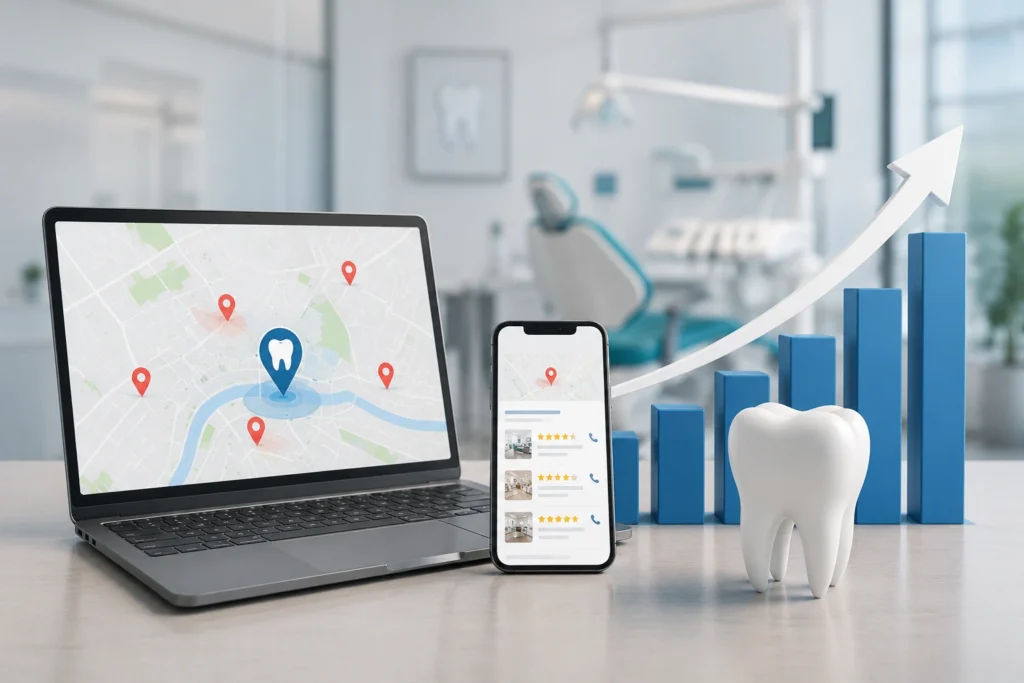
The logic is simple. Dental SEO is an investment that compounds. Paid ads stop the day you stop paying. SEO rankings, once earned, keep bringing patients month after month at no extra cost per click. Over a year or two, that difference is large.
The reason it works so well for dentists in particular is the value of a patient. In many industries, a new customer is worth a modest amount. In dentistry, a single implant or cosmetic patient can be worth thousands of pounds, and a regular patient returns for years. That maths tilts heavily in SEO’s favour. Research from Think with Google consistently shows that people research and choose local services online first, which is exactly where SEO places you.
What Makes Dental SEO Worth It, or Not
Whether SEO is worth it for a specific practice comes down to a handful of factors. The same investment can be excellent value for one practice and poor value for another. The table shows what pushes the decision each way.
| Factor | Makes SEO more worth it | Makes SEO less worth it |
|---|---|---|
| Treatment mix | High-value work like implants, Invisalign, cosmetics | NHS check-ups only, low margin per patient |
| Capacity | Room to take on new patients | Already fully booked with no spare capacity |
| Goals | Wants steady growth over time | Wants patients this week, or selling soon |
| Competition | Competitors ranking, patients searching online | Tiny rural area with almost no online demand |
| Time horizon | Willing to invest over 6 to 18 months | Expecting instant results |
The single biggest factor is treatment mix. A practice built on high-value treatments has the most to gain, because each new patient SEO brings can be worth many times the monthly investment.
Your Treatment Mix
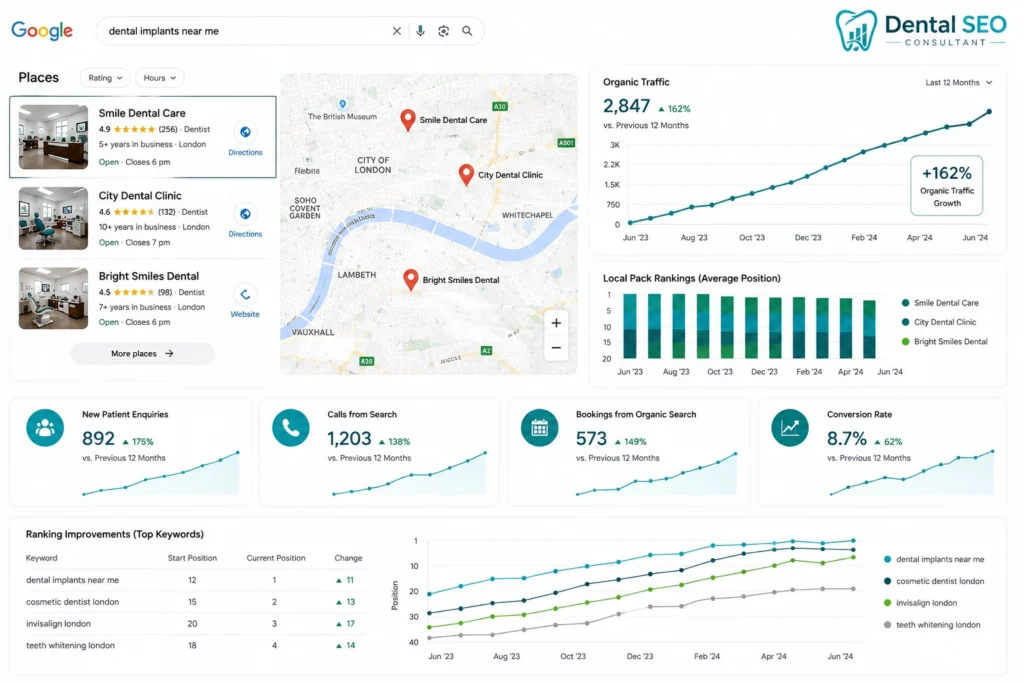
The treatments you offer decide how much a new patient is worth, and therefore how quickly SEO pays back. A practice promoting implants, Invisalign and cosmetic dentistry has high-value patients to win, so even a few extra a month justify the spend. A purely NHS practice with fixed, low-margin appointments has far less room for SEO to pay off.
Your Capacity and Goals
SEO only helps if you can absorb the patients it brings. A practice with spare chair time and a goal to grow is the ideal case. A practice already booked solid for months, with no plan to expand, may spend on SEO only to turn patients away. Marketing works best when it fills genuine capacity. Before investing, it is worth asking a simple question: if SEO brought ten extra patients next month, could the practice comfortably take them? If the answer is no, the timing may be wrong, even if SEO would otherwise be a strong fit.
Your Competition and Starting Point
If local competitors already rank and patients are searching, SEO is close to essential just to compete. If you are in a low-competition area with little online demand, the upside is smaller. Your current presence matters too. A practice starting from nothing has more to gain, but also further to travel. A quick way to judge this is to search for your key treatments in your area and see who appears. If competitors fill the map pack and the first page, that demand is real, and it is going to them instead of you.
When Dental SEO Is Worth It
Dental SEO is clearly worth the investment in these situations:
- Private practices offering high-value treatments where one patient covers months of cost.
- Practices in competitive towns and cities where patients search online and competitors already rank.
- Growing practices with spare capacity and a goal to attract new patients steadily.
- New or rebranded practices that need to build visibility from a low base.
- Practices planning for the long term, which benefit most from SEO’s compounding nature.
In each of these, the return over 12 to 18 months typically outweighs the cost by a wide margin, which is where the numbers on the pricing page put real figures to the return.
When Dental SEO May Not Be Worth It
Being honest, dental SEO is not the right investment for every practice. It is a poor fit when:
- The practice is already fully booked with no capacity or plan to expand.
- You need patients immediately, for example to fill next week, where paid ads suit better.
- You are planning to sell or close within a few months, so the long-term payoff never lands.
- The budget cannot be sustained, since SEO underdelivers when funded below a workable level and then stopped.
- The practice is purely NHS with fixed appointments and no private treatments to grow.
Recognising these cases matters. Spending on SEO when it cannot pay off is not a marketing failure, it is the wrong tool for the situation. A short conversation or an audit usually reveals which camp a practice is in.
Is Dental SEO Worth It for Different Types of Practice?
The answer changes with the kind of practice you run. The table below gives a realistic view by practice type.
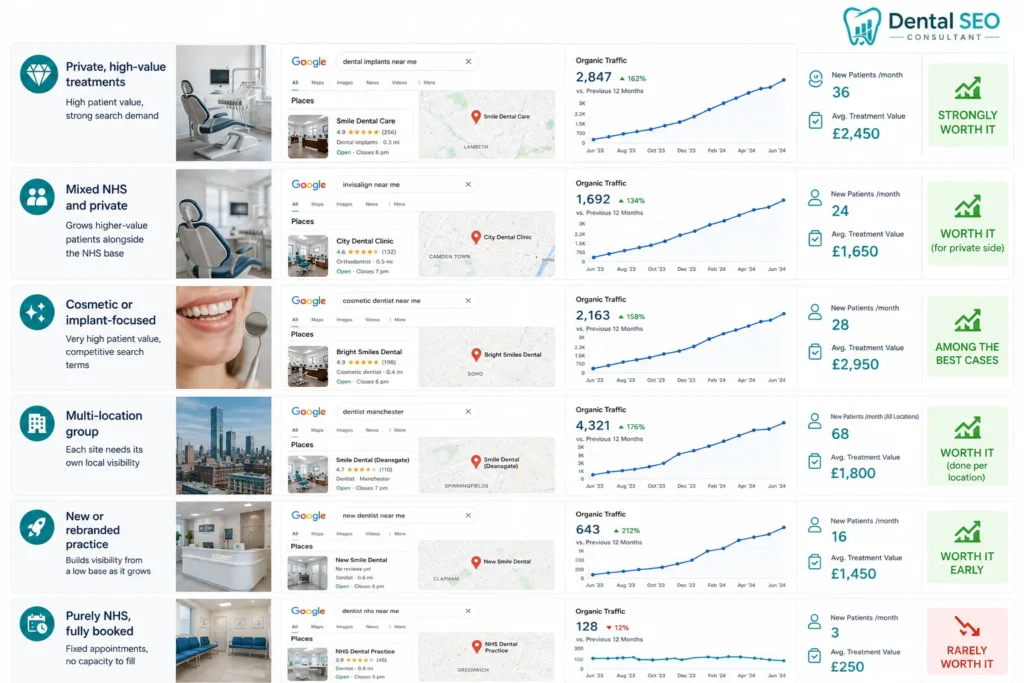
| Practice type | Is SEO worth it? | Why |
|---|---|---|
| Private, high-value treatments | Strongly worth it | High patient value, strong search demand |
| Mixed NHS and private | Worth it for the private side | Grows higher-value patients alongside the NHS base |
| Cosmetic or implant-focused | Among the best cases | Very high patient value, competitive search terms |
| Multi-location group | Worth it, done per location | Each site needs its own local visibility |
| New or rebranded practice | Worth it early | Builds visibility from a low base as it grows |
| Purely NHS, fully booked | Rarely worth it | Fixed appointments, no capacity to fill |
The pattern is consistent. The more a practice relies on high-value, privately funded treatments and has room to grow, the more worthwhile SEO becomes. The closer it is to a full NHS list with no spare chair time, the weaker the case.
How to Think About Dental SEO ROI
Return on investment sounds complex, but for dental SEO the concept is straightforward. You compare what it costs to win a patient against what that patient is worth. If a patient is worth far more than they cost to acquire, the investment works.
Two ideas make this clear:
- Patient value, not visit value. A patient is not worth one appointment. They return for years, refer family, and may take high-value treatment. That lifetime value is the real number.
- Payback through one treatment. For high-value work, a single extra patient a month can cover the entire monthly investment, with everything after that being profit.
This is why dentistry has such strong SEO economics compared with low-value industries. The exact figures, including realistic return ranges over time, are set out on the pricing page. The point here is the principle: judge SEO by patient value over time, not by the monthly cost in isolation.
Consider a practice that gains three or four extra new patients a month from improved rankings. If even one of those takes a high-value treatment, the return from that single patient can exceed the entire monthly investment on its own. Every additional patient beyond that widens the gap between cost and return. That is the quiet advantage of SEO: the asset keeps producing patients long after the initial work is done, so the return compounds while the cost stays flat.
It is also worth weighing SEO against paid ads. Ads buy instant visibility but stop when the budget stops, while SEO builds a lasting asset. Many practices use both, but for long-term value SEO usually wins.
Common Misconceptions About Dental SEO Value
Several myths make practices wrongly conclude SEO is not worth it. Clearing them up changes the decision.
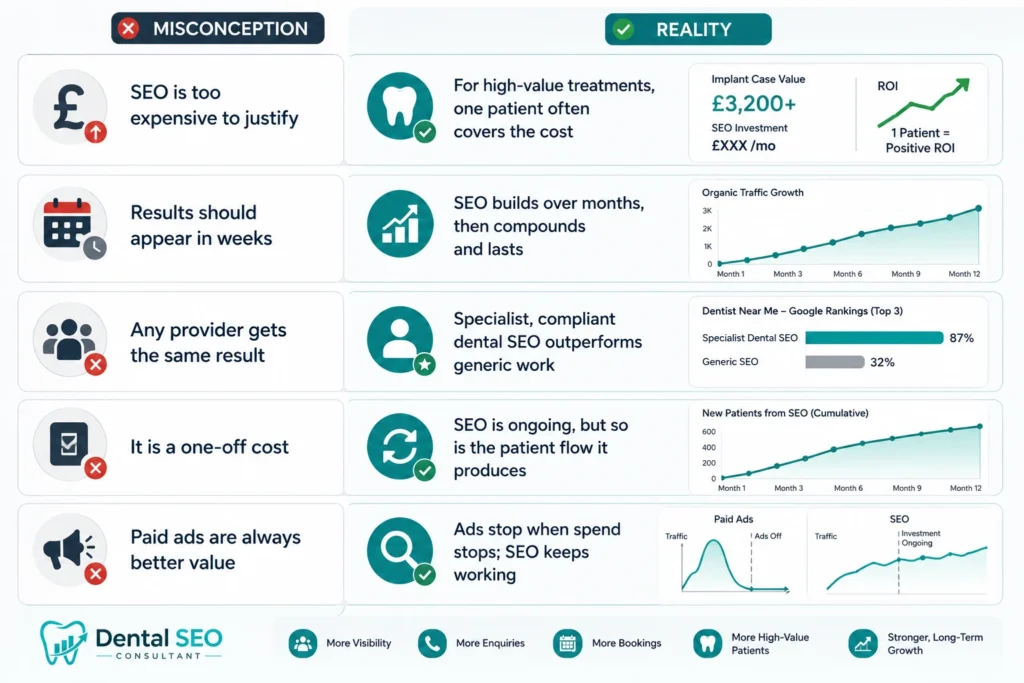
| Misconception | Reality |
|---|---|
| SEO is too expensive to justify | For high-value treatments, one patient often covers the cost |
| Results should appear in weeks | SEO builds over months, then compounds and lasts |
| Any provider gets the same result | Specialist, compliant dental SEO outperforms generic work |
| It is a one-off cost | SEO is ongoing, but so is the patient flow it produces |
| Paid ads are always better value | Ads stop when spend stops; SEO keeps working |
The most damaging myth is judging SEO on its monthly cost alone, without weighing it against the value of the patients it brings over time.
How to Get the Most Value From Dental SEO
If you decide SEO is worth it, a few choices maximise the return for your practice.
- Focus on high-value treatments, where each patient won is worth the most.
- Make sure your website converts, so the visitors SEO earns actually book.
- Give it time, since cutting SEO off early wastes the momentum it has built.
- Keep it compliant, because breaches undo the work and risk complaints under GDC and ASA rules. The General Dental Council standards apply to all your marketing.
- Treat it as an asset, not a monthly bill, and reinvest as it grows.
Value is not just about spending well. It is about making sure the patients SEO brings are ones you can serve and profit from.
Signs Dental SEO Is Delivering Value
Once you invest, you want to know it is working before judging whether it was worth it. Value shows up in a few clear signals, usually building over months rather than appearing at once.
- More new patient enquiries from search, tracked over time.
- Higher rankings for your key treatments and local terms.
- Growth in map pack visibility for “near me” searches.
- More calls and bookings attributed to organic search.
- A rising share of high-value treatment enquiries, not just routine check-ups.
If these are climbing over six to twelve months, the investment is paying off. If nothing moves after a sustained, properly funded effort, that is the signal to review the approach, not to abandon SEO as a concept.
FAQ
Is dental SEO worth the money?
For most UK practices, yes, particularly those offering high-value treatments. Because a single implant or cosmetic patient can be worth thousands of pounds, SEO often pays for itself with one or two extra bookings a month. It is less worthwhile for fully booked practices with no capacity or those needing instant results.
Does dental SEO actually work?
Yes, when done properly. SEO improves the signals Google uses to rank a practice, so it appears when patients search for a dentist or a treatment. The result is a steady flow of high-intent patients. It is not instant, and it needs specialist, compliant work, but the effect is real and lasting.
How do I know if dental SEO is worth it for my practice?
Look at your treatment mix, capacity and goals. If you offer high-value treatments, have room for new patients, and want to grow over time, SEO is very likely worth it. If you are fully booked, purely NHS, or planning to sell soon, it may not be. An audit shows your specific opportunity.
Is SEO better value than Google Ads for dentists?
Over the long term, usually yes. Ads deliver instant visibility but cost for every click and stop when the budget ends. SEO takes longer but builds a lasting asset that keeps producing patients. Many practices use ads short term while SEO builds, then rely mainly on organic results.
How long before dental SEO is worth it?
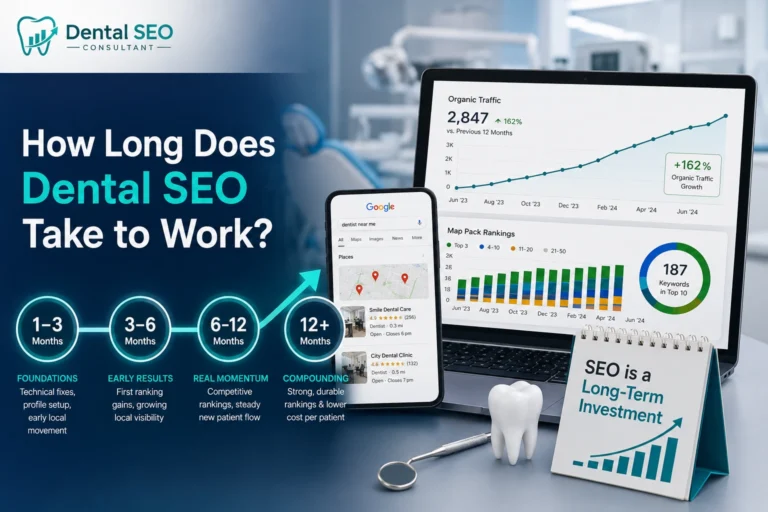
Dental SEO is a longer-term investment. Local visibility can improve within a few months, while competitive rankings take longer. Most practices see the return justify the cost over roughly 6 to 18 months, which is why it suits owners planning for sustained growth rather than a quick fix.
Is dental SEO worth it for an NHS practice?
It can be, but the case is weaker than for private practices. A purely NHS practice with full, fixed appointments has little to gain. An NHS or mixed practice looking to grow its private treatments, however, can use SEO effectively to attract those higher-value patients.
Is dental SEO worth it for a new dental practice?
Often yes. A new practice starts with little visibility, so SEO has the most room to build from. The earlier it starts, the sooner rankings compound. The one caution is capacity and budget: a new practice should make sure it can sustain the investment and serve the patients it attracts before committing.
Conclusion
Dental SEO is worth it for most UK practices, but not all. The deciding factors are your treatment mix, your capacity, your competition and your time horizon. For a practice offering high-value treatments with room to grow, the return usually outweighs the cost comfortably. For a fully booked or purely NHS practice with no expansion plans, the money may be better spent elsewhere.
The best way to know your own answer is to see your specific opportunity. Start with a free dental SEO audit, which shows what you could realistically gain, and check the pricing page for the figures that turn that opportunity into a clear return.