How Long Does Dental SEO Take to Work?
Dental SEO usually takes three to six months to show meaningful results, and six to twelve months to deliver a steady flow of new patients. Local visibility in the map pack often moves first, within the first few months, while competitive organic rankings for treatments like implants can take twelve months or more. New websites take longer than established ones, because Google needs time to trust them. SEO is a compounding investment, so results build and strengthen over time rather than switching on at once.
Introduction
The most common question a dentist asks before investing in SEO is simple: when will I see results? It is a fair question, and the honest answer is that SEO is a slow build, not a switch. Anyone promising page one in a few weeks is either misunderstanding the work or misleading you.
This guide gives a realistic timeline for dental SEO in the UK. It explains what happens month by month, what makes it faster or slower, and how to spot early signs of progress before the rankings fully arrive. The aim is to set expectations you can plan around, so you know what is normal and what is not.
How Long Does Dental SEO Take?
For most UK dental practices, dental SEO takes three to six months to produce meaningful movement and six to twelve months to deliver a reliable stream of new patients. It is not instant, and it is not permanent overnight. It builds.
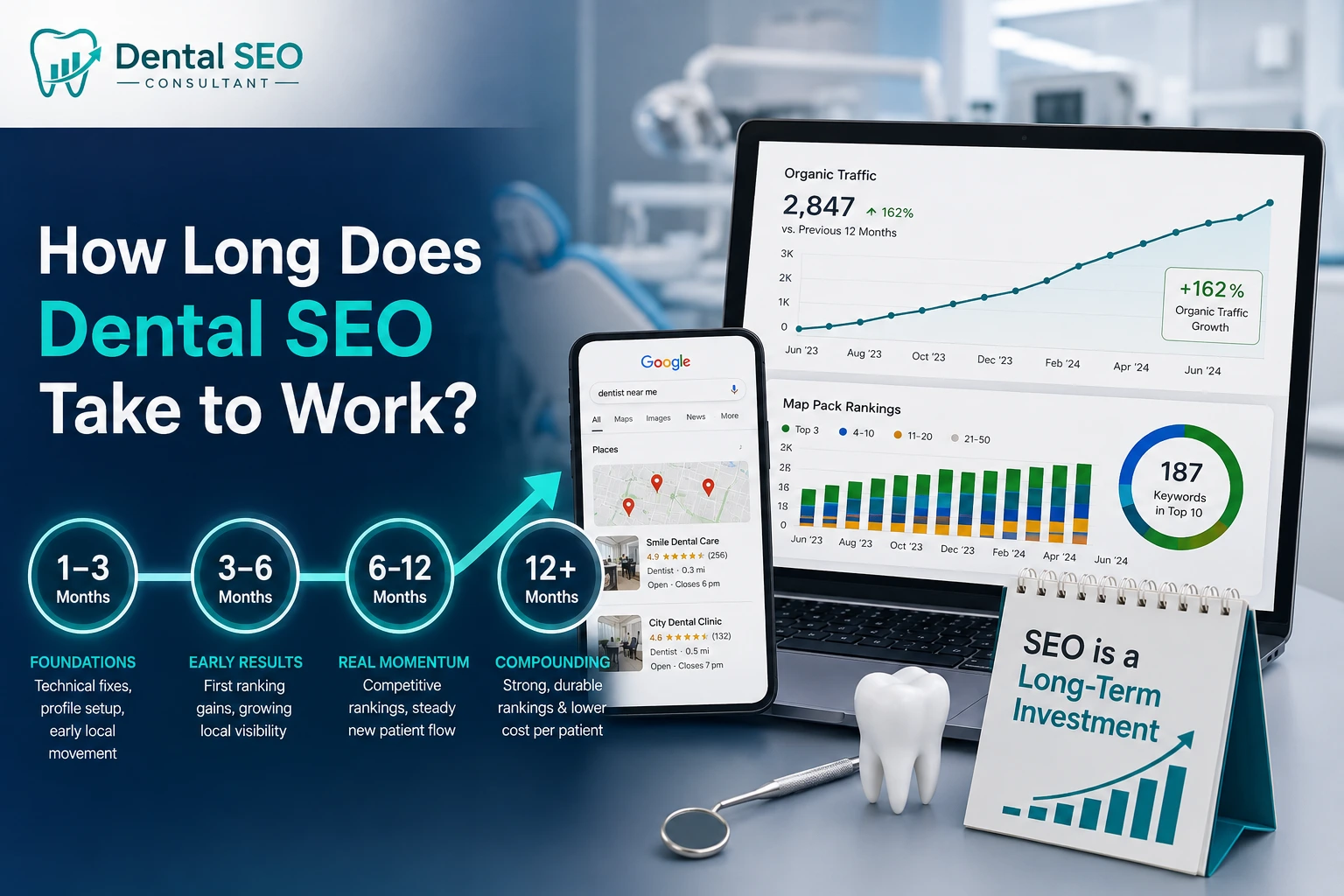
The timeline is not one number, because different parts of SEO move at different speeds. Local visibility tends to come first. Organic rankings for competitive treatments come later. The table shows the broad shape most practices can expect.
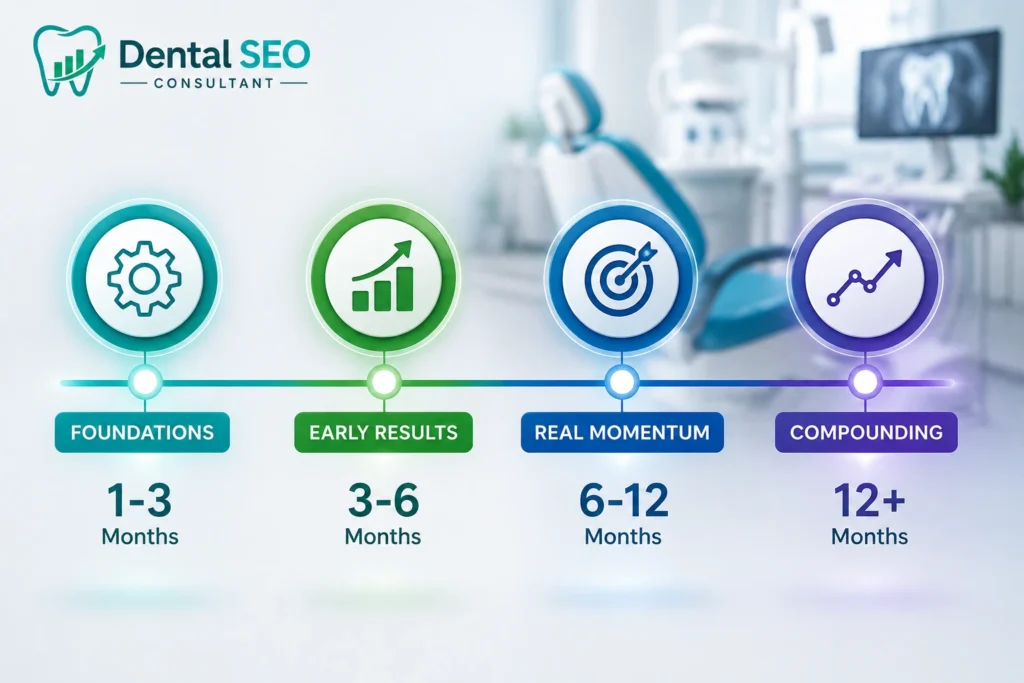
| Stage | Typical timeframe | What you see |
|---|---|---|
| Foundations | Months 1 to 3 | Technical fixes, profile setup, early local movement |
| Early results | Months 3 to 6 | First ranking gains, growing local visibility |
| Real momentum | Months 6 to 12 | Competitive rankings, steady new patient flow |
| Compounding | Months 12+ | Strong, durable rankings and lower cost per patient |
These are typical ranges, not guarantees. A practice in a quiet area may move faster, while a competitive city practice on a new website may take longer.
The Dental SEO Timeline Month by Month
SEO progresses in phases. Each phase builds on the last, which is why the early months can feel quiet before results accelerate. Here is what happens across a typical first year.
Months 1 to 3: Foundations
The first quarter is groundwork. This is where the technical health of the site is fixed, the Google Business Profile is optimised, and the structure for future rankings is put in place.
Little may appear in rankings yet, which is normal. Behind the scenes, Google is crawling and indexing the improved site, and local signals are starting to register. Practices often see early map pack movement toward the end of this phase. It is worth setting expectations here, because this quiet period is where impatient practices wrongly conclude SEO is not working, when in fact the groundwork being laid is what makes the later gains possible.
Months 3 to 6: Early Results
Now the work starts to show. Treatment pages begin ranking for less competitive, local searches. The Google Business Profile gains visibility, and the practice starts appearing for “near me” searches.
Enquiries usually begin to rise in this window, often from local and long-tail searches first. These are the early wins that confirm the strategy is working before the bigger terms arrive.
Months 6 to 12: Real Momentum
This is where SEO earns its keep. The site builds authority, more treatment pages rank, and the practice starts competing for higher-value, more competitive terms.
By the end of the first year, a well-run campaign typically delivers a steady, predictable flow of new patients from search. The rankings feel established rather than fragile. This is also when higher-value treatment pages, such as implants or Invisalign, tend to reach the first page in competitive areas, which is where much of the practice’s return comes from. The gains in this phase are usually larger and faster than the early months, because the authority built in the foundation phase now compounds.
Months 12 and Beyond: Compounding
After a year, SEO shifts from building to compounding. Established rankings hold, new content ranks faster because the site has authority, and the cost of winning each new patient falls.
This is the phase that makes SEO worthwhile. The asset keeps producing patients with maintenance rather than constant heavy lifting, and a strong position becomes harder for competitors to displace.
What Affects How Long Dental SEO Takes
Timelines vary widely because several factors speed SEO up or slow it down. Understanding them explains why two practices can see very different timeframes.
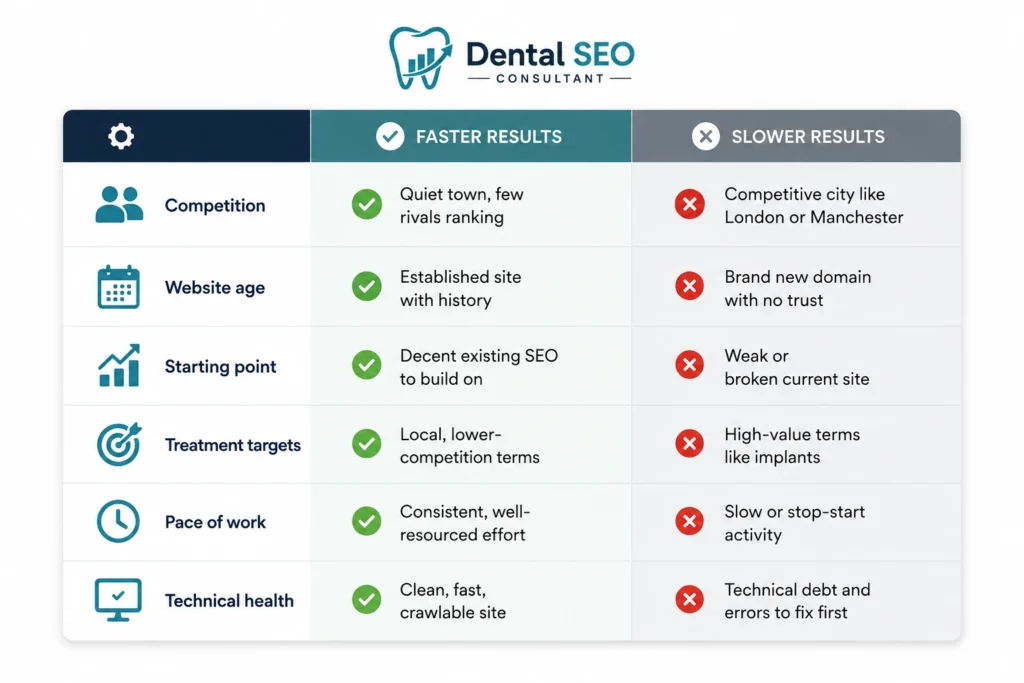
| Factor | Faster results | Slower results |
|---|---|---|
| Competition | Quiet town, few rivals ranking | Competitive city like London or Manchester |
| Website age | Established site with history | Brand new domain with no trust |
| Starting point | Decent existing SEO to build on | Weak or broken current site |
| Treatment targets | Local, lower-competition terms | High-value terms like implants |
| Pace of work | Consistent, well-resourced effort | Slow or stop-start activity |
| Technical health | Clean, fast, crawlable site | Technical debt and errors to fix first |
The two biggest drivers are competition and website age. A new practice website in a competitive city faces the longest road, while an established site in a quieter area can move quickly.
How the Dental SEO Timeline Varies by Practice Type
No two practices follow the exact same timeline. The table below gives a realistic view of how long different practices tend to wait for meaningful results, based on their situation.
| Practice situation | Typical time to meaningful results |
|---|---|
| Established site, quiet area, local terms | 3 to 5 months |
| Established site, competitive city | 6 to 9 months |
| New website, quiet area | 5 to 8 months |
| New website, competitive city | 9 to 12 months or more |
| Multi-location group | Varies by location, staggered |
These ranges assume consistent, properly resourced work. The pattern is clear: an established site in a low-competition area is the fastest case, and a new site competing in a major city is the slowest. Knowing which situation you are in sets a realistic expectation from the start, rather than judging your progress against a timeline that was never yours.
Why Local Results Come Faster Than Organic
Local visibility almost always arrives before organic rankings. The reason is that the map pack and organic results run on different systems, and the local one responds faster to focused work.
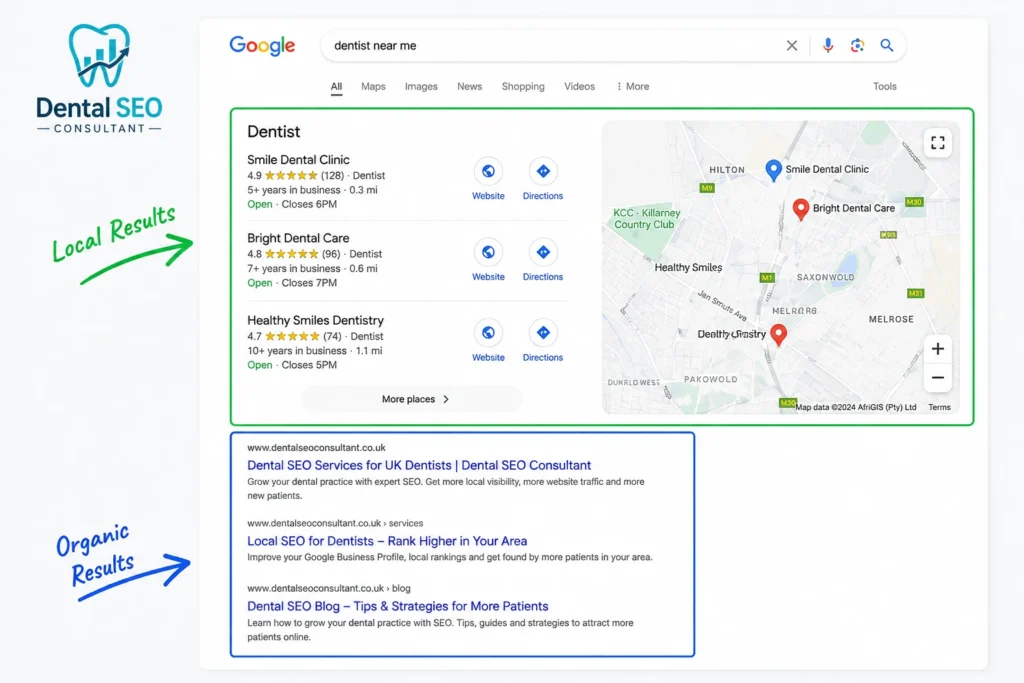
A practice can improve its Google Business Profile, fix its details across the web, and start earning reviews within the first few months, and the map pack often reflects that sooner than organic pages climb. This is why local work is usually the first phase of any campaign. The specific local timeline and how the map pack builds is covered in more depth as part of local SEO for dentists.
Organic rankings for treatment pages take longer because they depend on content depth, authority, and links, which accumulate gradually. Both matter, but they arrive on different schedules.
Why New Dental Websites Take Longer
A brand new website is the single biggest reason SEO takes longer. Google has no history with a new domain, so it starts cautiously and grants trust slowly.
This caution is stronger for dental sites than for most, because dental content is classed as YMYL, or Your Money or Your Life. Google holds health-related sites to a higher trust standard, so a new dental site has to prove its credibility before it ranks well. Displaying real clinician credentials, GDC registration, and consistent business details all help build that trust faster. Google’s own Search Central guidance notes that SEO changes can take time to be reflected in results.
An established site with existing history and authority skips much of this waiting, which is why it usually ranks faster than a new one doing identical work.
Early Signs Dental SEO Is Working
Rankings are the last thing to move, so waiting only for page-one positions can make good progress look like nothing is happening. There are earlier, leading indicators that show SEO is on track well before the headline rankings arrive.
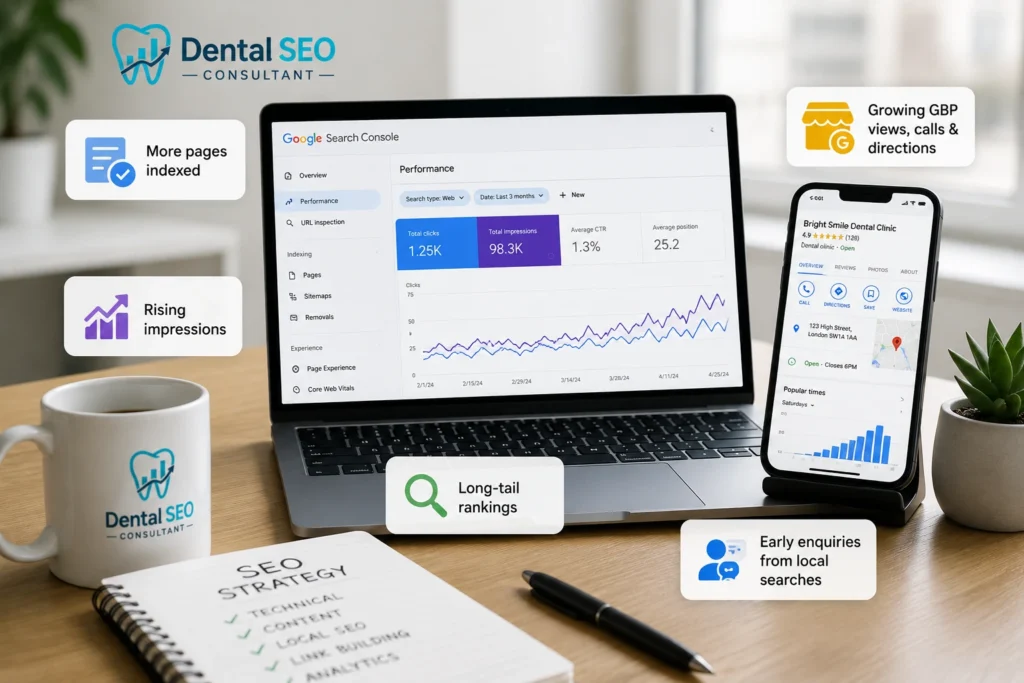
Watch for these signals in the early months:
- More pages indexed, shown in Google Search Console, meaning Google is reading the new content.
- Rising impressions, where the site appears in more searches even before it ranks highly.
- Long-tail rankings, where specific, low-competition searches start bringing visitors first.
- Growing Google Business Profile views, calls and direction requests.
- Early enquiries from local searches, ahead of the competitive terms ranking.
These signals confirm the foundations are working. Google Search Console is the clearest place to track them, and steady improvement there is a reliable sign the rankings will follow.
How to Get Dental SEO Results Faster
You cannot skip the fundamentals, but you can reach results sooner by focusing effort where it pays off first. These accelerate the timeline without cutting corners.
- Prioritise the Google Business Profile, since local visibility is the fastest win available.
- Fix technical issues early, so Google can crawl and index the site without obstacles.
- Target local, lower-competition terms first, to bank early rankings while the bigger terms build.
- Earn genuine reviews steadily, which lift both local ranking and patient trust quickly.
- Publish consistently, because a steady pace of quality content builds authority faster than sporadic bursts.
None of these are shortcuts or tricks. They are simply the order that produces visible results soonest, which keeps momentum and confidence up while the long-term work compounds.
Why Dental SEO Sometimes Takes Longer Than Expected
When SEO underperforms its timeline, the cause is usually one of a few avoidable problems rather than the strategy itself:
- Stop-start effort, where work pauses and momentum is lost each time.
- Thin or generic content that Google does not see as worth ranking.
- Unresolved technical issues quietly holding back otherwise good pages.
- Wrong targeting, chasing highly competitive terms before earning the authority to rank for them.
- Inconsistent details across the web, weakening Google’s trust in the practice.
Most delays trace back to one of these. Fixing the underlying issue, rather than doing more of the same, is what gets a stalled campaign moving again.
How Long Do Dental SEO Results Last?
Getting results is one question. Keeping them is another. The good news is that dental SEO results are durable. Once a practice earns strong rankings and a trusted profile, those positions tend to hold, unlike paid ads that vanish the moment spending stops.
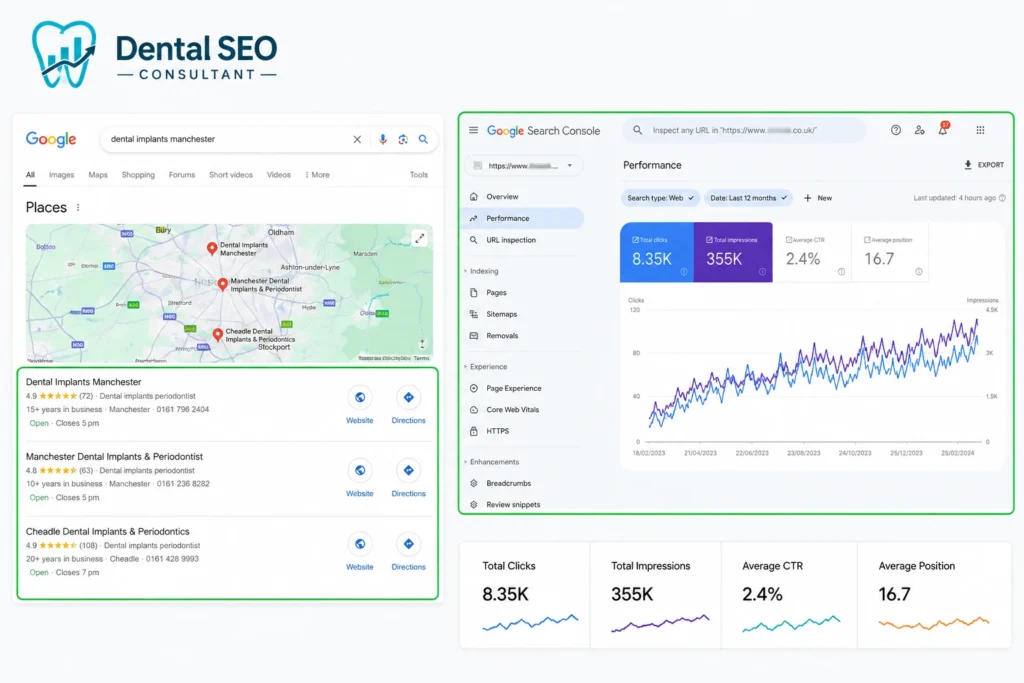
That durability is not automatic, though. Rankings can slip for a few reasons:
- Competitors improve, earning more reviews or better content and overtaking you.
- The work stops, so the site slowly falls behind more active rivals.
- A Google update reshuffles results, rewarding or demoting sites on new criteria.
This is why SEO is best treated as ongoing maintenance rather than a one-off project. The heavy building happens in the first year, but light, consistent upkeep protects the position. A practice that maintains its profile, keeps earning reviews and updates its content holds its rankings far longer than one that treats SEO as finished.
FAQ
How long does dental SEO take to work?
Most UK practices see meaningful results in three to six months and a steady flow of new patients in six to twelve months. Local map pack visibility usually improves first, within the early months, while competitive organic rankings for treatments like implants can take a year or more. SEO builds gradually rather than switching on at once.
Why does dental SEO take so long?
Because Google builds trust slowly, especially for health-related sites, and because rankings depend on content, authority and links that accumulate over time. Dental content is treated as YMYL, so Google applies a higher trust bar. New websites take longest, as Google has no history to judge them by.
How quickly can a dentist rank on Google?
Local map pack visibility can begin within the first few months for a well-optimised profile in a less competitive area. Ranking on the first page organically for competitive treatments typically takes six to twelve months or more. Quieter areas and established websites rank faster than competitive cities and new sites.
Is dental SEO faster than paid ads?
No, paid ads are faster to appear, often within hours, but they stop the moment you stop paying. SEO takes months to build but produces lasting results that continue without paying per click. Many practices use ads for speed while SEO builds in the background.
How do I know if my dental SEO is working before I rank?
Look at leading indicators in Google Search Console: more indexed pages, rising impressions, and early long-tail rankings. Growing Google Business Profile views, calls and early local enquiries are also good signs. These appear before top rankings and show the strategy is on track.
Can dental SEO results be permanent?
Rankings are durable but not permanent. Once established, strong rankings tend to hold with regular maintenance, but they can slip if the work stops, competitors improve, or a Google update reshuffles results. SEO is ongoing, which is also why the patient flow it creates is ongoing.
Does dental SEO work faster in a small town?
Usually yes. Less competition means fewer practices fighting for the same rankings, so a well-optimised site can climb faster and reach the top with less work. A practice in a quiet area targeting local terms often sees meaningful results in three to five months, while a competitive city practice may take twice as long for comparable positions.
Conclusion
Dental SEO takes three to six months to show real movement and six to twelve months to deliver a reliable stream of patients, with local visibility usually arriving first and competitive rankings later. New websites and competitive cities take longer, while established sites in quieter areas move faster. The key is to judge progress by the right signals, not just page-one rankings, and to keep the effort consistent so the results compound.
If you want a realistic timeline for your specific practice, based on your area, competition and starting point, begin with a free dental SEO audit. It shows what to expect and how quickly, so you can plan with confidence rather than guesswork, and see how a full dental practice SEO programme would progress over time.