How to Optimise a Dental Website for AI Search
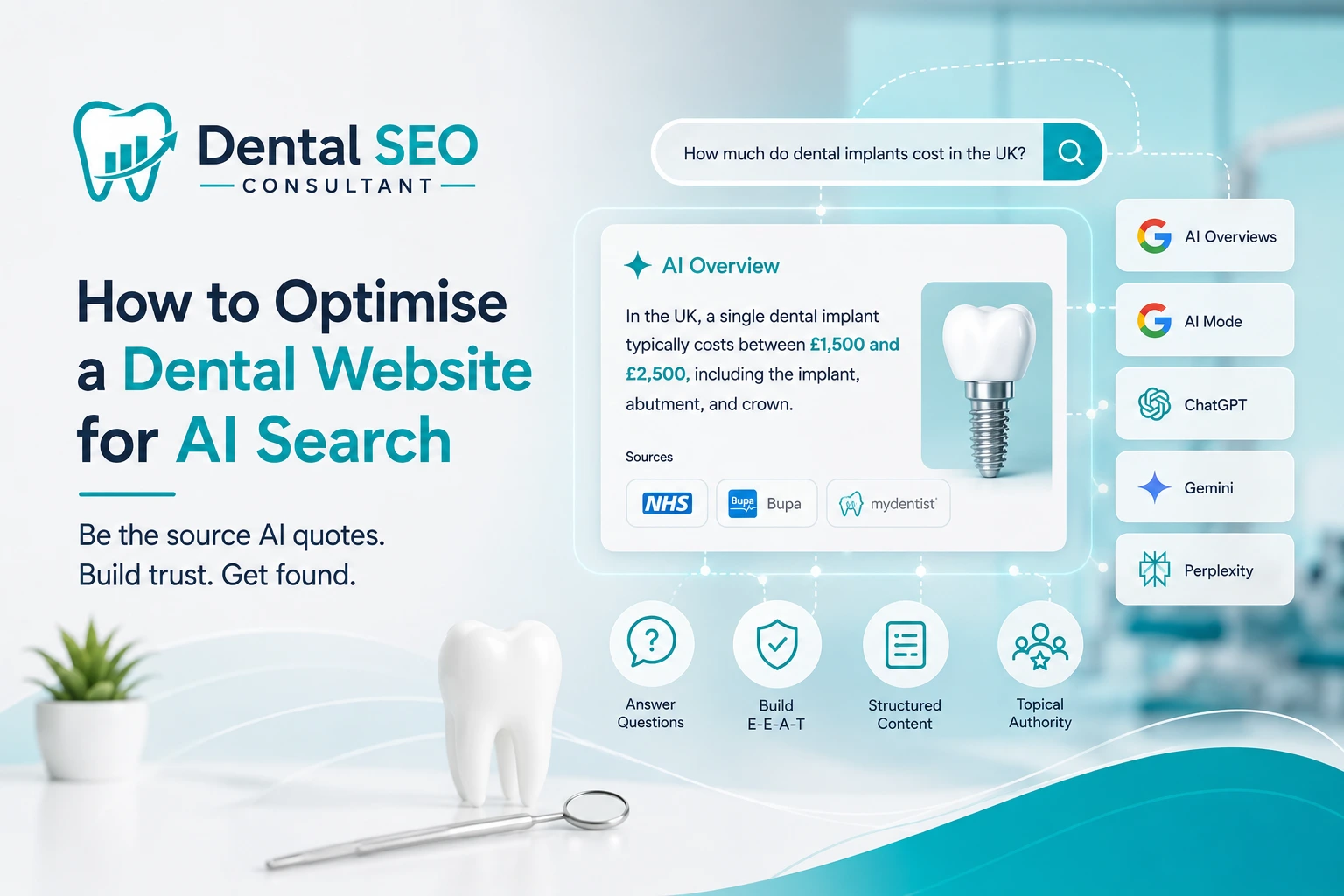
To optimise a dental website for AI search, give clear, direct answers to the questions patients ask, structure content so it is easy to extract, build strong E-E-A-T with named GDC-registered clinicians, keep content fresh, and rank well in normal Google search first. AI tools like Google AI Overviews, ChatGPT, Gemini, and Perplexity mostly cite pages that already rank and answer a question cleanly. Being the source an AI quotes is the new front page.
Introduction
Patients no longer only type “dentist near me” into Google. They ask ChatGPT how much implants cost, ask Gemini whether Invisalign hurts, and read Google’s AI summary before they ever click a website. In many searches, the AI answer now sits above everything else.
This changes the goal. It is no longer only about ranking; it is about being the source the AI quotes. This guide explains how AI search works, how these tools decide which dental sites to cite, and exactly how to optimise a practice website so it becomes one of them. It builds on good SEO rather than replacing it.
What Is AI Search, and Why It Matters for Dentists
AI search is any search experience where an AI system answers a question directly, usually by summarising and citing a handful of sources, instead of just listing links. For a dentist, it covers several tools patients now use.
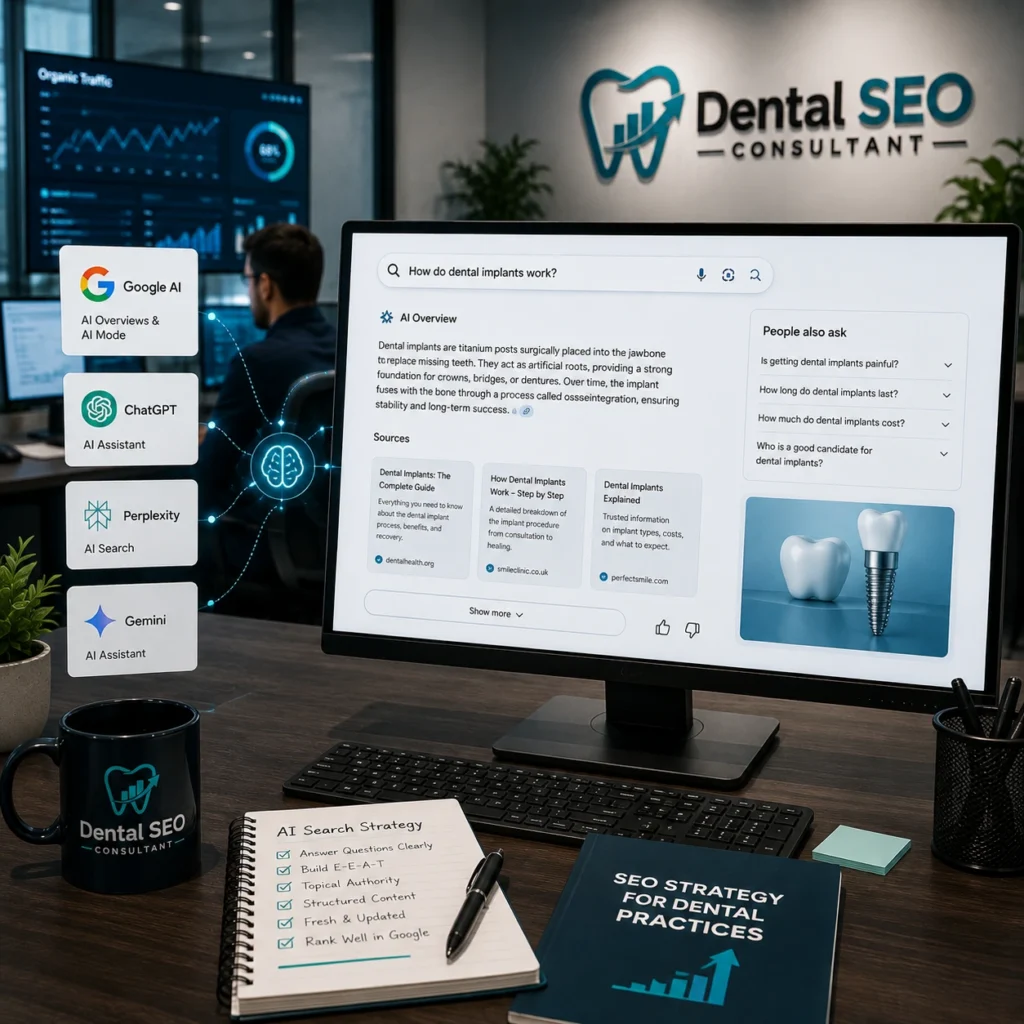
The main ones are:
- Google AI Overviews. The AI summary that appears at the top of many Google searches.
- Google AI Mode. A conversational search experience where users ask follow-up questions.
- ChatGPT, Gemini, and Perplexity. AI assistants that patients ask directly for dental information and recommendations.
This matters because the AI answer often gets read instead of the websites below it. If your practice is cited in that answer, you gain visibility and trust. If it is not, a competitor’s information shapes what the patient believes before they reach you.
How AI Search Is Different from Traditional Google
Traditional Google ranks a list of links and lets the patient choose. AI search does the work for them, reading multiple sources and giving one combined answer with a few citations. The difference changes what a practice should aim for, and it rewards different qualities than a decade of SEO advice trained most sites to chase.
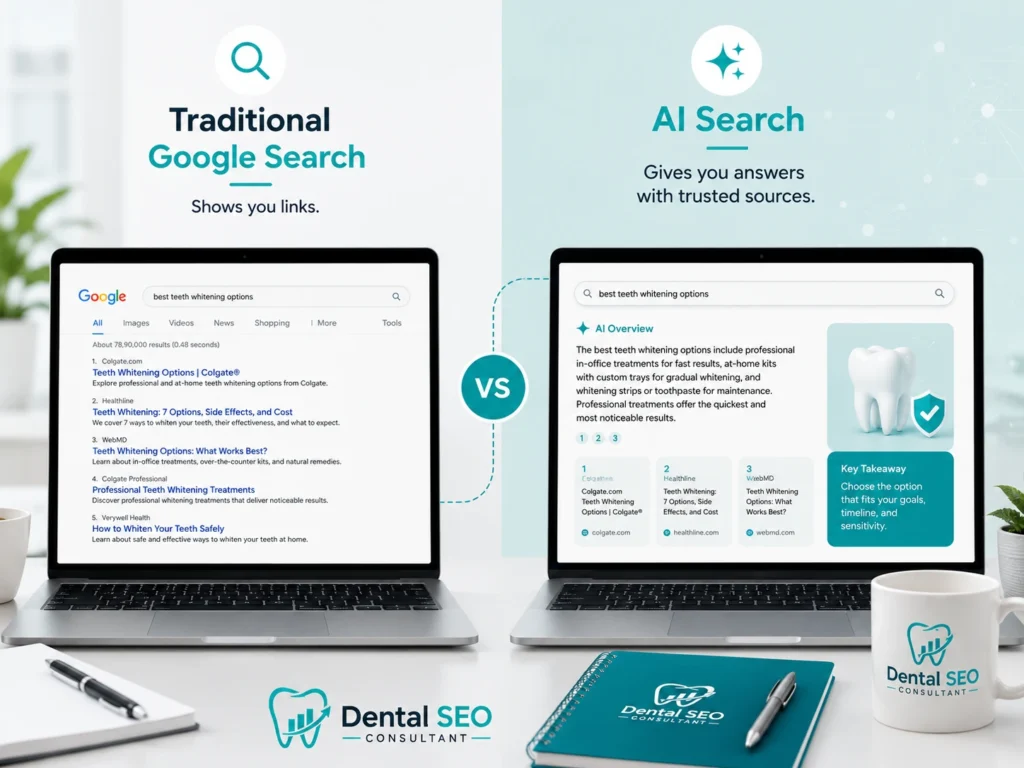
Three shifts matter most:
- From ranking to being cited. The prize is being one of the few sources the AI quotes, not just appearing on page one.
- From clicks to influence. Many AI answers are read without a click, so being named in the answer shapes the patient’s view even if they do not visit.
- From keywords to questions. AI search is driven by natural questions, so content that answers real questions clearly performs best.
None of this replaces SEO. AI systems mostly draw from pages that already rank well, so strong SEO is the foundation that AI visibility is built on.
Which Dental Searches Trigger AI Answers?
AI answers do not appear for every search. They show up most for questions, comparisons, and research, and least for direct booking intent. Knowing which of your target searches trigger AI answers tells you where AI optimisation pays off.
| Query type | Example | AI answer likely? |
|---|---|---|
| Informational | “does teeth whitening damage enamel” | Very likely |
| Cost | “how much are dental implants in the UK” | Likely, with citations |
| Comparison | “invisalign vs braces” | Very likely |
| How-to | “how to stop bleeding gums” | Very likely |
| Local recommendation | “best dentist near me” | Increasingly, through AI Mode |
| Direct booking | “book a dentist in [town]” | Less likely |
The pattern is clear. The research and question-style searches patients run early in their decision are exactly the ones AI now answers. That is where being the cited source shapes which practice a patient trusts before they are ready to book.
The AI Search Engines Dentists Should Care About
Each AI tool picks its sources slightly differently, so it helps to know how they work. The table gives a quick view of the main ones a UK dental practice should care about.
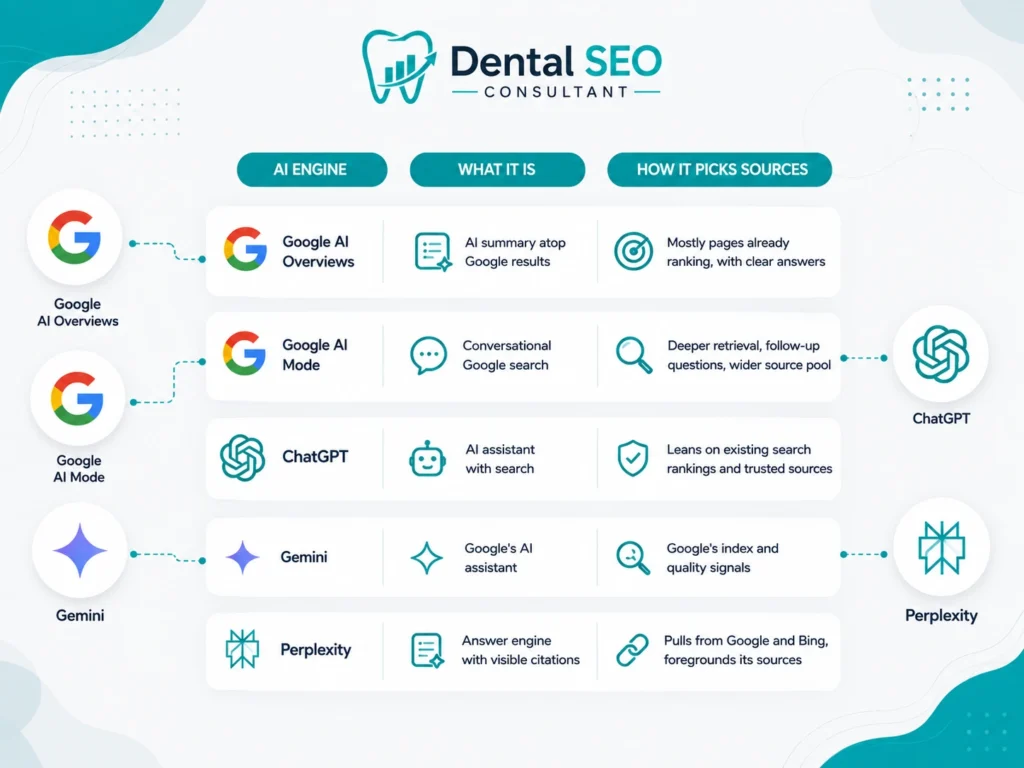
| AI engine | What it is | How it picks sources |
|---|---|---|
| Google AI Overviews | AI summary atop Google results | Mostly pages already ranking, with clear answers |
| Google AI Mode | Conversational Google search | Deeper retrieval, follow-up questions, wider source pool |
| ChatGPT | AI assistant with search | Leans on existing search rankings and trusted sources |
| Gemini | Google’s AI assistant | Google’s index and quality signals |
| Perplexity | Answer engine with visible citations | Pulls from Google and Bing, foregrounds its sources |
The common thread is that all of them favour clear, trustworthy, well-structured content from sites that already have search visibility. Optimise for that, and you improve across every engine at once.
How AI Chooses Which Dental Sites to Cite
AI systems are not magic. They select sources using signals that overlap heavily with good SEO, plus a few of their own. Understanding them shows where to focus.
The main factors:
- Existing rankings. Most AI citations come from pages already ranking on the first page, so traditional SEO comes first.
- A clear, extractable answer. Pages that answer a question directly, near the top, are far easier for an AI to quote.
- E-E-A-T. Experience, expertise, authoritativeness, and trust matter even more here. Content from named, credentialed clinicians is more likely to be cited.
- Topical authority. Sites that cover a subject thoroughly are trusted as reliable sources on it.
- Freshness. For anything time-sensitive, AI tools favour recently updated content.
- Third-party trust. Mentions and reviews on trusted sites reinforce that a practice is real and credible.
For dental sites, the E-E-A-T factor is decisive, because dental content is health content, and AI systems are cautious about which health sources they trust.
How to Optimise a Dental Website for AI Search
This is the practical work. Each step below makes a dental site easier for AI tools to understand, trust, and cite. Together they turn a normal practice website into a source AI quotes.
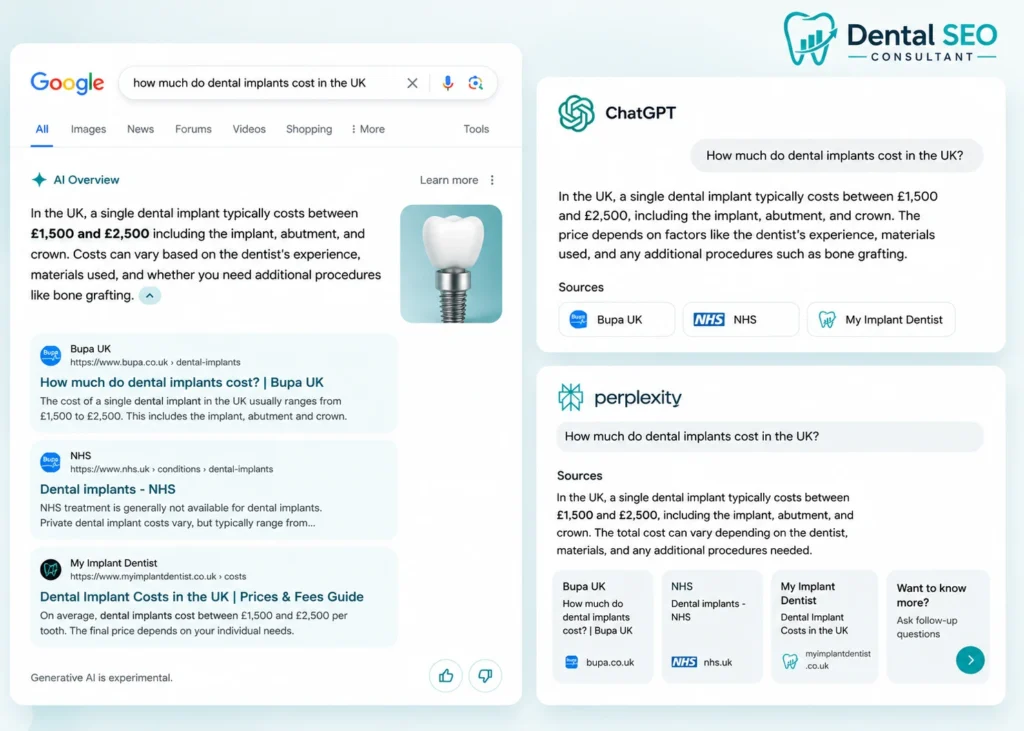
Answer Questions Directly
AI tools reward pages that answer a question cleanly. Use the real question as a heading, then give a direct answer of roughly forty to eighty words in the first paragraph below it, before adding detail. A page that opens a section with “How much do dental implants cost?” and answers it immediately is easy to quote.
Structure Content for Extraction
Machines extract structured content more easily than dense prose. Use clear headings, short paragraphs, and tables or lists where they fit. A well-organised page with obvious question-and-answer sections gives AI clean pieces to lift, which a wall of text does not. A simple habit that helps is to phrase a heading as the exact question a patient would ask, then answer it in the very next line, so the answer and its question stay together for the AI to pick up.
Build Topical Authority
Cover your subjects fully rather than thinly. A practice that has thorough, well-linked pages on implants, Invisalign, and its other treatments signals genuine expertise. AI systems favour sites that demonstrate depth on a topic over those that mention it in passing. This is why a cluster of connected, detailed pages on a treatment tends to be cited more often than a single shallow page trying to cover everything at once.
Strengthen E-E-A-T
Show who is behind the content. Name the treating dentists, display their GDC registration numbers and qualifications, and make the practice’s credentials and CQC registration visible. For health topics, this proof of real expertise is one of the strongest signals an AI uses to decide whether to trust and cite a page. Google’s own advice on creating helpful, people-first content makes clear that demonstrable expertise is central to how quality is judged.
Keep Content Fresh
Update key pages regularly, especially anything time-sensitive like prices, treatments or guidance. AI tools lean toward recently updated content for current topics, so a page left untouched for years is less likely to be chosen than one that is clearly maintained. Even small, genuine updates, refreshing figures, adding a new question patients have started asking, or noting a change in guidance, signal that a page is current and worth trusting.
Use Structured Data
Schema markup, such as Dentist, LocalBusiness, and FAQPage types, helps AI and search engines understand a page. While Google’s guidance on AI features notes that special schema is not required to appear in them, clean, accurate structured data that matches the visible content supports understanding and can win rich results.
Optimise Your Google Business Profile and Reviews
Local AI answers about “a good dentist near me” draw heavily on Google Business Profile data and genuine reviews. A complete, well-optimised profile with strong, recent reviews feeds the local AI answers as much as it feeds the map pack, which is covered in more depth under local SEO for dentists.
AEO and Local AI Search for Dental Practices
Answer Engine Optimisation, or AEO, is the practice of optimising specifically to be the answer an AI gives. For dentists, much of this is local, because so many dental searches carry local intent.
When a patient asks an AI assistant for a dentist in their area, the tools draw on local signals: the Google Business Profile, reviews, and the practice website’s local relevance. This means the same local work that wins the map pack also positions a practice to be named in local AI answers. A strong profile, genuine reviews and clear local treatment pages do double duty across both.
The practices most likely to be recommended by AI are usually the ones already visible locally, with strong trust signals and clear, well-structured information. Local visibility and AI visibility reinforce each other.
How to Track Your Dental Practice’s AI Search Visibility
You cannot improve what you do not measure, and AI visibility is harder to track than rankings. A practical approach combines two methods.
- Google Search Console. Since 2025, impressions and clicks from AI Overviews and AI Mode are counted within the Performance report, blended into your overall totals. Rising impressions on question-style queries are a good sign.
- Manual checking. Regularly ask ChatGPT, Gemini, Perplexity, and Google the questions patients would ask about your treatments and area. Note whether your practice or website is mentioned, and who is cited instead.
Doing this monthly builds a picture of where you appear in AI answers and where competitors are winning, which shows what to improve next.
Common Mistakes Dentists Make with AI Search
Most dental sites miss out on AI visibility for a few repeatable reasons:
- Burying the answer deep in a page instead of answering the question near the top.
- Thin content that mentions a treatment without covering it properly.
- No clear author or credentials, so the site fails the health-content trust test.
- Ignoring SEO fundamentals, when AI mostly cites pages that already rank.
- Keyword stuffing, which AI systems judge as low quality just as Google does.
- Never updating pages, so content looks stale on time-sensitive topics.
Fixing these is mostly a matter of clarity, credibility, and upkeep, the same qualities that make content genuinely useful to patients.
FAQ
What is AI search for dentists?
AI search is when tools like Google AI Overviews, ChatGPT, Gemini, and Perplexity answer a patient’s question directly and cite a few sources, instead of only listing links. For dentists, it means patients increasingly read an AI summary or ask an assistant about treatments and local dentists before visiting any website.
How do I get my dental practice cited in AI Overviews?
Rank well in normal Google search first, since most AI Overview citations come from pages already on the first page. Then answer questions directly near the top of each section, structure content clearly, build strong E-E-A-T with named clinicians, keep pages fresh, and use accurate structured data. Clear, trustworthy pages get cited.
Does AI search replace SEO for dentists?
No, it builds on it. AI systems mostly draw from pages that already rank well, so strong SEO remains the foundation. AI search adds a layer on top: making content clear and extractable enough for an AI to quote. Practices that do both traditional SEO and AI optimisation gain the most visibility.
Do patients really use ChatGPT to find a dentist?
Increasingly, yes. Patients use AI assistants to research treatments, compare options, understand costs and ask for recommendations, often before searching Google directly. While they may still book through Google or your website, the AI answer shapes their impression first, which is why being cited matters.
Is E-E-A-T important for AI search in dentistry?
Very. Because dental content is health-related, AI systems are cautious about which sources they trust and cite. Showing real expertise, named GDC-registered clinicians, credentials, and CQC registration is one of the strongest signals that a page is trustworthy enough for an AI to quote in a health answer.
How can I tell if my dental website appears in AI answers?
Use Google Search Console to watch impressions on question-style searches, where AI Overview data is now included. Alongside that, manually ask ChatGPT, Gemini, Perplexity and Google the questions patients would ask about your treatments and area, and note whether your practice is mentioned or a competitor is cited instead.
Do AI answers mean dentists lose website clicks?
AI answers do increase the number of searches that end without a click, because the patient gets their answer on the results page. But being the cited source still delivers value: it puts your practice name and expertise in front of the patient at the research stage, builds trust, and often earns the click when they are ready to act. The risk is being invisible in the answer, not being in it.
Conclusion
AI search has changed the goal for dental websites. It is no longer only about ranking; it is about being the trusted source an AI quotes when a patient asks about treatment or a local dentist. The practices that win are the ones that answer questions clearly, prove real expertise through named clinicians, cover their topics thoroughly, keep content fresh, and rank well in normal search first.
The good news is that this work also makes a website genuinely more useful to patients. To see how an AI-ready, compliance-led approach fits your practice, start with a free dental SEO audit, or learn more about working with a dental SEO consultant who builds for both search and AI.