How Google Ranks Dental Websites
Google ranks dental websites in three steps: it crawls the site, indexes the pages, then ranks them using hundreds of signals across many ranking systems. For dental practices, the signals that matter most are content relevance, E-E-A-T (Experience, Expertise, Authoritativeness, Trustworthiness), local proximity, Google Business Profile strength, backlinks, and Core Web Vitals. Because dental content is classed as YMYL (Your Money or Your Life), Google applies a higher trust bar than it does to ordinary business websites.
Introduction
Two dental practices in the same town can offer identical treatments, yet one appears on page one of Google and the other sits on page four. The difference is rarely luck. It comes down to how Google reads, understands, and scores each website.
This guide explains how Google ranks dental websites in plain terms. You will learn how Google’s ranking system works, which signals decide your position, why dental sites are held to a stricter standard than most, and how the local map pack ranks separately from the ten blue links. By the end, you will know exactly what Google is measuring when it decides where your practice shows up.
How Google Ranks Websites: Crawl, Index, Rank
Google ranks every website, dental or otherwise, through the same three-stage system. Understanding it first makes the dental-specific signals easier to follow.
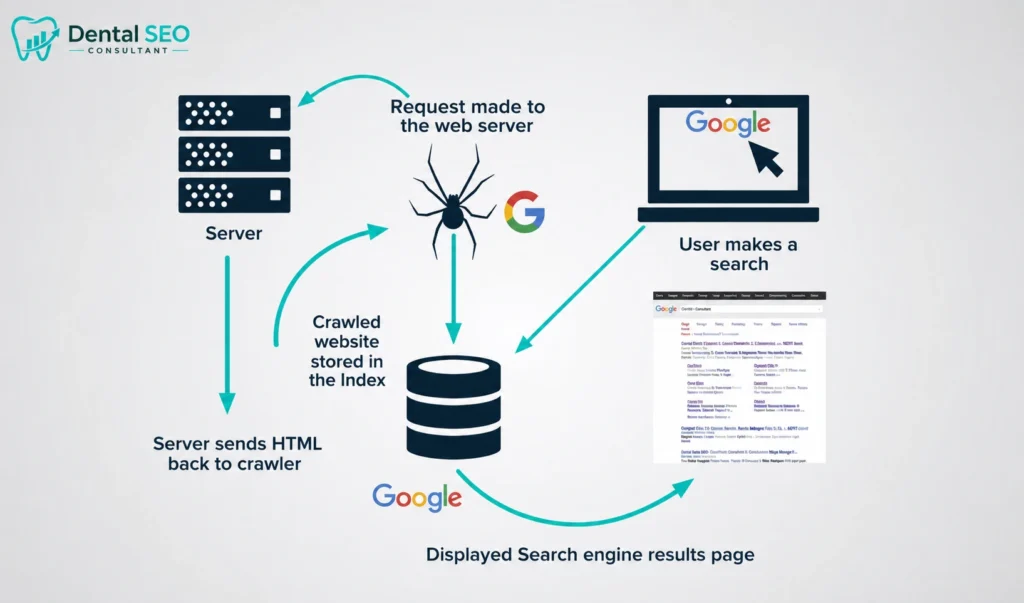
- Crawling. Google’s bot, called Googlebot, follows links across the web and reads the pages it finds. If a page has no internal links pointing to it and is not in your sitemap, Google may never see it.
- Indexing. Google analyses each crawled page, works out what it is about, and stores it in a giant database called the index. A page that is not indexed cannot rank for anything.
- Ranking. When someone searches, Google scans its index and orders the results using its ranking systems. This is where hundreds of signals combine to produce your position.
Only pages that pass all three stages can appear in search results. Many dental websites lose rankings at stage one or two, often because of a slow site, blocked pages, or thin content that Google chooses not to index. Google explains this pipeline in its own guide to how Search works.
Google Is Not One Algorithm: The Ranking Systems Behind Dental Results
Google does not rank dental websites with a single algorithm. It runs many ranking systems at once, each judging a different quality, and combines their scores. This is why fixing one thing on your site rarely fixes your rankings on its own.
| Ranking system | What it judges | What it means for a dental site |
| Link analysis and PageRank | Quality and relevance of sites linking to you | A link from the NHS or a dental body counts far more than a random directory |
| Helpful content signals (in core since 2024) | Whether content is made for patients or for search engines | Thin, copied treatment pages can pull down the whole site |
| Reviews system | Depth and originality of review-style content | Affects “best dentist” and comparison-style searches |
| RankBrain and neural matching | How well the page matches the meaning behind a search | Connects a search like “fix a chipped tooth” to a bonding page |
| Page experience | Loading speed, mobile usability, visual stability | Slow, image-heavy dental sites lose ground here |
| Freshness systems | Whether the search needs up-to-date content | Matters for queries like “NHS dentist accepting new patients” |
| Spam systems | Manipulative tactics and low-value content | Protects practices that follow the rules from ones that cheat |
No single system decides your position. They reinforce or offset each other, which is why a real diagnosis looks at several layers at once rather than one “magic” fix.
Why Google Ranks Dental Websites Differently
Dental content sits in a category Google calls YMYL, short for Your Money or Your Life. YMYL covers any topic that could affect a person’s health, safety, or finances. Dentistry qualifies because bad information about a treatment could harm a patient.
For YMYL pages, Google’s human quality raters and its algorithms demand stronger proof of expertise and trust. A blog about garden furniture can rank on decent writing alone. A page about dental implants cannot. Google wants to see who wrote it, what their clinical credentials are, and whether the practice is a real, registered, regulated business.
This is the single biggest reason generic SEO underperforms for dentists. The tactics that rank a plumber will not clear the trust bar Google sets for a healthcare provider. This is also the foundation of a proper dental practice SEO strategy, where every ranking decision has to account for the YMYL standard.
How Google Understands What a Dental Page Is About
Before Google can rank a dental page, it has to understand it. Google no longer just matches keywords. It reads a page closer to the way a person would, using entities and natural language models, then decides which searches the page actually fits.
Three parts of this process shape dental rankings:
- Entities and the Knowledge Graph. Google recognises “dental implants”, “Invisalign” and “GDC” as real things with relationships between them, not just strings of text. A page that covers a topic and its related entities looks more complete.
- Natural language understanding. Models such as BERT (launched in 2019) and MUM (2021) help Google grasp the context and intent behind a search, not only the individual words.
- Search intent matching. Google works out whether the searcher wants to learn, compare, or book, then ranks pages that match that intent.
The table below shows how Google reads intent behind common dental searches, and the type of page that tends to win.
| Search | Intent Google reads | Page that wins |
| “what is a dental implant” | Informational | An educational guide, not a booking page |
| “dental implants Guildford” | Local and transactional | A local treatment page plus map pack presence |
| “invisalign vs braces” | Comparison | A page weighing both fairly, not a sales pitch |
| “emergency dentist near me” | Urgent and local | Map pack plus fast-loading contact details |
This is why keyword-stuffed pages fail. Google understands meaning, so a page has to genuinely cover the topic and answer the real intent behind the search.
How Google Ranks Dentists in the Local Map Pack
The local map pack, also called the 3-pack, is the block of three business listings with a map that appears for local searches. It ranks separately from the standard organic results, using its own set of factors. Google groups these into three:
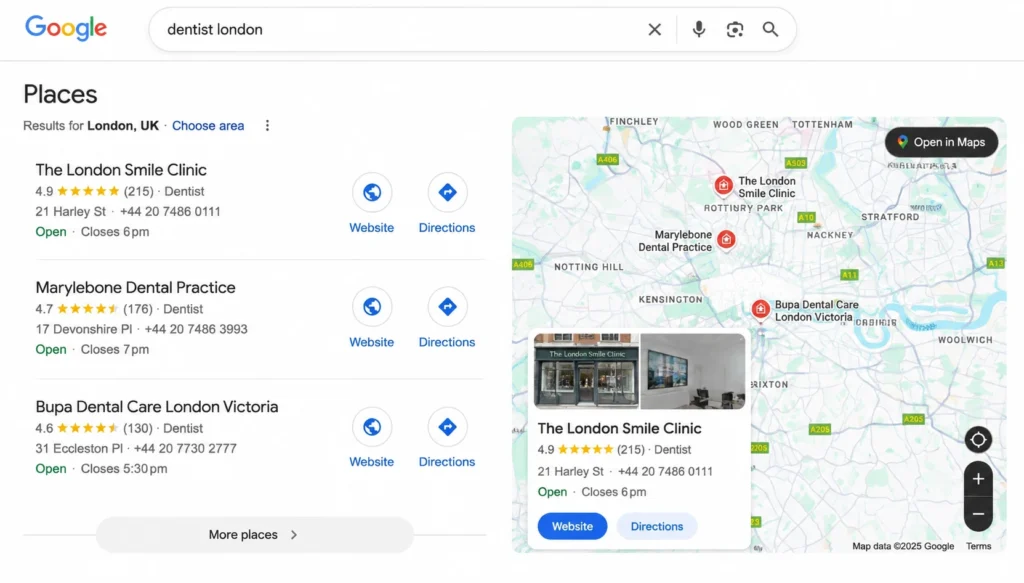
- Proximity. How close the practice is to the person searching, or to the location named in the search. This is the factor you cannot control.
- Relevance. How well your Google Business Profile and website match what the person is looking for. Correct categories, services, and treatment pages feed this.
- Prominence. How well known and trusted the practice is, judged by review quantity and quality, citations, and links.
A dental website can rank well in the map pack while ranking poorly in the organic results below it, and the reverse is also true. The two systems reward different things. Google sets out these local factors in its guide to improving local ranking. Winning the map pack is the core job of local SEO for dentists, and it usually moves faster than organic rankings.
How E-E-A-T Decides Which Dental Sites Google Trusts
E-E-A-T stands for Experience, Expertise, Authoritativeness, and Trustworthiness. Google added the extra “E” for Experience in December 2022. For dental websites, E-E-A-T is not a checkbox. It is how Google separates a legitimate practice from a thin affiliate page.
Google cannot verify a dentist’s skill directly, so it looks for real-world trust signals on the page and across the web:
- Author and clinician credentials. Named dentists with GDC (General Dental Council) registration numbers displayed on the site.
- Business legitimacy. CQC (Care Quality Commission) registration, a real address, and matching contact details.
- Compliance signals. A visible complaints procedure and content that follows GDC and ASA advertising rules.
- Reputation. Reviews, mentions and links from sources Google already trusts, such as the NHS website or professional bodies.
A practice that shows these signals gives Google a reason to trust it. One that hides its clinicians behind stock photos and vague copy gives Google a reason to hold it back. Note that GDC Standard 4.2.4 prohibits patient testimonials in advertising, so trust has to be built through credentials and third-party signals rather than testimonial quotes on the page.
What Google’s Quality Raters Check on a Dental Site
Google employs human quality raters who score sample pages against its published Search Quality Rater Guidelines. They do not set your position directly, but their judgements train the algorithms that do. For YMYL dental pages, they look for specific proof:
- Who is responsible for the website and its content, and whether that is a named, registered practice.
- The clinical expertise behind any health claims on the page.
- The reputation of the practice on independent, third-party sources.
- Whether the main content is accurate, safe and genuinely useful.
A dental page that these raters would score as low quality tends to struggle no matter how polished it looks, because the algorithms are trained to demote the same traits.
Technical and Core Web Vitals Signals for Dental Websites
Google can only rank a page it can crawl, render, and load quickly. Technical health is a gatekeeper. If it fails, strong content still struggles.
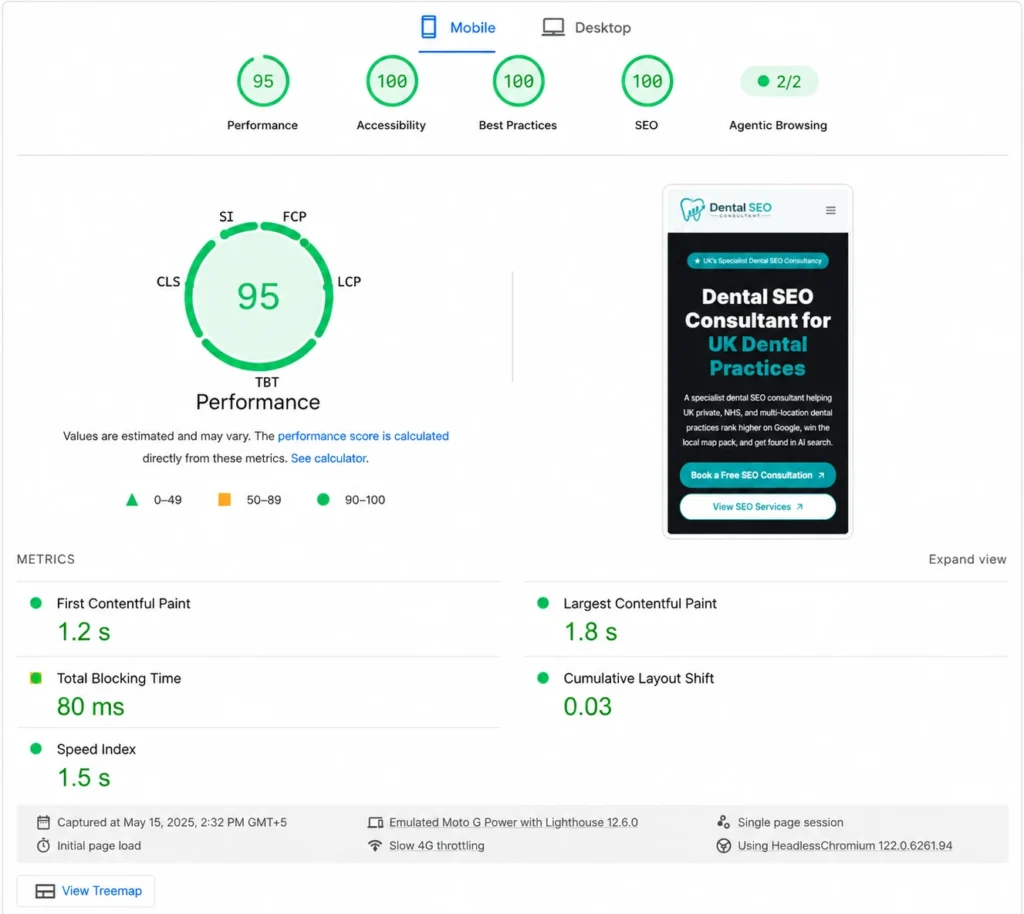
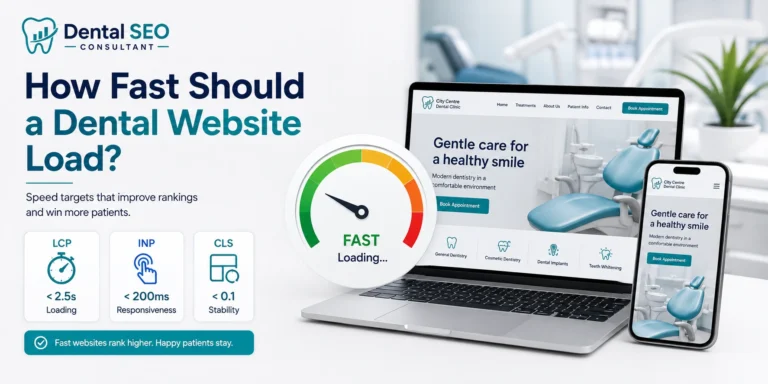
The measurable part of user experience is Core Web Vitals, a set of three metrics Google uses as ranking signals:
- LCP (Largest Contentful Paint). How fast the main content loads. Aim for under 2.5 seconds.
- INP (Interaction to Next Paint). How quickly the page responds when someone taps a button, such as a booking widget. INP replaced FID as a Core Web Vitals metric in March 2024.
- CLS (Cumulative Layout Shift). How stable the layout is while loading, so buttons do not jump around.
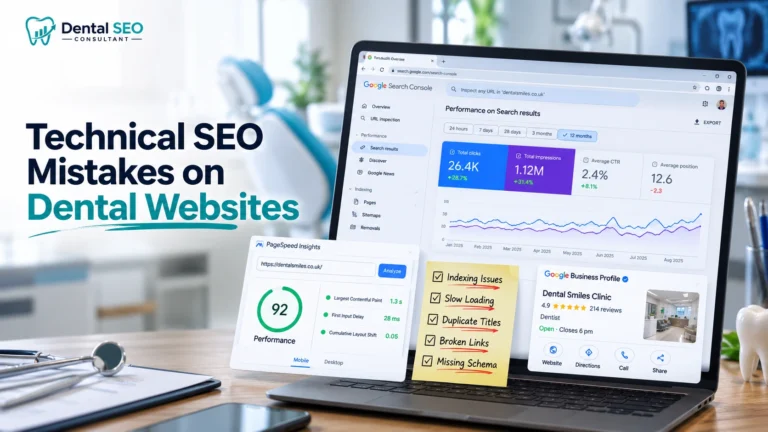
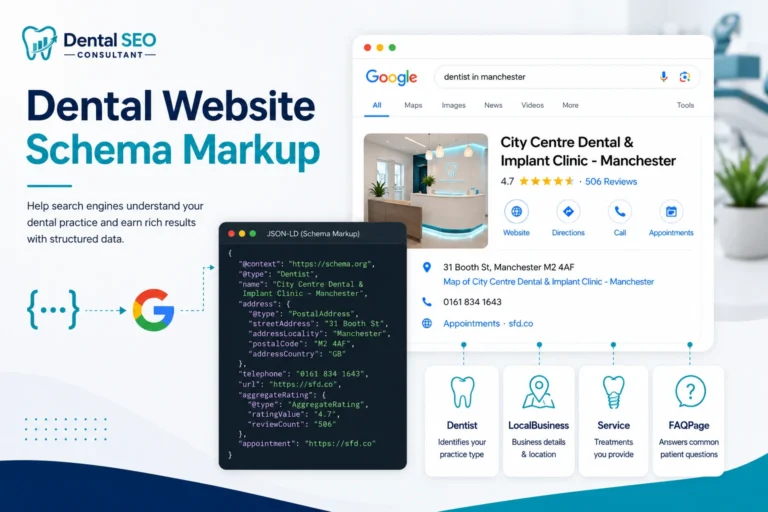
Dental websites often struggle here because they are image-heavy, with large before-and-after galleries and slow booking widgets. Google also uses mobile-first indexing, which means it judges your mobile version first. A site that works on desktop but is slow on a phone will be scored on the phone experience. Fixing these issues is the job of technical dental website SEO. Schema markup, such as Dentist and LocalBusiness types, also helps Google understand the page, even though it is not a direct ranking factor.
How Content Quality Affects Dental Rankings
Google’s content signals ask one question: was this page made to help a patient, or to rank in search? In March 2024, Google folded its Helpful Content system into the core ranking algorithm. It is no longer a separate update. Content quality is now judged continuously, across your whole site.
This matters for dentists in two ways.
First, unhelpful content anywhere on the site can drag down pages that are genuinely good. A practice with fifty thin, near-identical location pages can suppress its own strong treatment pages.
Second, Google rewards depth and first-hand experience. A treatment page that explains what the procedure involves, how long it takes, what recovery looks like, and what it costs will outperform a page of marketing slogans. Original clinical detail is a signal generic content cannot fake.
How the Google Results Page Changes by Dental Search Type
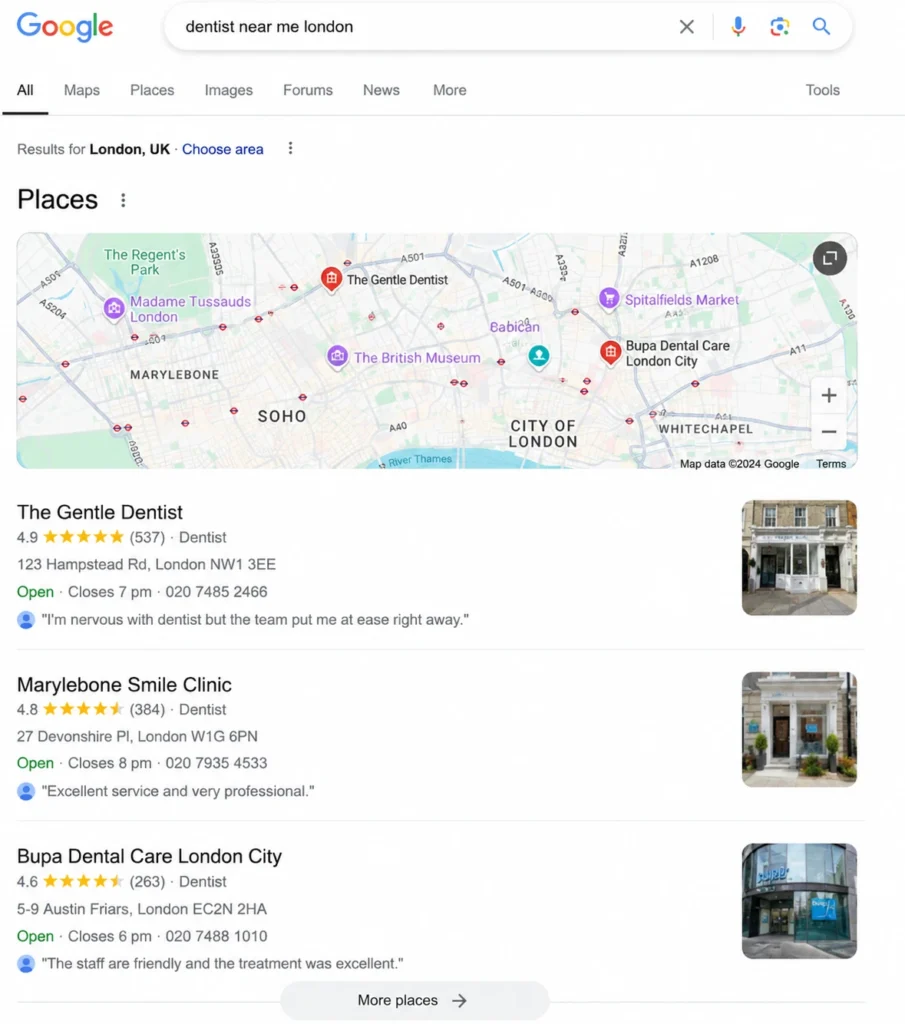
Google does not show the same layout for every dental search. The results page it builds depends on what the searcher wants, and each layout is won by a different type of page. Knowing which layout your target searches produce tells you which ranking system to satisfy.
| Dental search | What Google shows | What wins the top spot |
| “dentist near me” | Local map pack (3-pack) plus organic | A strong Google Business Profile with reviews |
| “cost of dental implants uk” | Featured snippet, organic, and often an AI Overview | A clear, well-structured cost guide |
| “how does teeth whitening work” | AI Overview, People Also Ask, and organic | An extractable, expert explainer |
| “best dentist in [city]” | Map pack plus review-style organic | Reputation, reviews and third-party mentions |
| “invisalign [city]” | Organic treatment pages plus local results | A dedicated local treatment page |
The same practice can win one layout and lose another, because each is driven by different signals. That is why a single ranking tactic rarely covers every search a practice cares about.
How to See How Google Ranks Your Dental Website
You can see much of what Google thinks of your site for free, using Google Search Console. It shows which searches you appear for, your average position, and whether Google can crawl and index your pages. This is the clearest window into how Google actually treats your website.
| Search Console report | What it tells a dental practice |
| Performance | Which searches show your site, your clicks, and your average position |
| Pages (Indexing) | Which pages Google has indexed, and which it has skipped |
| Core Web Vitals | Whether your pages pass Google’s speed and stability checks |
| Page Experience / Mobile | Problems on the mobile version Google ranks first |
| Links | Which sites link to you, and your most linked pages |
The first thing to check is the Pages report. If a treatment page is not indexed, it cannot rank for anything, no matter how good the content is. That single check explains a surprising number of “invisible” dental websites.
FAQ
How does Google decide which dentist ranks first?
Google combines relevance, trust, and local signals. For the map pack, proximity to the searcher, Google Business Profile strength, reviews and citations decide the order. For the organic results, content relevance, E-E-A-T, backlinks and technical health decide it. The dentist who ranks first usually wins across several of these at once, not just one.
Does Google treat dental websites as medical content?
Yes. Google classes dental content as YMYL (Your Money or Your Life), the same category it applies to medical and financial topics. This means Google demands stronger proof of expertise and trust before it ranks the page, including clinician credentials and business legitimacy signals.
How long does Google take to rank a new dental website?
A brand new dental website usually takes several months to build enough trust to rank for competitive terms. Local map pack visibility often improves first, sometimes within three to five months, while organic rankings for treatments like implants can take longer in competitive cities. New domains rank slower because Google has less history to trust.
Do reviews affect how Google ranks dentists?
Yes, for local search. Review quantity, quality, and recency feed the “prominence” factor Google uses to rank the map pack. Reviews do not directly rank standard organic pages, but they strongly influence which three practices appear in the local 3-pack.
Why is my competitor ranking above me with a worse website?
Usually because they win on signals you cannot see at a glance. They may have a stronger Google Business Profile, more relevant backlinks, better local proximity, or clearer E-E-A-T signals. A ranking gap almost always traces back to trust or local factors rather than page design.
Does website design affect how Google ranks a dentist?
Design is not a direct ranking factor, but the experience it creates is. A cluttered, slow or hard-to-navigate site hurts Core Web Vitals and mobile usability, which Google does measure. A clean design that loads fast and guides patients clearly supports ranking indirectly.
Do I need to keep doing SEO once I rank?
Yes. Rankings are not permanent. Google runs core updates several times a year, and competitors keep improving their own sites. A practice that stops maintaining its content, profile, and technical health tends to slip over time, even from a strong position.
Conclusion
Google ranks dental websites by crawling and indexing them, then scoring them across many ranking systems at once. The signals that decide your position are content relevance, E-E-A-T, local prominence, backlinks, and technical health, all judged against the higher YMYL trust bar Google reserves for health content. Local rankings and organic rankings run on separate systems, so a complete strategy has to earn both.
If you are not sure which signals are holding your practice back, a free dental SEO audit will pinpoint the exact blockers and show you what to fix first.