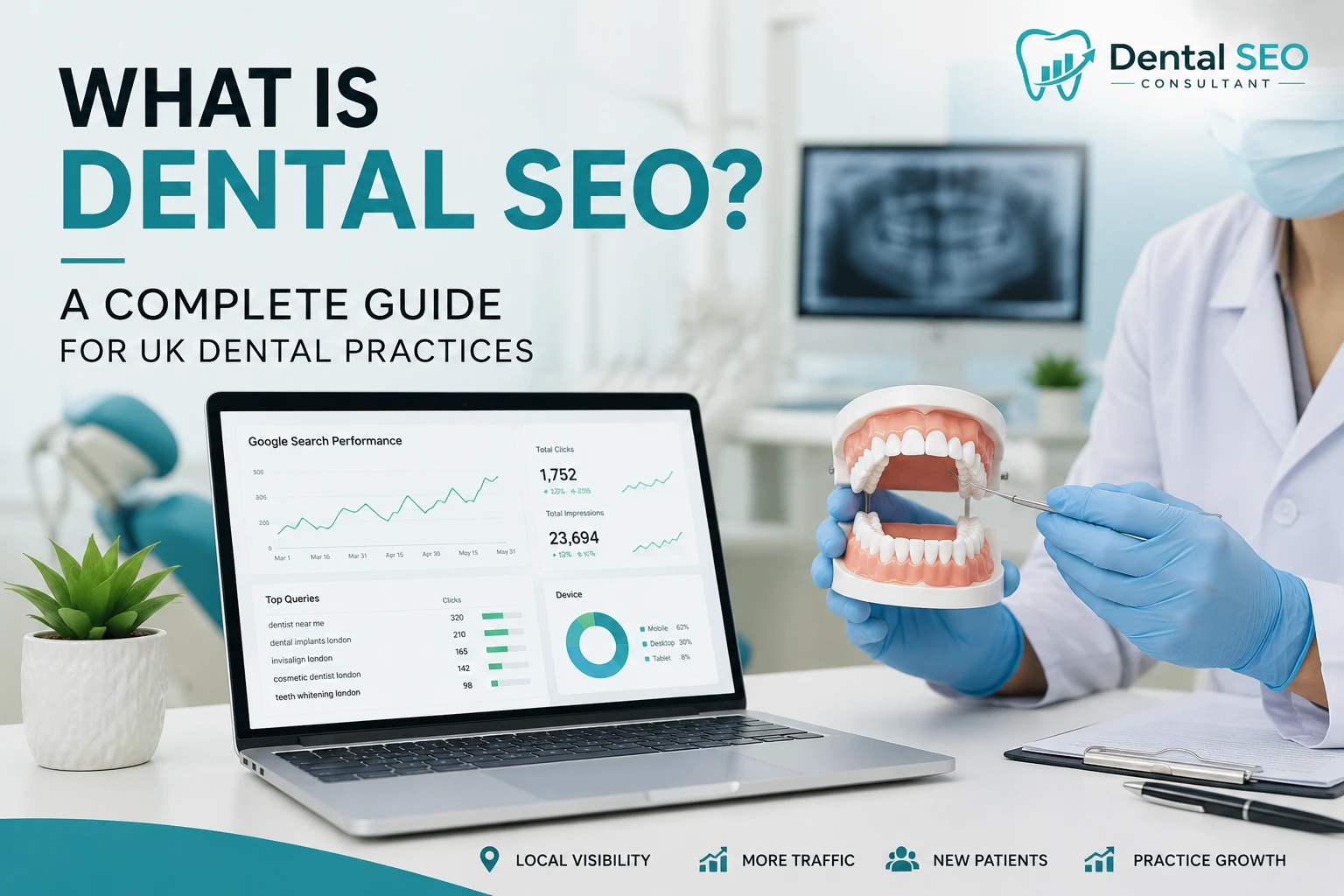
What Is Dental SEO? A Complete Guide for UK Dental Practices
Dental SEO is the practice of optimising a dental practice’s website, Google Business Profile and online presence so it ranks in Google and attracts new patients. It combines local SEO (the map pack), treatment page rankings and technical SEO, all produced under UK dental rules. Because dental content is classed as YMYL (Your Money or Your Life), Google holds it to a higher trust standard than ordinary business websites.
Introduction
Most patients now find a dentist the same way they find anything else. They open Google, search for a treatment or “dentist near me”, and pick from what appears. If a practice is not on page one, it is invisible to that patient, no matter how good the clinical work is.
Dental SEO is how a practice earns that visibility. This guide explains what dental SEO is in plain English, how it differs from ordinary SEO, the six parts it is built from, and the exact order to do it in. It is written for UK practices, so it covers the GDC and ASA rules that generic SEO advice ignores.
What Is Dental SEO?
Dental SEO is search engine optimisation applied to a dental practice. It is the work of making a practice’s website and Google listings visible to people searching for dental care, so those searchers turn into patients.
It works through two separate channels:
- Google Maps (the local pack). The block of three practices with a map that shows for searches like “dentist near me”. This is driven mainly by your Google Business Profile.
- Google organic results. The standard blue links below the map, where individual treatment pages rank for searches like “dental implants Guildford”.
Dental SEO serves a specific patient journey. Someone searches, lands on a Google Business Profile or a treatment page, visits the website, then books or enquires. The whole point is to be present and convincing at each of those steps.
Who Is Dental SEO For?
Dental SEO suits any practice that wants new patients from search, but the priorities shift by practice type.
- Private practices rely on it most, as they compete for high-value treatments like implants and Invisalign.
- NHS and mixed practices use it to fill private treatment demand and to appear for “NHS dentist [area]” searches.
- Cosmetic practices depend on treatment page rankings, where patients research decisions carefully.
- Multi-site dental groups need it at scale, with a page and profile for each location.
The core method is the same for all of them. What changes is which treatments and locations to prioritise. Google publishes the general principles of search optimisation in its SEO Starter Guide, and dental SEO applies those principles under the extra rules covered below.
How Dental SEO Is Different from Regular SEO
Dental SEO differs from general SEO in three ways: it carries regulatory compliance rules, it is treated as YMYL health content, and it serves a highly local, treatment-specific patient journey. Ignoring any of these is why generic SEO underperforms for dentists.
The three differences in short:
- Compliance. Dental advertising is regulated. Tactics that are normal in other industries, such as testimonial quotes, can break the rules.
- YMYL trust bar. Google treats dental content as healthcare, so it demands stronger proof of expertise and trust before it ranks a page.
- Patient journey. Dental searches are local and treatment-led. Patients search “[treatment] [area]”, not just “dentist”.
The Three Compliance Layers of UK Dental SEO
Every piece of dental SEO content in the UK has to pass three rulebooks at once. No other industry stacks these the same way, which is why this is the biggest gap generic agencies fall into.
| Layer | Set by | What it restricts |
|---|---|---|
| GDC Standards | General Dental Council | Patient testimonials in advertising (Standard 4.2.4); use of “specialist” unless on the Specialist Register |
| ASA CAP Code | Advertising Standards Authority | Before-and-after images, outcome guarantees, superlative and unsubstantiated claims |
| CQC and YMYL | Care Quality Commission, Google | Requires visible CQC registration and clinical credibility signals for trust |
You can read the actual rules on the General Dental Council website. The practical effect is that a dental page has to build trust through credentials and third-party signals, not through the testimonial-style social proof most marketing relies on.
The Six Components of Dental SEO
Dental SEO has six core components. Each one feeds either local visibility (the map pack), organic visibility (treatment pages), or both. A complete strategy needs all six working together.
| Component | What it does | Main channel it drives |
|---|---|---|
| Google Business Profile | Optimised listing with correct categories, services and photos | Local map pack |
| Local citations | Consistent name, address and phone across directories | Local map pack |
| Treatment pages | One dedicated page per high-value treatment | Organic rankings |
| Technical SEO | Site speed, mobile, schema markup, crawlability | Both |
| Content production | GDC-compliant treatment copy, FAQs and articles | Organic rankings |
| Link acquisition | Links from dental directories, bodies and local sources | Both |
Missing any one of these leaves a gap. A practice with perfect treatment pages but no Google Business Profile will still be absent from the map pack, which is where most “near me” searches convert.
What Dental SEO Is Not
Dental SEO is often confused with paid advertising and social media. They are different tools with different economics. Understanding the difference stops a practice from overpaying for the wrong one.
| Channel | How it works | Key difference from SEO |
|---|---|---|
| Dental SEO | Earns organic rankings that build over time | Compounds and stays; does not vanish when spend stops |
| PPC (Google Ads) | Pays for instant placement at the top of results | Fast, but visibility ends the moment the budget ends |
| Social media | Reaches people who already follow the practice | Talks to existing audience, not new searchers |
| Word of mouth | Offline referrals from patients | Captures no online search demand |
SEO and PPC are complementary, not competing. PPC buys visibility today while SEO builds it for the long term. What dental SEO is never is “black hat” tricks such as fake reviews or spam links. For a regulated healthcare business, those tactics risk both a Google penalty and a compliance breach.
Why Dental Practices Need Specialist SEO
Dental practices should be cautious about generic SEO agencies, because a non-specialist can create real regulatory risk while chasing rankings. The problem is rarely bad intent. It is that a general agency does not know the dental rulebook.
Common failures when a non-specialist runs dental SEO:
- Publishing patient testimonial quotes on the website, breaching GDC Standard 4.2.4.
- Placing before-and-after images in ad-style banners without meeting ASA conditions.
- Describing a dentist as a “specialist” when they are not on the GDC Specialist Register.
- Skipping GDC registration numbers and clinical credentials, so the site fails the YMYL trust test.
- Targeting only “dentist near me” while ignoring the treatment pages that win high-value patients.
Each of these can undo the SEO work or trigger a complaint. This is the case for a specialist dental practice SEO strategy, where compliance is built into every content decision rather than bolted on later.
How to Do Dental SEO: A Step-by-Step Guide
Dental SEO works best in a set order. Doing it in sequence delivers the fastest visible results, because the early steps unlock the map pack (which moves quickly) before the slower organic work. Here is the sequence a practice should follow.
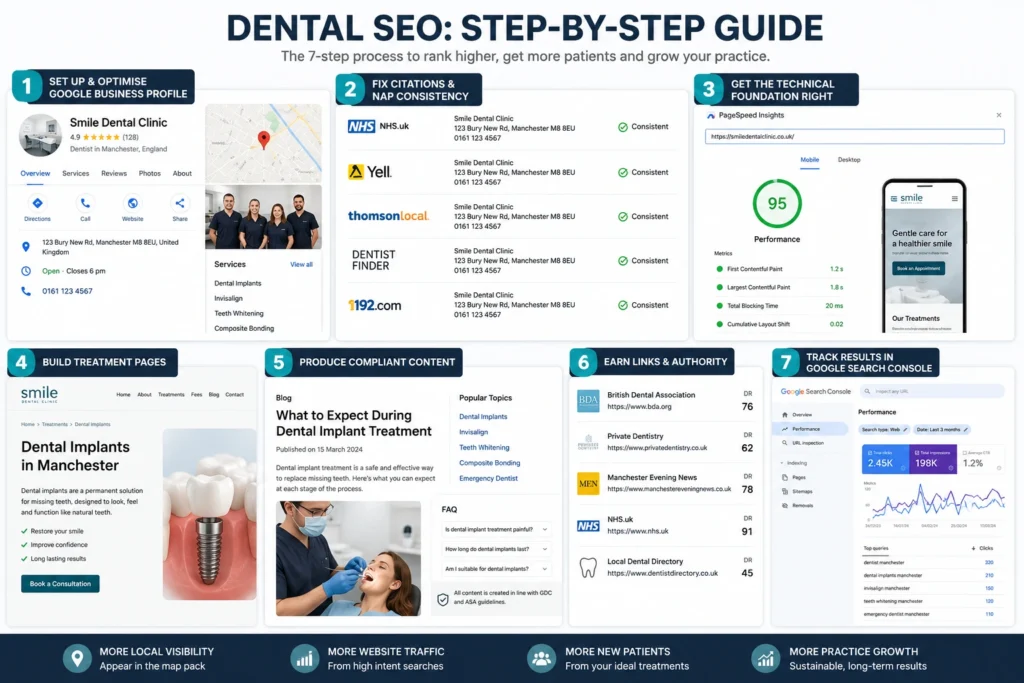
Step 1: Set Up and Optimise Google Business Profile
Start with the Google Business Profile. It is the single biggest lever for local visibility and the fastest to move.
Verify the listing, then complete every field. Set the correct primary category (such as Dentist or Dental Clinic), add each treatment as a service, upload real photos of the practice and team, and confirm opening hours. Keep the name, address and phone number exactly as they appear on the website.
Step 2: Fix Citations and NAP Consistency
Next, make sure the practice’s details are identical everywhere online. NAP stands for name, address and phone number.
Audit the major UK directories: the NHS website if the practice is NHS or mixed, then general and dental listings. Any mismatch, even a different phone format, weakens Google’s confidence in the listing and can hold back map pack rankings.
Step 3: Get the Technical Foundation Right
Before adding more content, fix the site’s technical health. Google cannot rank pages it struggles to load or crawl.
The essentials for a dental site:
- Display CQC registration and each clinician’s GDC registration number.
- Make sure the site is fast and stable on mobile, since Google judges the mobile version first.
- Add schema markup, such as Dentist and LocalBusiness, to help Google understand the pages.
- Confirm every important page can be crawled and is indexed. Technical fixes are the core of dental website SEO.
Step 4: Build Treatment Pages
Create one dedicated page for each high-value treatment. A single “services” page listing everything cannot rank for individual treatment searches.
Prioritise by value and demand: dental implants, Invisalign, teeth whitening, veneers, composite bonding and emergency care. Each page should describe the procedure factually, name the clinician and their credentials, and target the local variant of the search, such as “dental implants [town]”.
Step 5: Produce Compliant Content
With the structure in place, build out content that answers real patient questions. This is where topical authority grows.
Add FAQ sections to treatment pages, write patient education articles, and cover local area context. Every piece must follow the GDC and ASA rules from Step 1, which means no testimonial quotes and no guaranteed-outcome claims.
Step 6: Earn Links and Authority
Links from trusted sources tell Google the practice is credible. For dental sites, relevance matters more than volume.
Focus on quality UK sources: dental directories, professional body listings, local business groups and genuine local press. A handful of relevant links outperforms dozens of low-quality ones, which Google may ignore or penalise.
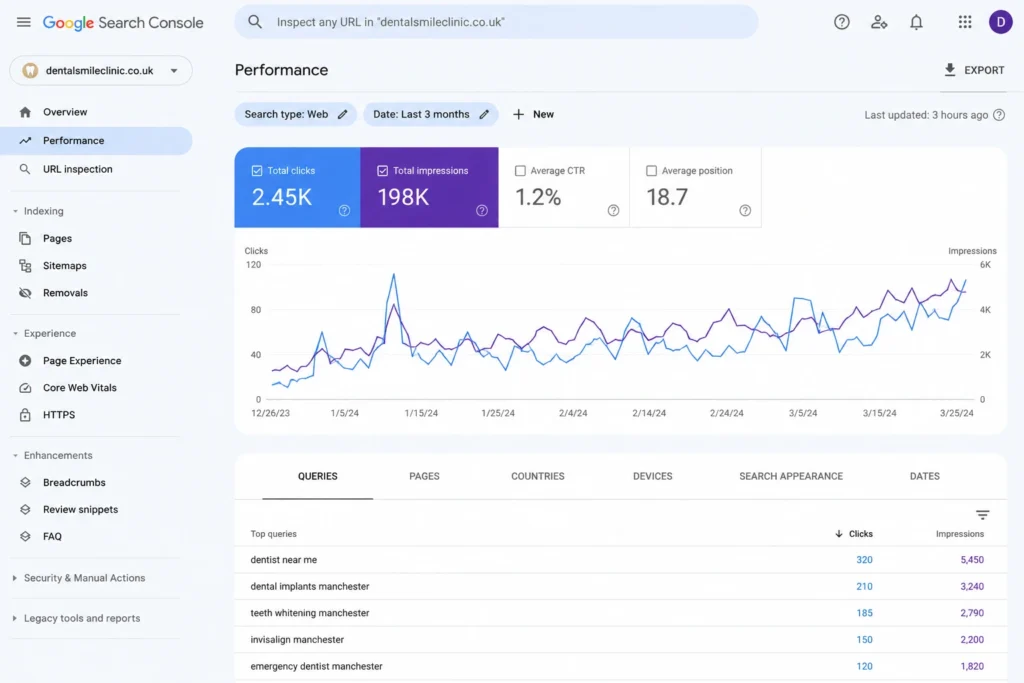
Step 7: Track Results in Google Search Console
Finally, measure. Google Search Console is free and shows exactly how Google sees the site.
Watch which searches show your pages, your average position, and whether treatment pages are indexed. If a page is not indexed, it cannot rank, so that is always the first thing to check. This feedback loop tells you what to improve next.
The table below summarises the sequence and what each step earns.
| Step | Action | What it earns |
|---|---|---|
| 1 | Google Business Profile | Map pack visibility (fastest win) |
| 2 | Citations and NAP | Trust and consistency for local search |
| 3 | Technical foundation | A site Google can rank |
| 4 | Treatment pages | Rankings for procedure searches |
| 5 | Compliant content | Topical authority and patient answers |
| 6 | Links and authority | Credibility signals for competitive terms |
| 7 | Search Console tracking | Data to keep improving |
How Long Before Dental SEO Works?
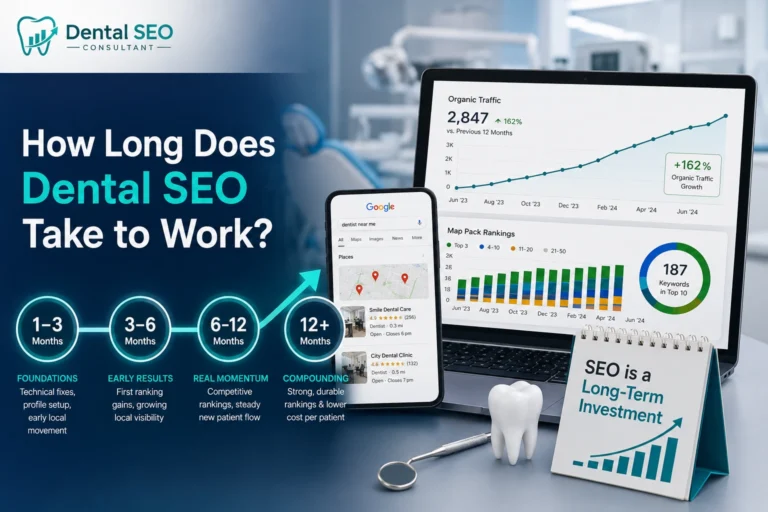
Dental SEO is a compounding investment, not an instant switch. Local map pack movement often shows within the first few months, while competitive treatment rankings in busy cities take longer to build. New websites are slower because Google has less history to trust. The work done early keeps paying off, which is what separates SEO from paid ads that stop the day the budget does.
FAQ
Is dental SEO worth it for a dental practice?
For most UK practices, yes, especially for high-value treatments. A single extra dental implant patient a month, at a typical UK value of £2,500 to £4,000, usually covers the cost of specialist SEO. Because organic rankings compound and persist without ongoing ad spend, dental SEO tends to be a stronger long-term investment than PPC.
How does dental SEO actually work?
It works by improving the signals Google uses to rank a practice: an optimised Google Business Profile, consistent citations, dedicated treatment pages, technical health, compliant content and quality links. Together these tell Google the practice is relevant, local and trustworthy, so it ranks the site for the searches patients use.
What keywords should a dental practice target?
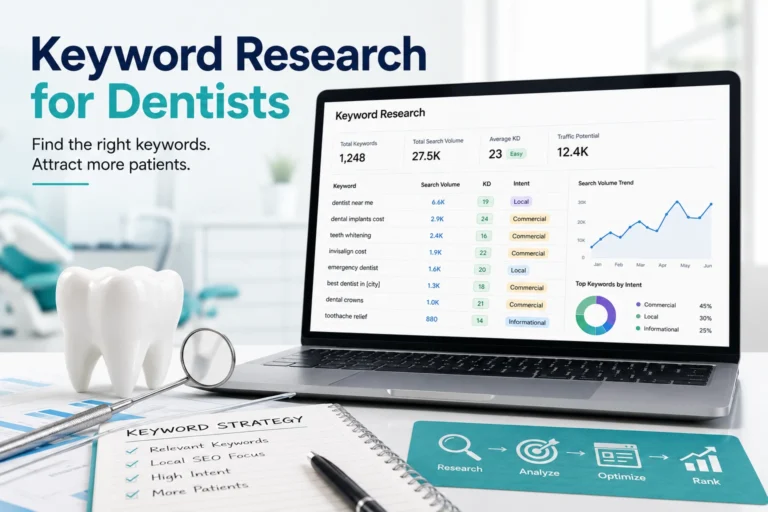
Start with local, treatment-specific terms such as “dental implants [area]” or “Invisalign [area]”. These lower-competition searches rank faster and attract patients ready to book in the practice’s catchment. Broad city-level terms come later, once the site has built authority.
How much does dental SEO cost in the UK?
Dental SEO in the UK typically ranges from around £1,200 a month for a single practice in a less competitive area, up to £3,000 or more for competitive city-centre practices targeting several treatments. You can see a full breakdown on the dental SEO pricing page.
Does dental SEO have to follow GDC rules?
Yes. All dental website content, including anything created for SEO, must follow the GDC Standards for the Dental Team. Standard 4.2.4 bans patient testimonials in advertising, the ASA CAP Code restricts before-and-after images and outcome claims, and “specialist” can only be used by clinicians on the GDC Specialist Register.
Can a practice do dental SEO itself?
A practice can handle the basics, such as completing its Google Business Profile and keeping citations consistent. The harder parts- treatment page strategy, technical fixes, compliant content and link building – usually need specialist help, particularly because of the YMYL trust bar and dental advertising rules. Many practices start the foundations in-house and bring in a dental SEO consultant for the rest.
Conclusion
Dental SEO is how a UK practice becomes visible to the patients already searching for it. It is built from six components, run in a clear order, and produced under GDC and ASA rules that generic SEO ignores. Done properly, it earns rankings that compound over time and keep bringing in patients without paying for every click.