Dental Marketing for Dentists: The Complete UK Guide
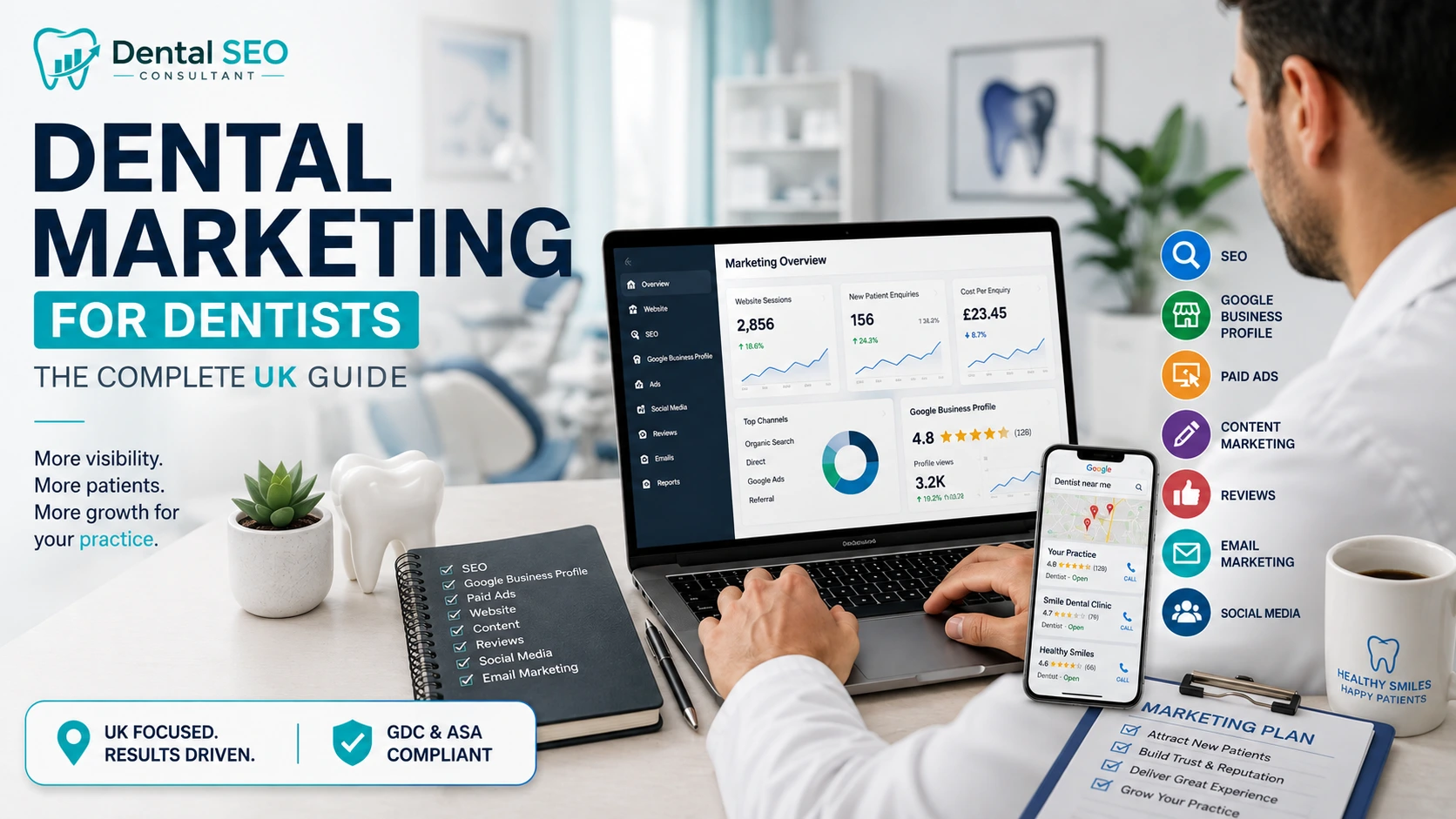
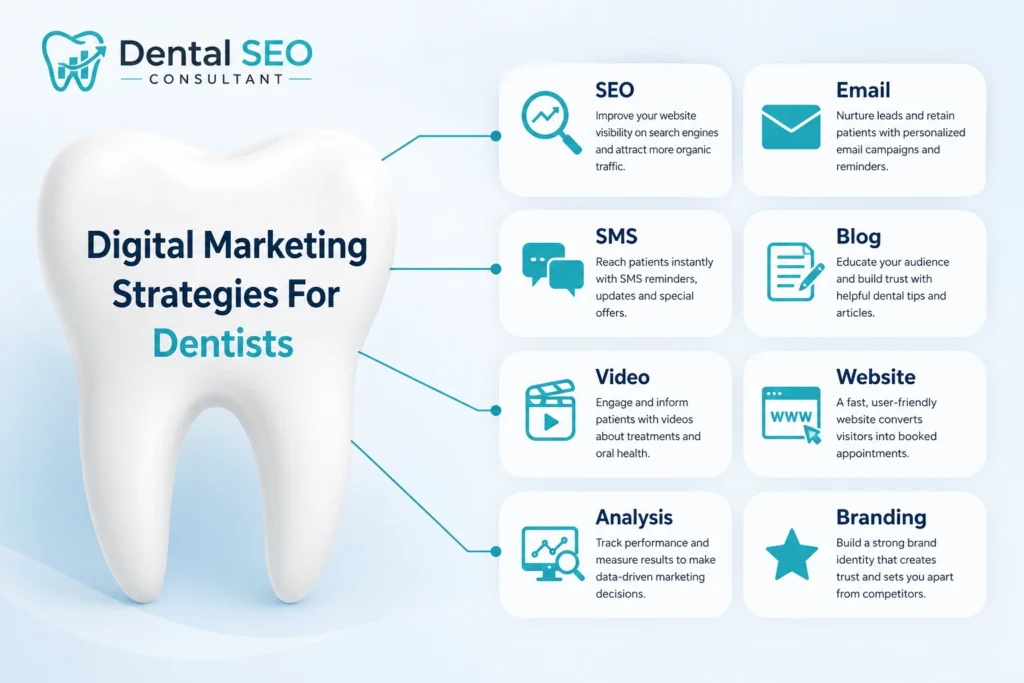
Digital marketing for dentists is the mix of online channels a practice uses to attract and keep patients: SEO, Google Business Profile, paid ads, a converting website, content, social media, email and reviews. In the UK, every channel must follow GDC and ASA advertising rules. The practices that grow fastest do not use every channel at once. They pick two or three that match their goals and budget, then measure what actually books patients.
Introduction
Most dental practices do not have a demand problem. They have a visibility problem. The patients are searching, comparing, and booking online every day. The question is whether they find your practice or a competitor’s.
This guide covers digital marketing for dentists from the ground up. It explains what dental marketing is, the channels available, how to choose between them, how to get more patients without breaking UK advertising rules, and how to build a plan that pays for itself. It is written for UK practices, so compliance is built in rather than ignored.
What Is Dental Marketing?
Dental marketing is everything a practice does to attract new patients and keep existing ones. It is broader than any single tactic. SEO is part of it, but so are paid ads, the website, social media, email, and the practice’s reputation.
It helps to split it into two halves:
- Attracting new patients. Being visible when people search, comparing well against local competitors, and giving them a reason to choose you.
- Keeping existing patients. Recalls, reactivation, treatment follow-ups, and referrals from people who already trust the practice.
Marketing is the umbrella. The channels below are the tools under it. A practice does not need all of them, but it does need the right ones working together.
Why Dental Marketing Is Different in the UK
Dental marketing carries rules that most industries do not face. A UK dental practice markets a regulated healthcare service, so what it can say and show is limited by law and by professional standards.
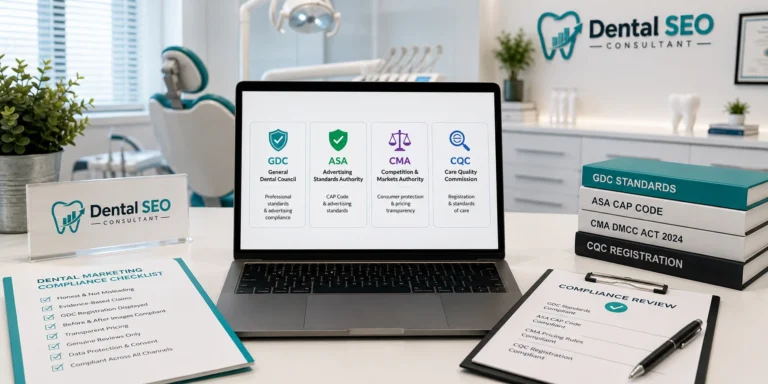
Three bodies shape what is allowed:
- The General Dental Council (GDC). Sets the professional standards for the dental team. GDC Standard 4.2.4 prohibits patient testimonials in advertising.
- The Advertising Standards Authority (ASA). Enforces the CAP Code, which restricts before-and-after images, outcome guarantees and unsubstantiated claims.
- The Care Quality Commission (CQC). Requires practices to display registration and operate transparently.
You can check the professional rules directly on the General Dental Council site and the advertising rules with the Advertising Standards Authority. The practical effect is simple. Dental marketing has to build trust through credentials, clear information and genuine reviews, not through the testimonial-heavy tactics common elsewhere.
The Digital Marketing Channels for Dental Practices
There is no single best channel. Each one does a different job, at a different speed, for a different cost. The table below compares the main channels a UK dental practice can use.

| Channel | Best for | Speed | Cost model |
|---|---|---|---|
| SEO | Long-term flow for high-value treatments | Slow to build, then compounds | Fixed monthly, no per-click cost |
| Local SEO and Google Business Profile | “Near me” and map pack visibility | Faster than organic | Fixed monthly |
| PPC (Google Ads) | Instant visibility, launches, filling gaps | Immediate | Pay per click, stops with budget |
| Website and UX | Turning visitors into booked patients | Ongoing | Build cost plus upkeep |
| Content marketing | Trust, patient education, AI citation | Slow | Fixed |
| Social media | Brand and retention with existing followers | Ongoing | Time or ad spend |
| Recalls, reactivation, treatment follow-ups | Fast for an existing list | Low | |
| Reviews and reputation | Trust, local ranking, higher conversion | Ongoing | Low |
The sections below look at the channels that carry the most weight for patient growth.
Search Engine Optimisation (SEO)
SEO earns free, lasting visibility in Google for the treatments patients search for. Because dental searches carry high intent, someone looking for “dental implants [town]” is usually ready to book; this is the channel with the strongest long-term return.
SEO is not one job. It splits into local visibility, treatment page rankings and technical health. For the full picture of how a practice ranks and what an SEO programme involves, see our dental practice SEO strategy, and for a search-led approach to the whole marketing mix, our dental SEO marketing service.
Local SEO and Google Business Profile
Most dental searches are local. The Google Business Profile decides whether a practice shows in the map pack, the block of three listings that appears for “dentist near me”. A complete, well-optimised profile with genuine reviews is often the fastest win in dental marketing. This is the core of local SEO for dentists.
Pay-Per-Click (Google Ads)
Pay-Per-Click (Google Ads) buys instant placement at the top of Google for chosen searches. It is the opposite of SEO in one key way. It delivers visibility today, but that visibility ends the moment the budget stops. It suits practice launches, promoting a new treatment, or filling the diary while SEO builds. Costs per click for competitive dental terms can be high, so tight targeting matters.
The Practice Website
Every other channel sends people to the website, so it decides whether marketing spend converts. A slow, unclear, or hard-to-book site wastes the traffic the other channels work to earn. Fast loading, clear treatment information, obvious booking options, and mobile usability are the foundations. Fixing these is the job of dental website SEO.
Content Marketing
Content is how a practice answers the questions patients ask before they book. Treatment explanations, FAQs, and patient guides build trust and topical authority, and they are increasingly what AI tools like Google AI Overviews and ChatGPT cite when patients ask for dental information. Good content supports SEO and works long after it is published.
Social Media and Email
Social media and email are mostly retention channels. Social media keeps a practice visible to people who already follow it and supports brand and community. Email is the quiet workhorse for recalls, reactivating lapsed patients and following up on treatment plans, often at the lowest cost of any channel.
Reviews and Reputation
Reviews influence both rankings and decisions. Review quantity, quality and recency feed local ranking, and they are the first thing many patients check before booking. The rules matter here. Practices can encourage genuine Google reviews, but must not publish patient testimonials as advertising or incentivise reviews, which breaches GDC and ASA rules.
How to Choose the Right Channels
The mistake most practices make is trying to do every channel at once, spreading budget and attention too thin. The better approach is to match channels to the goal. Start with what you want, then pick the channels that deliver it.
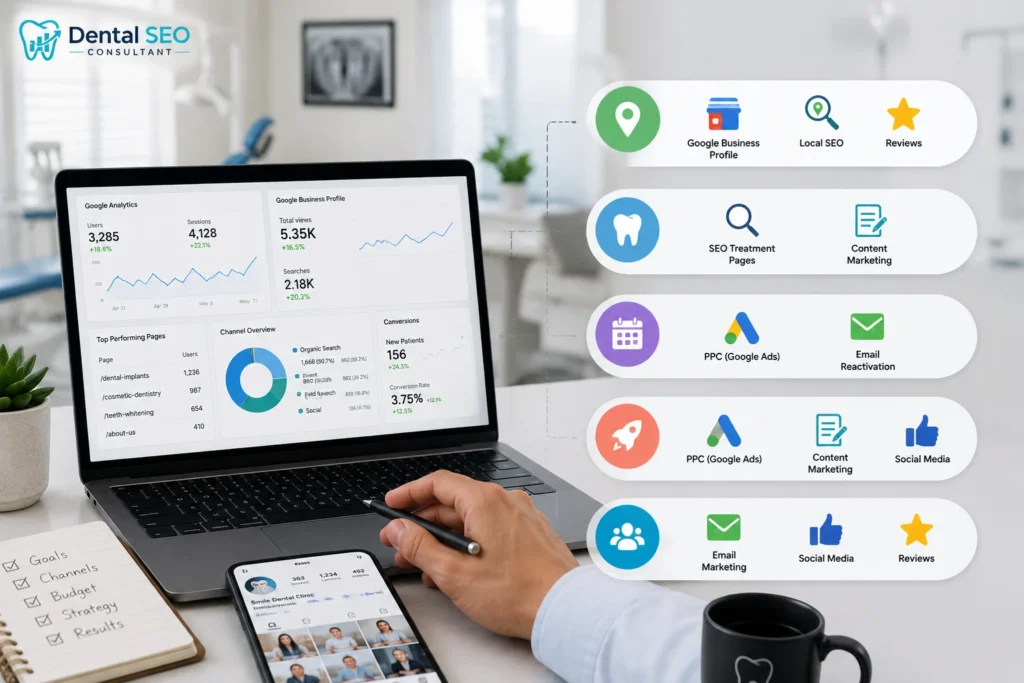
| Goal | Best channels to start with |
|---|---|
| More “near me” patients | Google Business Profile, local SEO, reviews |
| Rank for a specific treatment | SEO treatment pages, content marketing |
| Fill the diary this month | PPC, email reactivation |
| Launch a new treatment | PPC, content, social media |
| Improve patient retention | Email, social media, reviews |
For most single-site practices, the strongest starting combination is a strong Google Business Profile, SEO for the key treatments, and a website that converts. Paid ads then fill short-term gaps while the organic work builds.
How to Get More Patients: Marketing Ideas That Work
Beyond the big channels, there are practical, compliant tactics that consistently bring dental practices more patients. These are the ideas worth acting on first.
- Build a page for each treatment. One page per treatment, with local wording, ranks far better than a single services page.
- Win the map pack. Complete the Google Business Profile fully and keep earning genuine reviews.
- Reactivate lapsed patients. A simple email to patients who have not booked in 12 months is often the cheapest new revenue available.
- Answer real questions. Turn the questions patients ask at reception into FAQ and blog content.
- Fix the booking path. Make online booking or enquiry obvious on every page, especially on mobile.
- Ask happy patients for a Google review. Compliantly, without incentives, at the right moment after treatment.
- Target high-value treatments. Focus effort on implants, Invisalign and cosmetic work, where one patient can cover months of marketing cost.
None of these rely on testimonials or claims that break the rules. They work by being visible, useful and easy to act on.
How to Build a Dental Marketing Plan
A plan turns scattered activity into a system. It does not need to be complex. Follow this sequence and review it each quarter.
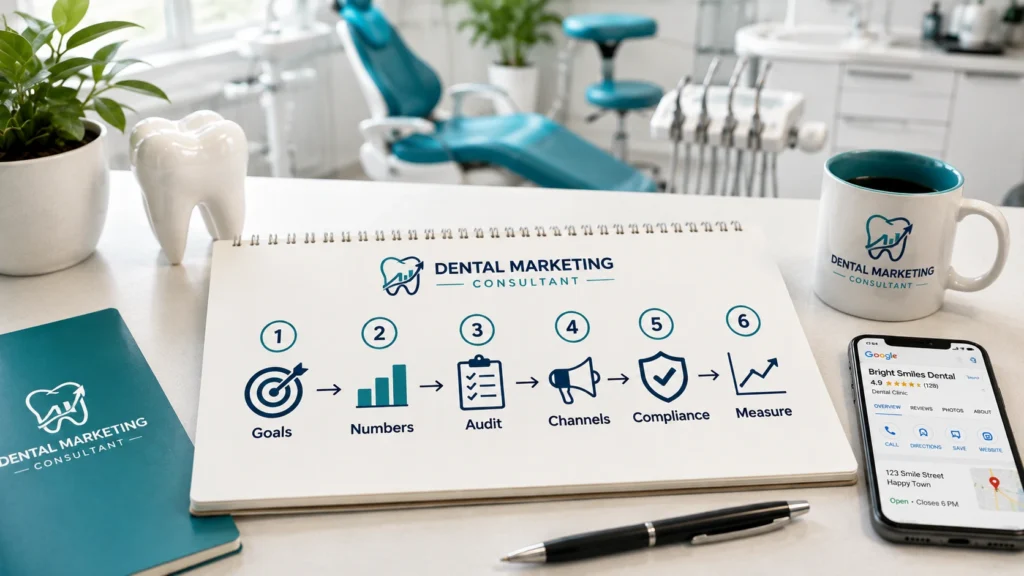
Step 1: Set Clear Goals
Decide what growth looks like in numbers. “More patients” is vague. “Ten new implant enquiries a month” is a target you can plan and measure against.
Step 2: Know Your Numbers
Work out the average value of a patient and of your key treatments, and how much new capacity you have. This tells you what you can afford to spend to win a patient and still profit.
Step 3: Audit Your Current Presence
Check where you stand now: your Google Business Profile, your rankings, your website speed and your reviews. This shows the gaps to fix before spending on new activity.
Step 4: Choose Two or Three Channels
Pick the channels that match your goals from the table above. Doing a few channels well beats doing all of them poorly.
Step 5: Build Compliance In
Confirm every piece of marketing follows GDC and ASA rules before it goes live. Fixing a breach after a complaint costs far more than getting it right first.
Step 6: Execute and Measure
Run the activity and track what actually produces booked patients, not just clicks or likes. Then move budget toward what works.
How to Measure Dental Marketing ROI
Marketing that is not measured is guesswork. The point is not activity; it is booked patients at a sensible cost. These are the metrics that matter.
| Metric | What it tells you |
|---|---|
| New patient enquiries | How much demand your marketing captured |
| Cost per acquisition (CPA) | What it costs to win one new patient |
| Patient lifetime value (LTV) | The long-term worth of that patient |
| Channel attribution | Which channels actually drive bookings |
| Return on marketing spend | Whether the whole effort is profitable |
The key comparison is CPA against LTV. If a new patient costs £150 to acquire and is worth £2,000 over time, the marketing is working, even if the upfront number looks large.
Common Dental Marketing Mistakes
Most wasted dental marketing budget traces back to a short list of avoidable mistakes.
- Doing every channel at once instead of two or three done well.
- Ignoring compliance and publishing testimonials or claims that breach GDC or ASA rules.
- Chasing vanity metrics like followers and likes instead of booked patients.
- Sending traffic to a weak website that fails to convert visitors.
- Stopping too early, before SEO and content have had time to compound.
- Neglecting existing patients, who are cheaper to retain than new ones to win.
FAQ
What is dental marketing?
Dental marketing is everything a practice does to attract new patients and retain existing ones, across channels like SEO, Google Business Profile, paid ads, the website, content, social media, email and reviews. In the UK, it must follow GDC and ASA advertising rules, which limit tactics such as patient testimonials.
What is the best marketing channel for dentists?
There is no single best channel. For lasting, high-intent patient flow, SEO and Google Business Profile usually deliver the strongest return. For immediate results, PPC works. Most practices do best combining a strong Google Business Profile, SEO for key treatments and a website that converts.
How much should a dental practice spend on marketing?
There is no fixed figure, but many UK practices invest a percentage of turnover into marketing. The more useful measure is cost per acquisition against patient lifetime value. If winning a patient costs far less than they are worth over time, the spend is justified regardless of the headline budget.
How do dentists get more patients?
By being visible where patients search and easy to book. In practice that means an optimised Google Business Profile, dedicated treatment pages that rank, genuine reviews, a fast website with clear booking, and reactivation emails to lapsed patients. Focusing on high-value treatments makes each new patient worth more.
Is digital marketing worth it for dentists?
For most UK practices, yes. Because a single high-value patient can be worth thousands of pounds, even modest marketing usually pays for itself. Organic channels like SEO and content compound over time, making them a stronger long-term investment than relying on paid ads alone.
What marketing are dentists not allowed to do in the UK?
UK dentists cannot use patient testimonials in advertising (GDC Standard 4.2.4), cannot make guaranteed-outcome or misleading claims, and cannot use before-and-after images or “specialist” titles unless strict conditions are met. The ASA CAP Code and GDC Standards set these limits, and breaching them risks complaints and penalties.
Conclusion
Digital marketing for dentists is not about doing everything. It is about choosing the right channels for your goals, running them under UK rules, and measuring what books patients. For most practices, that means a strong Google Business Profile, SEO for the treatments that matter, a website that converts, and a few supporting channels used well.
If you want to know which channels will move the needle for your practice, start with a free dental SEO audit. It shows where your visibility is strong, where it is leaking patients, and what to fix first. You can also explore the full range of dental SEO services to see how a search-led strategy fits your goals.