PPC and Google Ads for Dentists: A Complete UK Guide
PPC (pay-per-click) for dentists means paying Google to place your practice at the top of search results, and paying only when someone clicks. Google Ads is the main platform. It delivers patients almost instantly, which suits practice launches, new treatments, and filling the diary. The trade-off is that visibility stops the moment the budget stops, and clicks for high-value treatments like implants can be expensive. In the UK, every ad must follow GDC and ASA advertising rules.
Introduction
A dentist can go from invisible to the top of Google in an afternoon with PPC. That speed is the appeal, and it is real. But the same speed hides a catch that costs practices thousands: the moment you stop paying, you disappear.
This guide explains PPC and Google Ads for UK dental practices without the hype. You will learn how it works, what it actually costs, the compliance rules that trip up dental ads, when PPC is the right tool, and when your money is better spent elsewhere. The aim is to help you spend on ads deliberately, not out of panic.
What Is PPC for Dentists?
PPC stands for pay-per-click. It is a form of online advertising where a practice bids to appear for chosen searches, and pays a fee each time someone clicks the ad. For dentists, this almost always means Google Ads, which places ads at the top of Google search results above the organic listings.
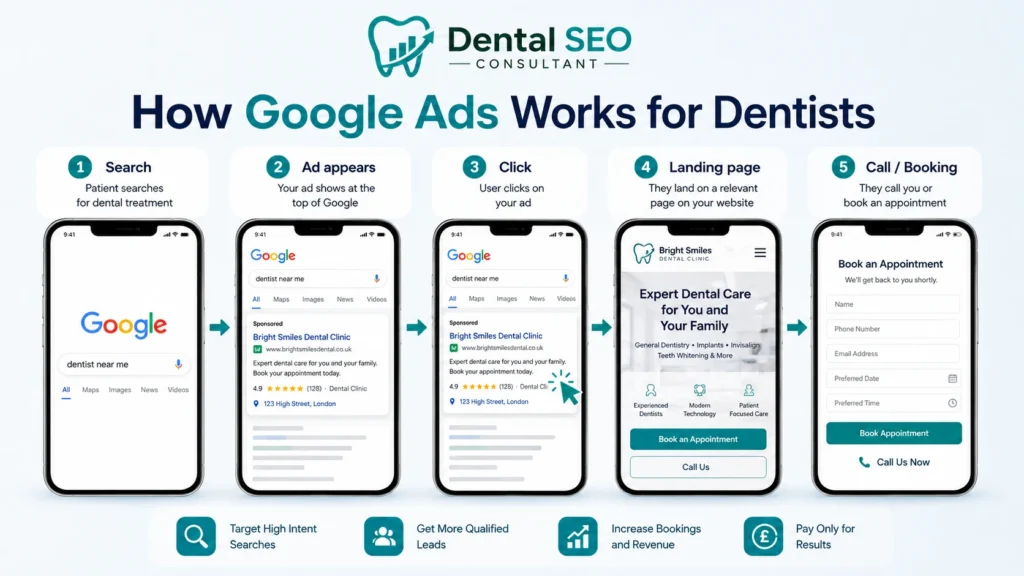
The core idea is simple. A patient searches “dental implants Guildford”, your ad appears at the top labelled “Sponsored”, they click, and you pay for that click whether or not they book. Your job is to make enough of those clicks turn into patients to cover the cost and profit.
PPC is a MOFU channel, meaning it works best on searchers who are already deciding, not just browsing. That is why treatment-specific and location-specific searches perform far better for dentists than broad terms.
How Google Ads Works for Dental Practices
Google Ads is not a fixed price list. It is an auction that runs every time someone searches. Understanding the mechanics stops a practice from overpaying.
The Google Ads Auction and Quality Score
When someone searches, Google runs an instant auction among advertisers bidding on that term. Your position is not decided by bid alone. Google combines your bid with a Quality Score, its rating of how relevant and useful your ad and landing page are.
This matters because a practice with a higher Quality Score can rank above a competitor while paying less per click. Relevant ads that lead to a fast, on-topic landing page are rewarded. Weak ads pointing at a generic homepage are punished with higher costs.
Keywords and Match Types
You choose the searches your ads show for by picking keywords. Match types control how closely a search must fit your keyword:
- Exact match shows your ad only for very close versions of the term.
- Phrase match shows it for searches that include your term’s meaning.
- Broad match shows it for loosely related searches, which can waste budget if left unchecked.
Just as important are negative keywords, the terms you block. A private practice should add “NHS”, “jobs” and “free” as negatives so it does not pay for clicks it cannot convert.
Ads, Assets and Landing Pages
Your ad is the text a searcher sees. Assets, previously called extensions, add extra lines such as location, phone number and links to specific treatments. The landing page is where the click arrives.
The single biggest waste in dental PPC is sending clicks to the homepage. A click on a “dental implants” ad should land on a dedicated implants page with clear information and an easy way to book. Anything else leaks the money you just paid for.
Types of Google Ads Campaigns for Dentists
Google Ads is not a single format. Different campaign types do different jobs, and choosing the wrong one is a fast way to waste budget. These are the types that matter for a dental practice.
| Campaign type | What it does | Best use for dentists |
|---|---|---|
| Search | Text ads on Google results for chosen keywords | The core of dental PPC; captures active treatment searches |
| Performance Max | Automated ads across Google’s whole network | Useful with strong conversion data, risky for beginners |
| Display | Image ads shown on other websites | Brand awareness and remarketing, not direct bookings |
| Remarketing | Ads shown to people who already visited your site | Bringing back patients who did not book first time |
For most practices, Search campaigns should take almost all the budget, because they reach people actively looking for treatment. Display and Performance Max are supporting tools, not starting points. A common trap is letting Google push a brand-new account straight into Performance Max before there is any conversion data to guide it, which spends money with little control over where it goes.
How Much Does PPC Cost for Dentists?
There is no fixed price for dental PPC. You control the total budget, but the cost per click is set by the auction and varies widely by treatment and location. High-value, high-competition terms cost the most.
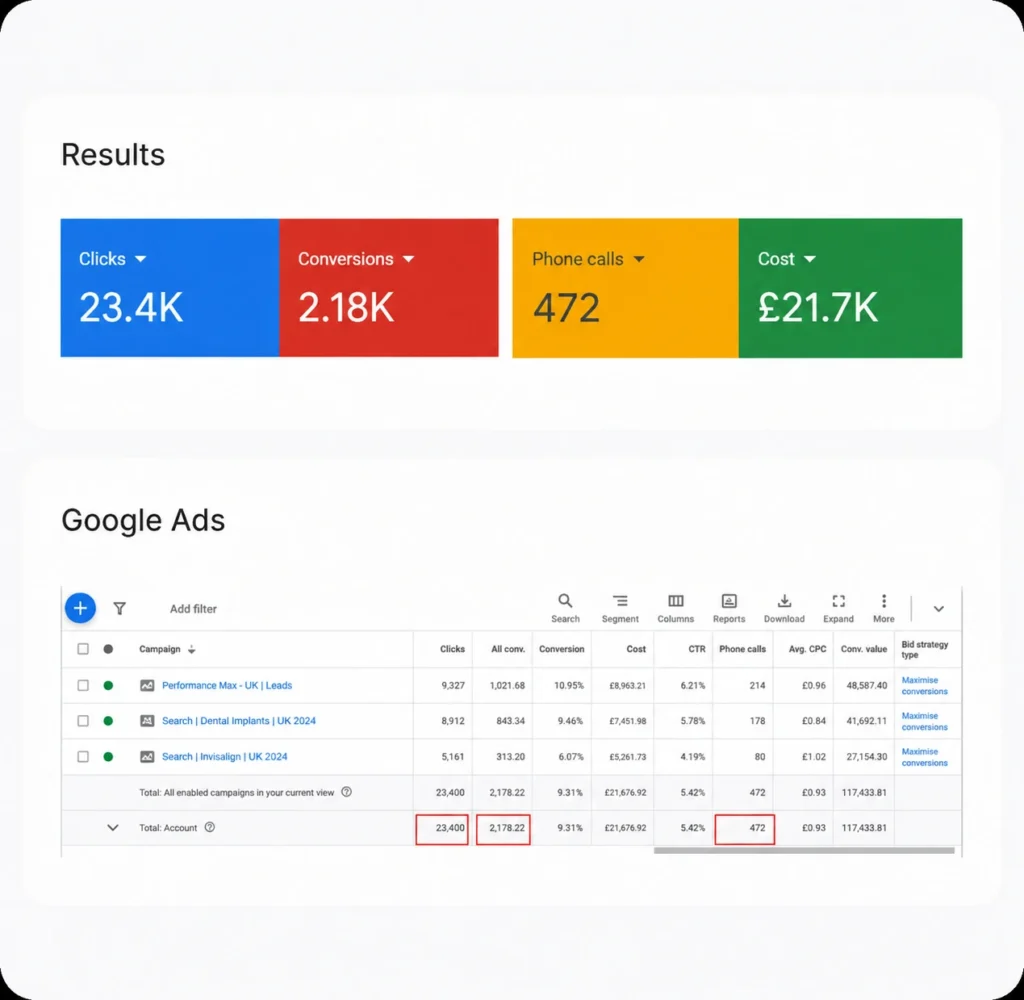
| Cost driver | Effect on price |
|---|---|
| Treatment value | High-value terms like “dental implants” attract the highest bids |
| Location | City-centre and affluent areas cost more per click |
| Competition | More local practices bidding pushes CPC up |
| Quality Score | Relevant ads and landing pages lower your cost per click |
| Match type | Broad match without controls inflates wasted spend |
As a rough guide, clicks for competitive dental treatment terms often run to several pounds each, and considerably more for the most contested terms in major cities. Because not every click books, the real number that matters is not cost per click but cost per acquisition, what it costs to win one actual patient. You can estimate local costs before spending using Google’s own Keyword Planner inside Google Ads.
Note that PPC ad spend is separate from the cost of managing campaigns or of SEO. It buys clicks, not rankings.
The Pros and Cons of PPC for Dental Practices
PPC is a tool, not a strategy. It does some things brilliantly and others poorly. Weigh both sides before committing budget.
| Pros | Cons |
|---|---|
| Near-instant visibility at the top of Google | Visibility stops the moment you stop paying |
| Full control over budget, targeting and timing | Competitive treatment clicks can be expensive |
| Easy to measure clicks, calls and bookings | Ongoing management needed to avoid wasted spend |
| Ideal for launches and short-term demand | Builds no lasting asset, unlike SEO |
| Can target exact treatments and locations | Patients often skip ads in favour of organic results |
The honest summary is that PPC buys attention while you have budget, but it never compounds. Turn it off and you are back where you started.
When PPC Makes Sense for a Dental Practice
PPC earns its cost in specific situations, usually when speed matters more than long-term value. It is the right tool when:
- Launching a new practice that has no rankings yet and needs patients now.
- Promoting a new treatment such as implants or Invisalign before organic pages rank.
- Filling short-term gaps in the diary or during quiet seasons.
- Targeting high-value treatments where one patient easily covers the ad spend.
- Testing demand for a treatment or location before investing in SEO content.
Outside these cases, a practice pouring money into PPC every month, with no long-term plan, is renting visibility it could eventually own.
PPC vs SEO for Dentists: The Short Version
Most dentists researching PPC are really asking a bigger question: should I pay for ads or invest in ranking organically? The short answer is that they solve different problems.
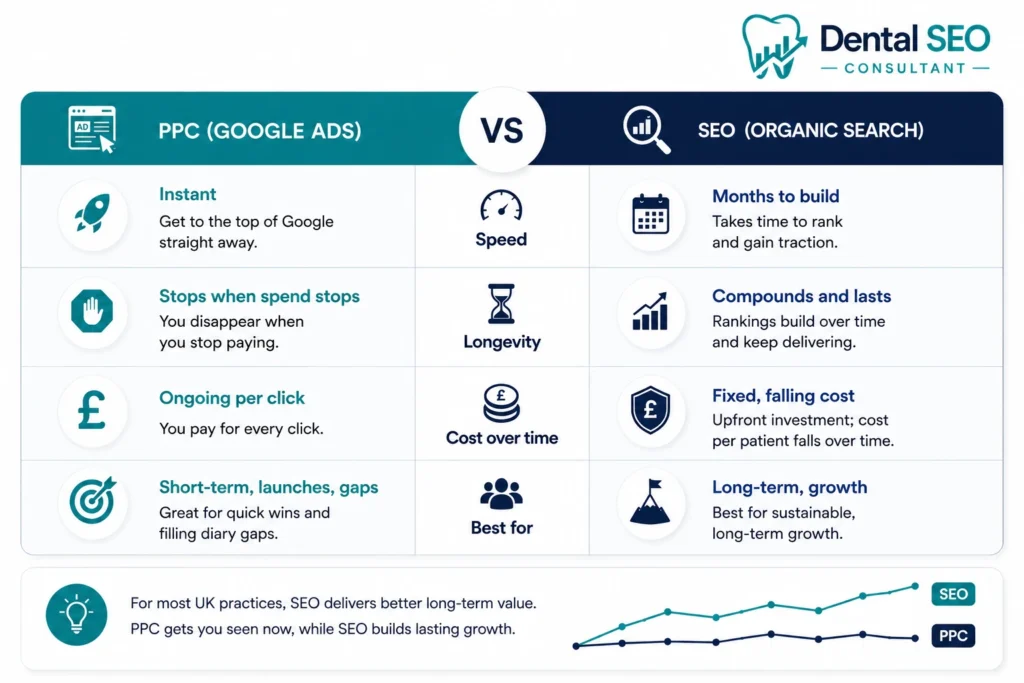
| PPC (Google Ads) | SEO | |
|---|---|---|
| Speed | Instant | Months to build |
| Longevity | Stops when spend stops | Compounds and lasts |
| Cost over time | Ongoing per click | Fixed, falling cost per patient |
| Best for | Short-term, launches, gaps | Long-term, sustainable growth |
For most established UK practices, SEO is the better long-term investment because it keeps working without paying for every click, while PPC fills the gap in the meantime. The full decision depends on your goals, budget and timeline, which is where a proper dental SEO strategy and a search-led view of the whole marketing mix come in.
How to Run Dental Google Ads Well
Most dental PPC fails not because the channel is bad, but because it is run carelessly. A few disciplines separate profitable campaigns from budget drains.
- Send each ad to a matching landing page, never the homepage.
- Use negative keywords from day one to block irrelevant, non-converting searches.
- Track conversions, so you know which clicks become calls and bookings, not just visits.
- Focus on high-value treatments where the numbers work, rather than broad “dentist” terms.
- Set a realistic budget and let campaigns gather data before judging them.
- Review weekly at first, cutting wasted spend and scaling what converts.
Compliance in Dental Google Ads
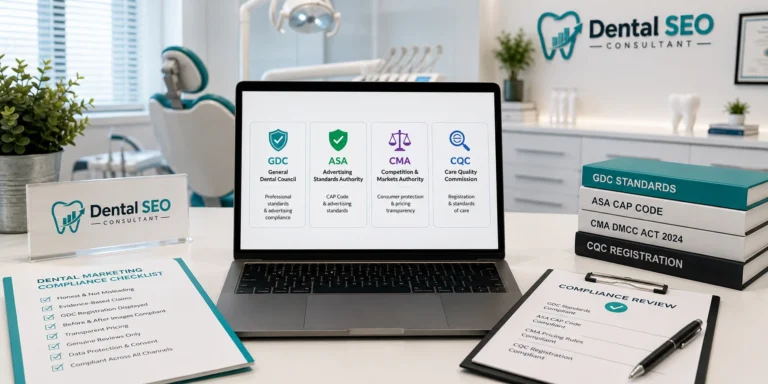
PPC does not escape UK dental rules. Google Ads copy is advertising, so it must follow GDC and ASA requirements just as your website does.
The main limits to respect in ads:
- No patient testimonials in the ad, in line with GDC Standard 4.2.4.
- No “specialist” claim unless the clinician is on the GDC Specialist Register.
- No guaranteed outcomes or misleading superlatives such as “best” or “painless”.
- No before-and-after imagery unless it meets the strict ASA conditions.
The advertising rules are set out by the Advertising Standards Authority, and breaching them in a paid ad carries the same risk as breaching them on your site, with the added exposure of a public, targeted advert.
Should Dentists Run PPC Themselves or Get Help?
A practice can run its own Google Ads, and some do it well. The platform is open to anyone. The real question is whether the time and the learning curve are worth it against the cost of getting it wrong.
Running it yourself can make sense when:
- The budget is small and you can afford to learn slowly.
- You have time to review and adjust campaigns every week.
- You are testing demand before committing more money.
Getting professional help tends to pay off when:
- The budget is large enough that wasted spend genuinely hurts.
- You are bidding on competitive, high-cost treatment terms.
- You would rather focus on dentistry than on managing ad accounts.
Whichever route you take, the priorities are identical: tight targeting, treatment-specific landing pages, conversion tracking and compliance. Whoever runs the account should be able to show you cost per patient, not just clicks and impressions. If a report only talks about clicks, it is not measuring the thing that pays your bills.
Common PPC Mistakes Dentists Make
The same errors drain dental ad budgets again and again. Avoiding them is most of the battle.
- Sending all traffic to the homepage instead of treatment-specific pages.
- Ignoring negative keywords, so budget leaks on “NHS”, “jobs” and “free” searches.
- Bidding on broad terms like “dentist” that attract clicks but few bookings.
- Not tracking conversions, so success is measured in clicks rather than patients.
- Running ads and stopping abruptly, losing all momentum the moment budget pauses.
- Breaching compliance with testimonial or outcome claims in ad copy.
FAQ
What is PPC for dentists?
PPC, or pay-per-click, is online advertising where a dental practice pays to appear at the top of Google for chosen searches and pays only when someone clicks. Google Ads is the main platform. It gives dentists near-instant visibility, which suits launches, new treatments and filling short-term gaps in the diary.
What is PPC for dentists?
PPC, or pay-per-click, is online advertising where a dental practice pays to appear at the top of Google for chosen searches and pays only when someone clicks. Google Ads is the main platform. It gives dentists near-instant visibility, which suits launches, new treatments and filling short-term gaps in the diary.
How much do Google Ads cost for a dental practice?
There is no fixed cost. You set the budget, but the price per click is decided by an auction and varies by treatment and area. Competitive terms like “dental implants” in major cities cost the most, often several pounds a click or more. The figure that matters is cost per acquisition, what it costs to win one patient, not the cost per click.
Are Google Ads worth it for dentists?
They can be, in the right situations. PPC is worth it for launching a practice, promoting high-value treatments, or filling gaps quickly, where the speed justifies the cost. For steady, long-term growth, most practices get better value from SEO, which keeps working without paying for every click. Many use PPC short-term while SEO builds.
Can dentists advertise on Google in the UK?
Yes, dentists can run Google Ads in the UK, but the ads must follow GDC Standards and the ASA CAP Code. That means no patient testimonials, no guaranteed-outcome claims, no misuse of “specialist”, and no before-and-after images unless strict conditions are met. The rules that govern your website apply equally to paid ads.
Is PPC better than SEO for dentists?
Neither is simply better; they do different jobs. PPC delivers instant visibility that stops when spending stops. SEO takes months but compounds and lasts. For short-term needs, PPC wins. For sustainable growth, SEO usually offers a stronger return over time. The best approach often combines both: PPC first, SEO for the long game.
How do I stop wasting money on dental PPC?
The biggest fixes are sending each ad to a matching treatment page, adding negative keywords to block irrelevant searches, tracking real conversions rather than clicks, and focusing budget on high-value treatments. Reviewing campaigns weekly and cutting what does not convert prevents most wasted spend.
How long does it take for dental Google Ads to work?
PPC delivers visibility almost immediately, often within hours of a campaign going live. Bookings can start in the first week. What takes longer is optimisation, the process of learning which keywords, ads and landing pages convert, so cost per patient usually improves over the first one to three months as wasted spend is cut.
Do I need a large budget to start dental PPC?
No. You can start small and scale what works. A modest budget focused tightly on one or two high-value treatments in your local area performs far better than a large budget spread across broad terms. The key is control and tracking, not size. Starting narrow protects you from expensive mistakes while you learn what converts.
Conclusion
PPC and Google Ads give dentists something no other channel does: patients almost immediately. Used deliberately, for a launch, a new treatment or a quiet spell, it is a sharp tool. Used as a permanent crutch, it becomes an expensive way to rent visibility you never get to keep.
The smartest approach for most UK practices is to use PPC for speed while building SEO for lasting, compounding growth. If you want to see where paid ads fit against your organic opportunity, start with a free dental SEO audit. It shows what you could rank for organically, so you only pay for the clicks you truly need.