How Dentists Rank in the Google Map Pack (Top 3)
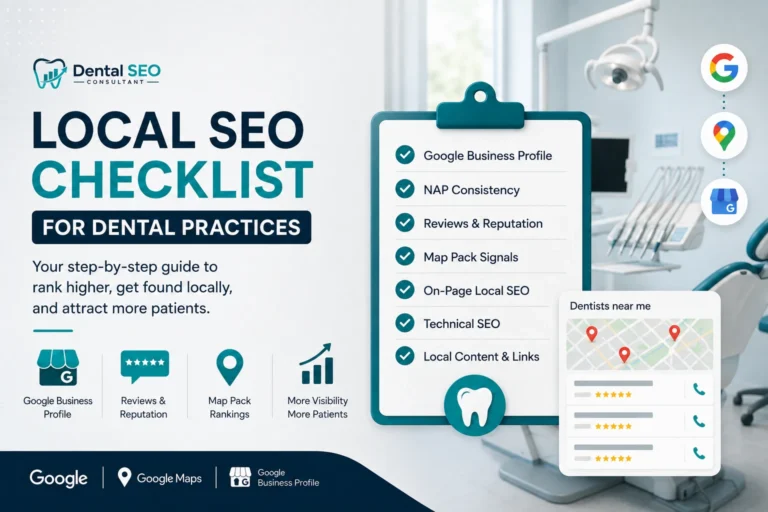
Google ranks dentists in the map pack using three factors: proximity (how close the practice is to the searcher), relevance (how well the profile and website match the search), and prominence (how well known and trusted the practice is, mainly through reviews, citations, and links). Proximity cannot be changed, but relevance and prominence can. Improving those two is how a practice climbs into the top three.
Introduction
The map pack is the most valuable spot in local search for a dentist. It is the block of three practices with a map that sits at the very top of Google, above the normal results, for searches like “dentist near me”. Being one of those three brings a steady stream of ready-to-book patients. Being fourth or lower means most of them never see you.
This guide explains exactly how Google decides those three positions, why your practice might be missing, and what actually moves the needle. It focuses on the ranking side of local search, not the profile setup, so you understand the levers behind the top three.
What Is the Google Map Pack?
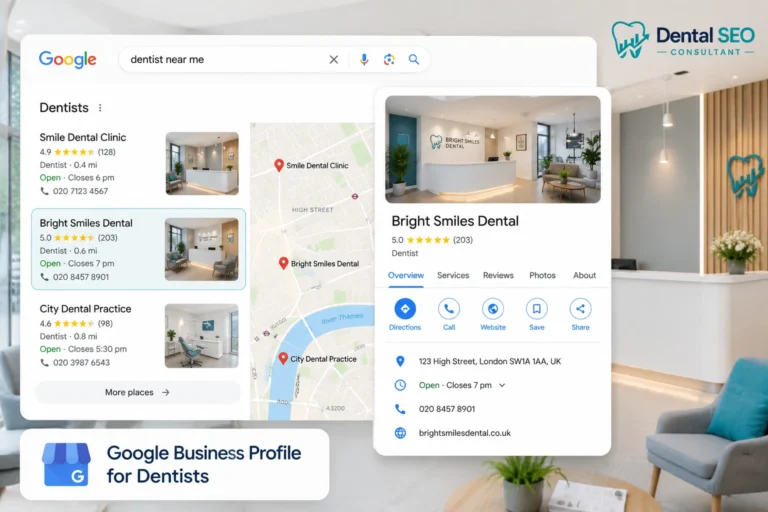
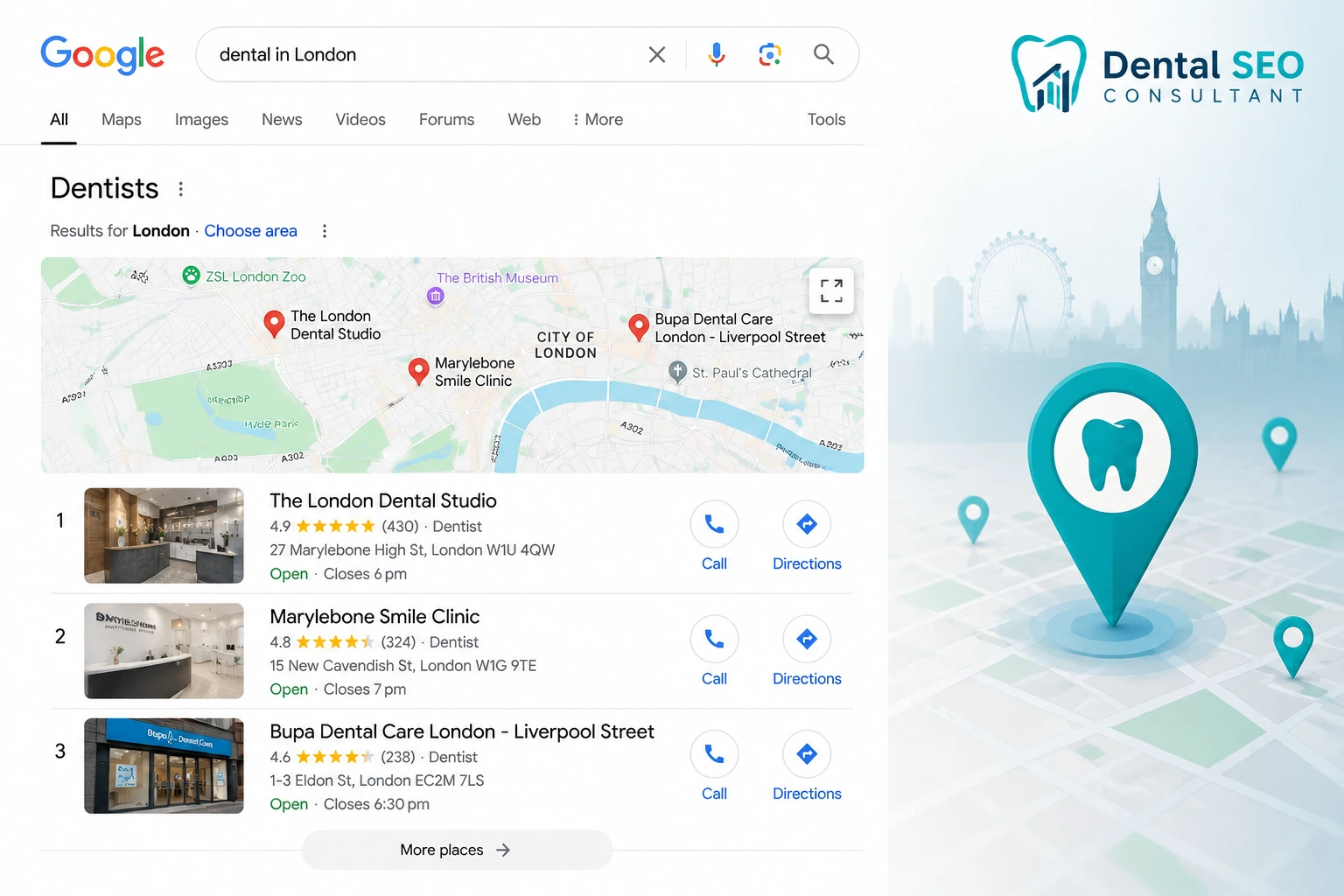
The Google map pack, also called the local pack or 3-pack, is the group of three business listings shown with a map for local searches. For a dentist, it appears whenever someone searches with local intent, such as “dentist near me”, “emergency dentist” or “dental implants [town]”.
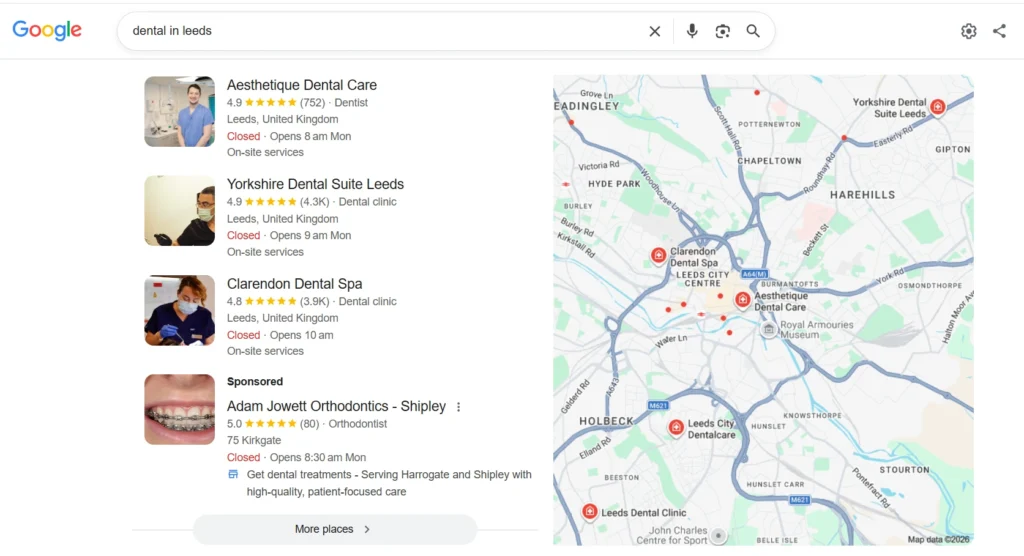
It is different from the organic results in three ways:
- It shows businesses, not web pages. Each listing is a Google Business Profile, not a website.
- It sits above organic results. The pack takes the top of the page, so it captures the most clicks.
- It ranks on local factors. Proximity and reputation matter far more here than on standard organic listings.
If a searcher taps “More places”, they open the local finder, a longer list beyond the top three. The goal of dental local SEO is to improve your chances of appearing in that visible top three, where local visibility can turn into more calls and bookings.
Map Pack vs Organic Results: What Is the Difference?
The map pack and the organic results below it are two separate systems, and a dental practice can rank well in one while missing the other. Knowing the difference helps you target the right work.
| Map pack | Organic results | |
|---|---|---|
| Shows | Google Business Profile | Website pages |
| Position | Top of the page, above organic | Below the map pack |
| Main factors | Proximity, reviews, profile | Content, links, technical SEO |
| Best for | “Near me” and local intent | Research and treatment questions |
For a dentist, both matter but do different jobs. The map pack captures patients ready to book nearby, while organic pages capture patients researching treatments and comparing options. A complete local strategy aims to appear in both, since they occupy different parts of the same results page.
How Google Ranks Dentists in the Map Pack: The Three Factors
Google ranks the map pack using three core factors: proximity, relevance, and prominence. Every tactic that improves local rankings works by strengthening one of these. Understanding them tells you where to focus.
| Factor | What it measures | Can you control it? |
|---|---|---|
| Proximity | How close the practice is to the searcher | No, but you can influence how Google reads your location |
| Relevance | How well your profile and site match the search | Yes, through categories, services and content |
| Prominence | How well known and trusted the practice is | Yes, through reviews, citations and links |
Google confirms these factors in its own guide to improving local ranking. The sections below break down each one and how a dental practice can strengthen it.
Proximity: Why Location Drives Map Pack Rankings
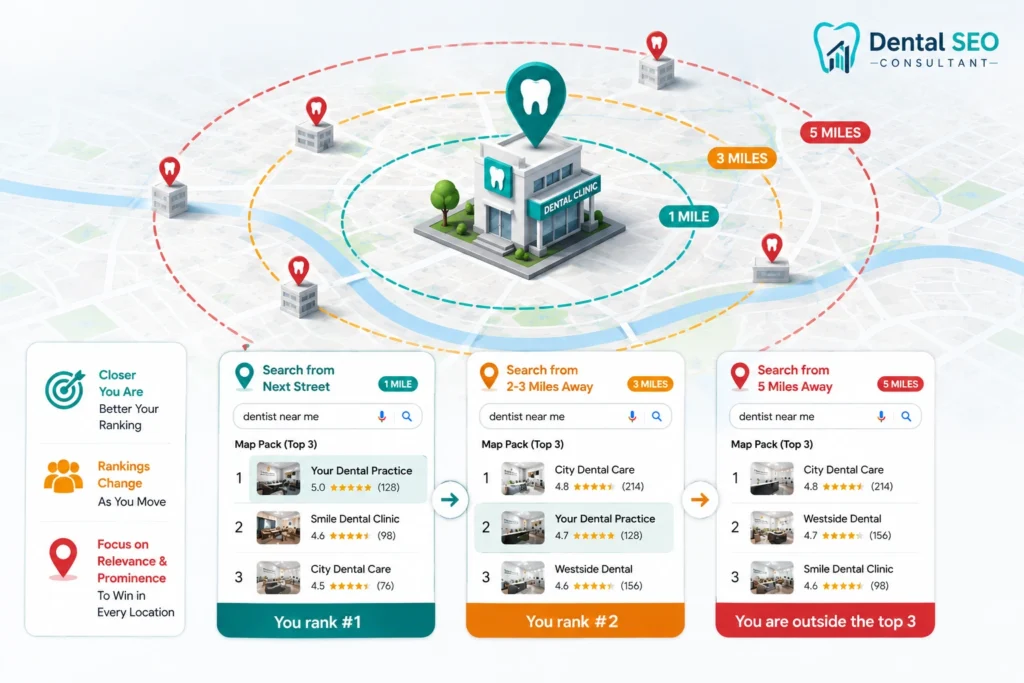
Proximity is how close your practice is to the person searching, or to the area they name in the search. It is the factor with the most weight in the map pack, and the one you cannot directly change.
This is why map pack rankings shift as a patient moves around town. A practice can rank first when someone searches from the next street, and vanish from the pack when they search from three miles away. There is no single “number one” in the map pack. Your position depends on where the searcher is standing.
While you cannot move your practice, you can influence how Google reads your location:
- Set an accurate address on the Google Business Profile so Google places you correctly on the map.
- Keep the address identical across your website and listings, so Google is confident where you are.
- Target nearby areas through content, with location pages and local wording, since you cannot rely on proximity alone for patients further out.
Proximity means a practice in a dense city competes with many others close by, while a practice in a quieter area may rank across a wider radius simply because there is less competition nearby.
Relevance: How to Match What Patients Search For
Relevance is how well your practice matches what the person is searching for. Google decides this from your Google Business Profile and your website. Unlike proximity, relevance is fully within your control.
The main inputs Google reads for relevance:
- Primary category. Setting Dentist as the primary category is the strongest relevance signal. The wrong category can keep you out of the pack entirely.
- Secondary categories and services. Adding categories like cosmetic dentist or dental implants provider, and listing each treatment as a service, helps you appear for those specific searches.
- Website content. Dedicated treatment pages that match searches, such as an implants page, reinforce relevance for those terms.
A practice that only lists “Dentist” and a generic services page will struggle to rank for “Invisalign near me”, because nothing signals that it offers Invisalign. Matching your profile and site to the treatments patients search for is the core of relevance.
Prominence: How Google Measures a Practice’s Reputation
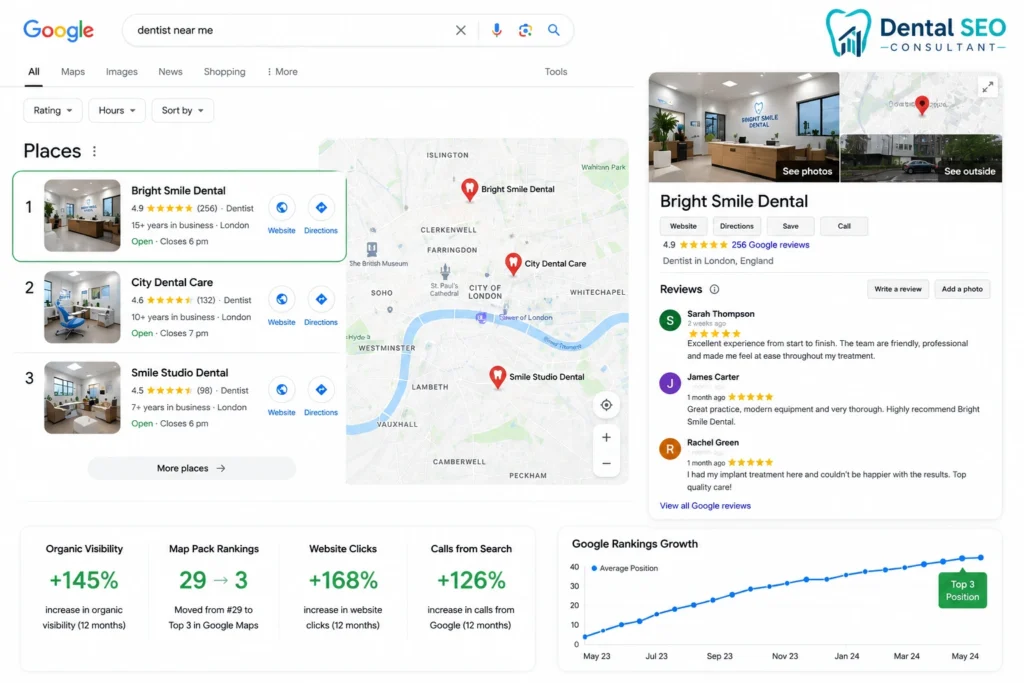
Prominence is how well known and trusted a practice is, both online and in the real world. It is Google’s way of judging reputation, and it is where most competitive map pack battles are won or lost.
The main signals that build prominence:
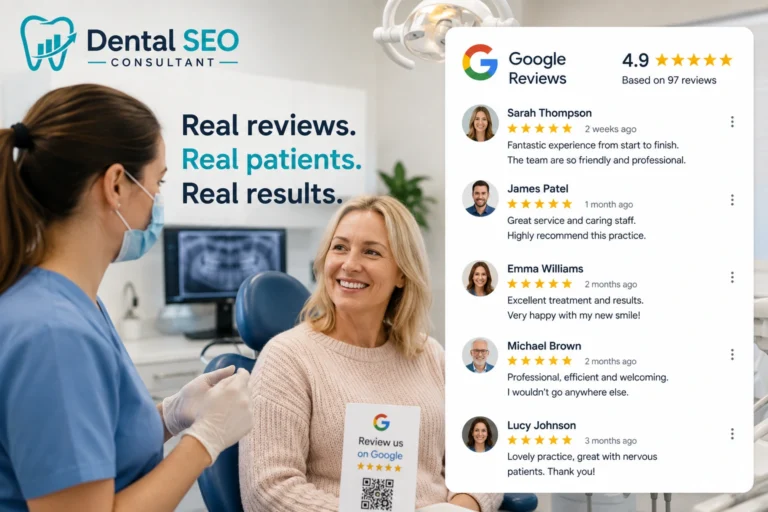
- Reviews. The number, average rating and recency of Google reviews all feed prominence. A steady flow of recent, genuine reviews is one of the strongest levers.
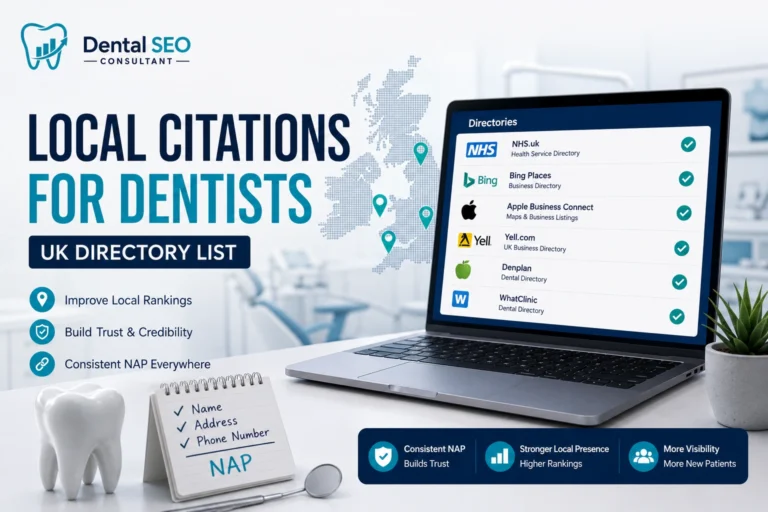
- Citations. Consistent mentions of your name, address and phone across trusted directories confirm the practice is real and established.
- Links. Links from relevant, trusted sources, such as local organisations or professional bodies, add authority.
- Website authority. A strong, well-ranked website supports the profile’s prominence.
For UK dental practices, reviews must be earned genuinely. You can encourage patients to leave honest reviews, but you cannot incentivise them, and testimonials cannot be used as advertising, in line with General Dental Council standards. Building prominence compliantly, through real reviews and genuine local relationships, is what separates the top three from the rest.
Why Your Dental Practice Isn’t in the Top 3
If a practice is missing from the map pack, the cause is almost always one of a short list of problems. Working through them usually reveals the blocker.
- The profile is not fully optimised, with a wrong category or missing services, weakening relevance.
- Too few reviews, or a lower rating than nearby competitors, weakening prominence.
- Proximity works against you, because stronger competitors sit closer to where patients search.
- Inconsistent NAP, where your details differ across the web, undermining Google’s trust.
- A weak or slow website, giving little support to the profile.
- A new or unverified profile, which Google has not yet trusted enough to rank.
Often it is a combination. A practice with a decent profile but few reviews, sitting near a well-reviewed competitor, will lose the pack on prominence even if everything else is fine.
How to Improve Your Dental Map Pack Ranking
Improving map pack rankings means strengthening the two factors you control: relevance and prominence. The table below maps common actions to the factor they improve, so effort goes where it counts.
| Action | Factor it improves |
|---|---|
| Set the correct primary and secondary categories | Relevance |
| List every treatment as a service | Relevance |
| Build dedicated treatment pages on the website | Relevance |
| Earn a steady flow of genuine Google reviews | Prominence |
| Respond to every review professionally | Prominence |
| Keep name, address and phone consistent everywhere | Prominence and trust |
| Earn links from local and dental sources | Prominence |
| Target nearby areas with local content | Relevance and reach |
The order matters. Fix relevance first, because a profile in the wrong category cannot rank no matter how many reviews it has. Then build prominence steadily over time, since reviews and links accumulate rather than appear overnight. This ongoing work is the heart of a local SEO for dentists programme.
How to Track Your Map Pack Rankings
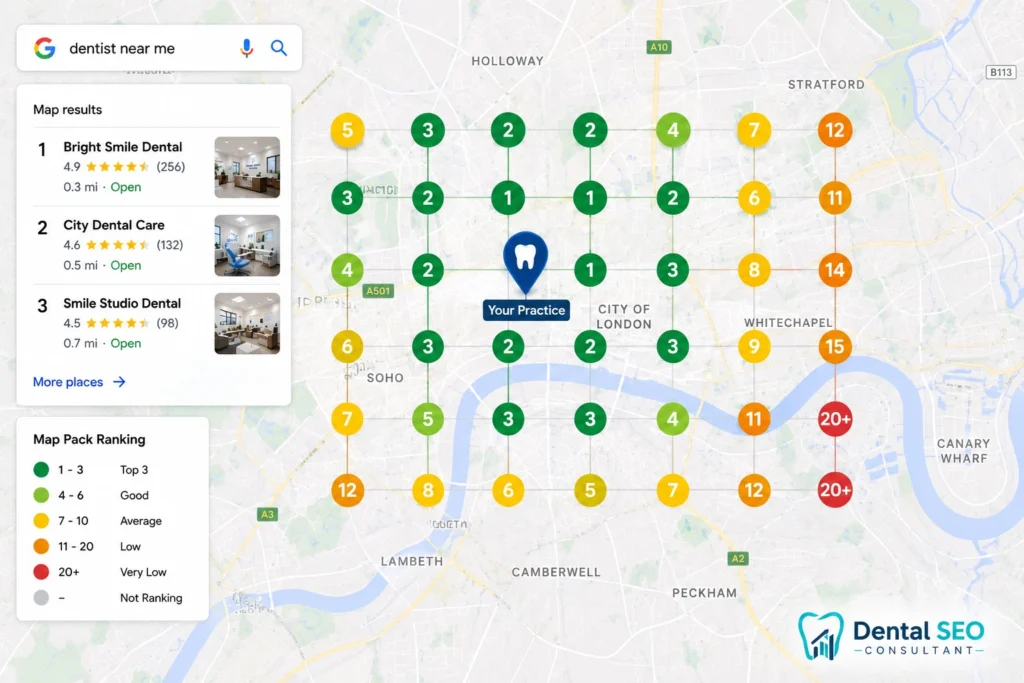
Because map pack position changes with the searcher’s location, a single rank check is misleading. Your practice may rank first at the surgery and fifth a mile away. Tracking has to account for this.
The two practical ways to track:
- Search from different points in your catchment, ideally on a device not logged into your business account, to see how position shifts by location.
- Use a local rank tracking tool that checks rankings across a grid of points around the practice, giving a map of where you rank strongly and where you fade.
The grid view is the most honest picture. It shows the real shape of your local visibility, not a single flattering or unflattering snapshot. Watching it over time tells you whether your relevance and prominence work is actually widening your reach.
How Patients Choose Between the Top Three
Ranking in the map pack is only half the win. Once you are one of the three, patients still choose between you and two competitors in seconds. The profile has to convert as well as rank.
What tips the decision:
- Star rating and review count. A 4.8 with 200 reviews often beats a 4.9 with 5.
- Recent reviews. Fresh reviews signal an active, trusted practice.
- Photos. Real images of the practice and team build confidence.
- Proximity and hours. “Open now” and a short distance win convenience-driven patients.
- A clear action. An easy call, booking, or directions button removes friction.
Two practices can rank side by side, and the one with more recent reviews and better photos will take most of the clicks. Getting into the pack earns the visibility; the quality of the profile earns the patient.
Map Pack Ranking Myths for Dentists
Local SEO attracts a lot of bad advice. These are the map pack myths that waste dental practices’ time and money.
| Myth | Reality |
|---|---|
| There is one fixed number one in the map pack | Rankings change by the searcher’s location; proximity varies |
| Adding keywords to your business name helps | It breaches Google’s rules and risks suspension |
| More listings on more directories always helps | Consistency matters more than quantity; conflicting details hurt |
| Buying reviews boosts prominence | Fake or incentivised reviews breach rules and can be removed |
| A great website alone wins the pack | The profile drives the pack; the website only supports it |
| Once you rank, you stay there | Competitors and review growth constantly reshuffle the pack |
FAQ
What is the Google map pack for dentists?
The Google map pack, or local 3-pack, is the group of three practices shown with a map at the top of Google for local dental searches. Each listing is a Google Business Profile, not a website. Ranking in it brings high-intent patients searching terms like “dentist near me”, which is why it is so valuable.
How do dentists rank in the Google map pack?
Google ranks the map pack on three factors: proximity to the searcher, relevance of the profile and website to the search, and prominence based on reviews, citations and links. Proximity cannot be changed, but improving relevance through categories and services, and prominence through genuine reviews and links, is how practices climb into the top three.
Why is my dental practice not showing in the map pack?
Common reasons are an unoptimised profile with the wrong category, too few reviews compared with competitors, inconsistent name and address details, an unverified profile, or stronger competitors sitting closer to where patients search. Usually it is a combination, most often weak relevance or prominence against nearby rivals.
Can you pay to be in the Google map pack?
No, you cannot pay for a map pack position. The three listings are earned through Google’s local ranking factors. Google Ads can place a paid listing above or within local results in some cases, but that is advertising, marked as sponsored, and separate from the organic map pack.
How long does it take to rank in the map pack?
It varies. A well-optimised profile in a less competitive area can appear within a few months. Competitive city locations take longer, because prominence, especially reviews and links, builds gradually. A new or recently verified profile also needs time before Google trusts it enough to rank.
Do reviews help you rank in the map pack?
Yes. Reviews are a major prominence signal. The number, average rating and recency of genuine Google reviews all influence map pack ranking, and they strongly affect whether patients choose you. UK dentists must earn reviews honestly, without incentives, and cannot use testimonials as advertising.
Conclusion
Ranking in the Google map pack comes down to three things: how close you are, how well you match the search, and how trusted you are. You cannot change your location, but you can control the other two. A fully optimised profile in the right categories, backed by a steady flow of genuine reviews and consistent details across the web, is what lifts a practice into the top three.
If you want to see exactly where your practice ranks across your area and what is holding it back, start with a free dental SEO audit. It maps your local visibility and shows the specific relevance and prominence gaps to fix as part of your wider local SEO.