Local SEO Checklist for Dental Practices
The local SEO checklist for a dental practice covers seven areas: an optimised Google Business Profile, consistent name, address and phone details across the web, a steady flow of genuine reviews, strong map pack signals, location and treatment pages on the website, solid technical health, and local content and links. Working through them in order builds the local visibility that puts a practice in front of nearby patients searching for a dentist.
Introduction
Most dental patients search locally. They look for a dentist “near me”, a treatment in their town, or an emergency appointment nearby. Local SEO is how a practice makes sure it appears for those searches, in the map pack and the local results, ahead of the practices around it.
This is a complete, practical checklist for local SEO, built for UK dental practices. It walks through every area you need to cover, in a sensible order, with a short explanation of each and a link to a deeper guide where one exists. Use it to audit your own practice and see exactly where the gaps are.
What Is Local SEO for Dentists?
Local SEO is the work of making a dental practice visible in local search results and on Google Maps, so nearby patients find it first. It is different from general SEO because it is driven by location and by the Google Business Profile, not only by the website.
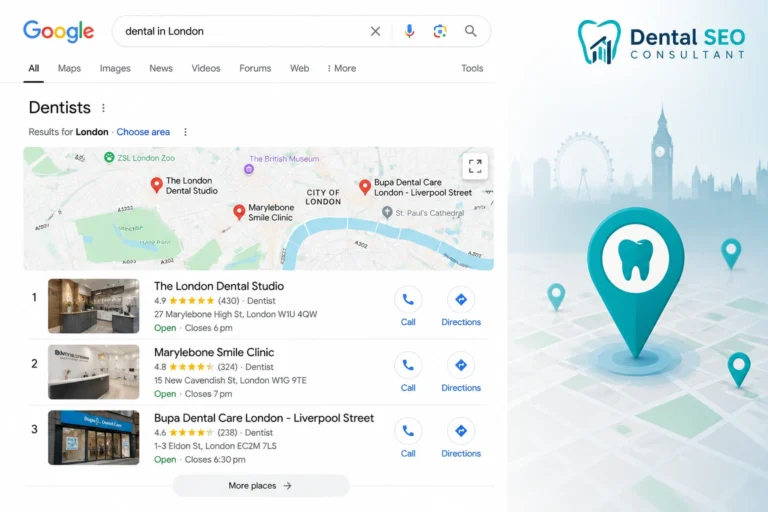
It has two goals: appearing in the map pack, the block of three practices shown with a map, and ranking in the local organic results below it. Doing both well is the aim of a full local SEO programme for dentists, and this checklist covers the steps that get you there.
The Complete Local SEO Checklist for Dental Practices
Before the detail, here is the full checklist at a glance. Each area is explained in its own section below.
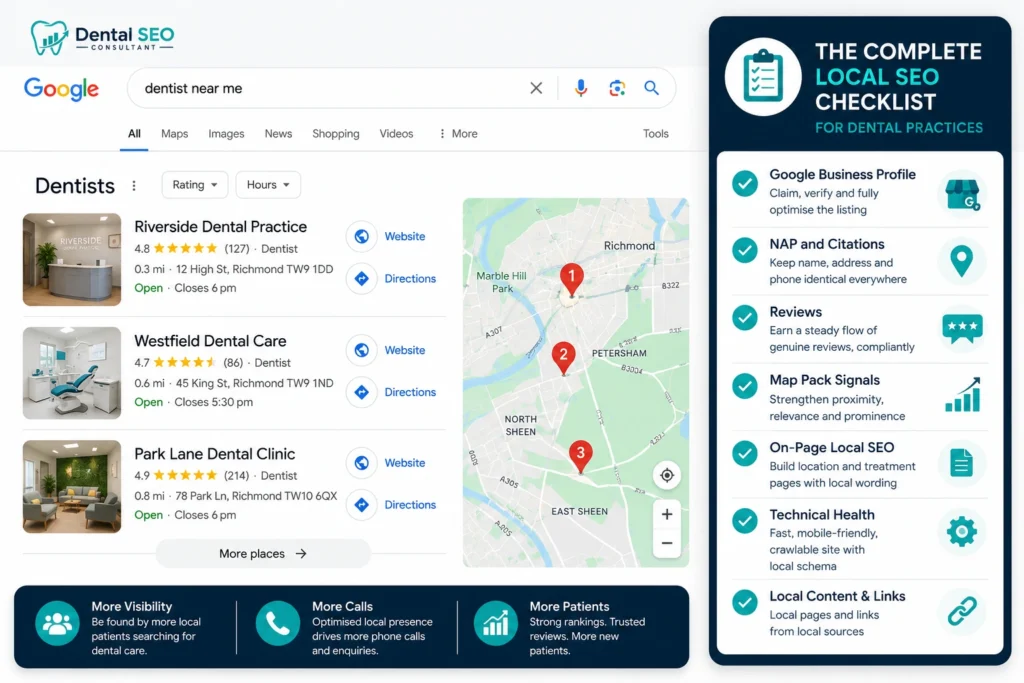
| Area | Core task |
|---|---|
| Google Business Profile | Claim, verify and fully optimise the listing |
| NAP and citations | Keep name, address and phone identical everywhere |
| Reviews | Earn a steady flow of genuine reviews, compliantly |
| Map pack signals | Strengthen proximity, relevance and prominence |
| On-page local SEO | Build location and treatment pages with local wording |
| Technical health | Fast, mobile-friendly, crawlable site with local schema |
| Local content and links | Local pages, and links from local sources |
A practice that can tick every row is in a strong local position. Most cannot at first, and the gaps are where the opportunity lies.
1. Optimise Your Google Business Profile
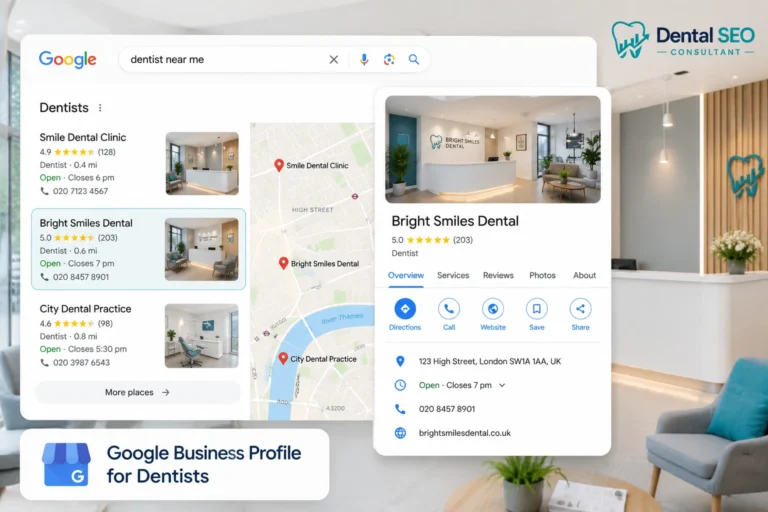
The Google Business Profile is the single most important local asset, because it decides whether a practice appears in the map pack. Claim and verify it, set the correct primary category, list every treatment as a service, add real photos, and keep the details accurate.
This is the foundation, so it is worth doing thoroughly rather than quickly. The full field-by-field process is covered in the guide to optimising your GBP, which is the first thing to complete before moving down the list.
2. Fix NAP Consistency and Local Citations
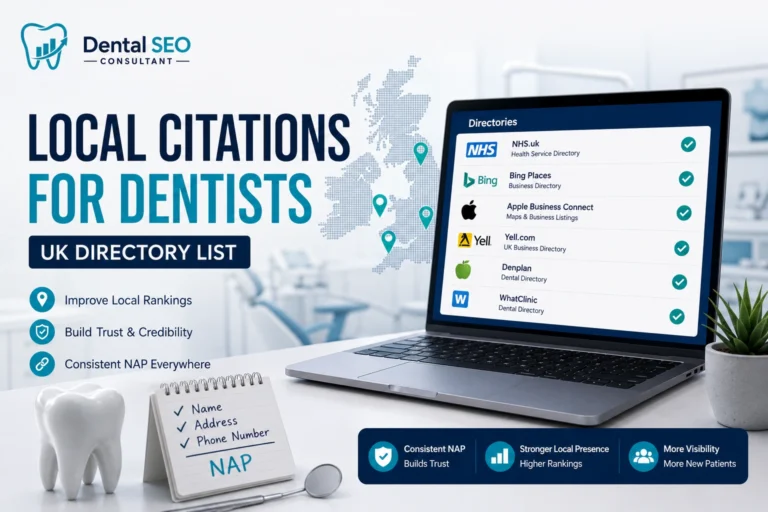
NAP stands for name, address and phone number. Google trusts a practice more when these details are identical everywhere they appear, on the website, the profile and every directory listing.
Work through this in two steps:
- Audit your details. Check that your name, address and phone match exactly across your site, Google Business Profile and major directories. Even a different format, like “Street” versus “St”, can weaken trust.
- Build consistent citations. List the practice on reputable UK directories, and on the NHS website if you are an NHS or mixed practice, always with identical details.
Consistency matters more than volume here. A handful of accurate citations beats dozens of conflicting ones. Conflicting details are one of the most common hidden reasons a practice struggles to rank locally, because they make Google unsure which information to trust. Fixing these inconsistencies is part of the broader technical foundation covered by dental website SEO.
3. Build a Steady Flow of Genuine Reviews
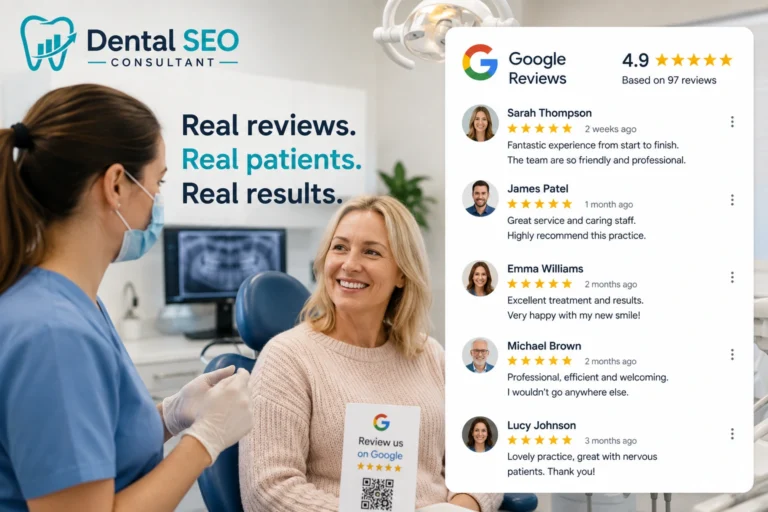
Reviews are a major local ranking signal and a powerful trust factor. Their number, rating and recency all feed how a practice ranks in the map pack, and they often decide which practice a patient chooses.
The key is to earn them consistently and within the rules, which for UK dentists means no incentives and no filtering for only happy patients. The complete method is set out in the guide to getting more Google reviews the compliant way. Aim for a steady trickle of recent reviews rather than a one-off push.
4. Strengthen Your Map Pack Signals
The map pack ranks on three factors: proximity, relevance and prominence. Proximity you cannot control, but relevance, through categories and services, and prominence, through reviews and links, you can.
Most of the other checklist items feed these signals, so working through the list improves your map pack position as a by-product. The full breakdown of how the top three are decided is covered in the guide to how dentists rank in the map pack.
5. Build On-Page Local SEO
This is where the website itself does local work, and it is often the most neglected part of the checklist. The goal is to make each page clearly relevant to the treatments and the areas you serve, so it can rank for the specific searches patients actually type, not just the practice name. This is the difference between being found for “dentist [your name]” and being found for “dental implants [your town]”.
The on-page local essentials:
- Treatment pages with local wording. A page for each key treatment, naming the town or area you serve, so it can rank for searches like “dental implants [town]”.
- A clear location and contact page. With your address, map, opening hours and directions.
- Location pages for multiple areas, if you genuinely serve more than one, each with unique, useful content rather than copies.
- Local terms used naturally, in headings and copy, without stuffing.
Building these pages properly is a core part of a wider dental practice SEO strategy, and it is what lets a practice rank for treatment searches, not just its own name.
6. Get the Technical Foundation Right
Google can only rank a site it can crawl, load and read easily. Technical health underpins everything else on this checklist, because even a perfect Google Business Profile cannot fully make up for a website that frustrates patients and search engines alike.
The technical local essentials:
- Fast loading on mobile, since Google judges the mobile version first and most local searches are on phones.
- A crawlable, indexed site, so every important page can appear in search.
- Local business schema, such as Dentist and LocalBusiness structured data, to help Google understand the practice and its location.
- Secure HTTPS and clean navigation, so patients and Google can move around the site easily.
None of this is glamorous, but a slow or broken site quietly undermines strong local work. Google explains the local ranking factors these support in its guide to improving local ranking, and the correct markup in its local business structured data documentation.
7. Add Local Content and Local Links
The final area builds authority and relevance over time. It is what separates a practice that ranks locally from one that dominates its area.
Two strands matter:
- Local content. Useful pages and articles relevant to your area and patients, which also increasingly feed local AI answers, as covered in optimising for local AI search. This can include area-specific treatment information, answers to questions local patients ask, and content that shows the practice is part of its community.
- Local links. Links from genuine local sources, such as community groups, local sponsorships, local press and relevant professional bodies, which signal that the practice is an established part of its area. These are harder to earn than directory listings, which is exactly why they carry weight.
Quality matters far more than quantity. A few genuine local links and useful local pages outperform any volume of low-quality ones.
How to Prioritise Your Local SEO Checklist
You do not have to do everything at once, and the order matters. Some items deliver quick wins, while others build slowly. Working in the right sequence keeps momentum up and gets results sooner.
A sensible order for most practices:
- Google Business Profile first. It is the fastest route into the map pack and needs no website changes.
- NAP consistency next. Fixing conflicting details removes a hidden brake on everything else.
- Reviews, started early and kept going. They take time to accumulate, so begin straight away.
- Technical fixes. Clear the obstacles that hold the website back before adding to it.
- On-page local pages. Build the treatment and location pages that rank for searches.
- Local content and links last. These compound over time once the foundations are in place.
The first three deliver the quickest visible results, which is why they come first. The later items are slower to pay off but build the lasting authority that keeps a practice ahead. Trying to do all seven at once usually means none are done properly.
How to Track Your Local SEO Progress
Local SEO is not a one-off task, so measuring it matters. Because map pack rankings change with the searcher’s location, a single check is misleading. Track progress across a few sources instead.
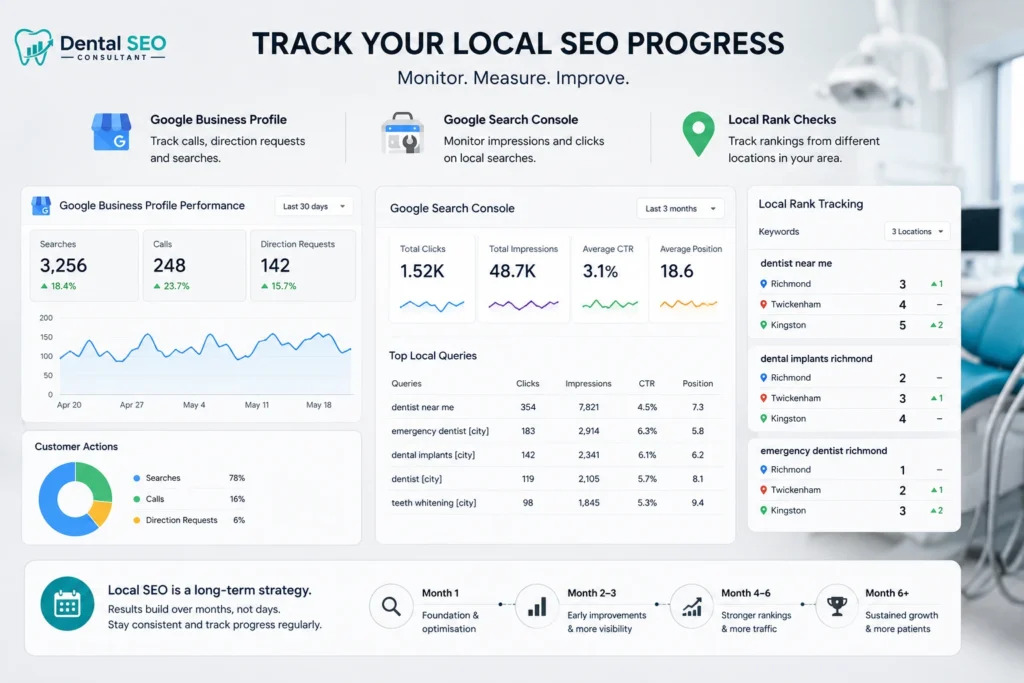
- Google Business Profile performance, for calls, direction requests and searches.
- Google Search Console, for impressions and clicks on local searches.
- Local rank checks from different points in your catchment, since position varies by location.
Give it time, too. Local visibility builds over months, not days, and expecting instant results leads practices to give up too soon. A realistic view of the timeline is set out in the guide to how long local SEO takes to show results.
Common Local SEO Mistakes Dentists Make
Even practices that work through the checklist trip on the same errors. Avoid these:
- An incomplete or unverified Google Business Profile, which keeps a practice out of the map pack entirely.
- Inconsistent NAP details across the web, undermining Google’s trust.
- Too few or stale reviews compared with local competitors.
- A single services page instead of dedicated treatment and location pages.
- A slow, mobile-unfriendly website that fails on the devices most patients use.
- Breaking the review rules, with incentives or gating that risk penalties.
- Giving up too early, before local SEO has had time to build.
Most of these come down to doing the basics incompletely. The checklist above exists to make sure none of them slip through.
FAQ
What is local SEO for a dental practice?
Local SEO is the work of making a dental practice visible in local search results and on Google Maps, so nearby patients find it. It focuses on the Google Business Profile, consistent business details, reviews, and location-relevant website pages, all aimed at appearing in the map pack and local results for searches like “dentist near me”.
What is the most important part of dental local SEO?
The Google Business Profile is the most important single element, because it decides whether a practice appears in the map pack, where most local searches convert. After that, consistent business details and a steady flow of genuine reviews carry the most weight. These three together form the core of local visibility.
How long does local SEO take for a dental practice?
Local SEO usually shows movement faster than general organic SEO, often within the first few months for a well-optimised profile in a less competitive area. Competitive city locations take longer. Because rankings build gradually, especially reviews and citations, it is best treated as an ongoing effort rather than a quick fix.
Can a dental practice do local SEO itself?
Yes, much of this checklist can be done in-house, especially completing the Google Business Profile, fixing NAP consistency and asking for reviews. The harder parts, such as technical fixes, treatment page strategy and local link building, often benefit from specialist help, but a practice can make real progress on the basics alone.
How many citations does a dental practice need?
There is no fixed number. Consistency matters far more than quantity. A practice listed accurately on the main UK directories, with identical details everywhere, is in a stronger position than one with many listings that conflict. Focus on getting the important citations right rather than chasing a high count.
Where should a dental practice start with local SEO?
Start with the Google Business Profile, because it is the fastest route into the map pack and needs no website changes. Then fix any inconsistent business details across the web, and begin asking patients for reviews. These first steps deliver the quickest visible results, before moving on to website and content work that builds more slowly.
Does local SEO help with Google Maps rankings?
Yes. Local SEO and Google Maps rankings are closely linked. Optimising the Google Business Profile, earning reviews and keeping details consistent are exactly the signals that lift a practice in Google Maps and the map pack. The whole checklist works toward stronger Maps visibility.
How is local SEO different from regular SEO for dentists?
Regular SEO focuses on ranking website pages in Google’s organic results, mainly through content, links and technical health. Local SEO adds a layer driven by location and the Google Business Profile, aimed at the map pack and “near me” searches. Dentists need both, but local SEO is usually where the fastest patient gains come from.
Do I need a separate page for each location I serve?
If you genuinely serve several distinct areas, a dedicated page for each can help you rank in those areas, but only if each page has unique, useful content. Thin, near-identical location pages can do more harm than good. For a single-site practice, one strong location and contact page is usually enough alongside your treatment pages.
Conclusion
Local SEO for a dental practice comes down to covering every area on this checklist consistently: an optimised Google Business Profile, consistent details, genuine reviews, strong map pack signals, local website pages, technical health, and local content and links. None of them is complicated on its own, but together they decide whether nearby patients find your practice or a competitor’s.
Work through the list, fix the gaps in order, and give it time to build. Local SEO rewards practices that are thorough and consistent rather than those chasing quick tricks, and the checklist above is designed to make sure nothing important is missed. To see exactly where your practice stands and which items need attention first, start with a free dental SEO audit, which maps your local visibility and shows what to fix first.