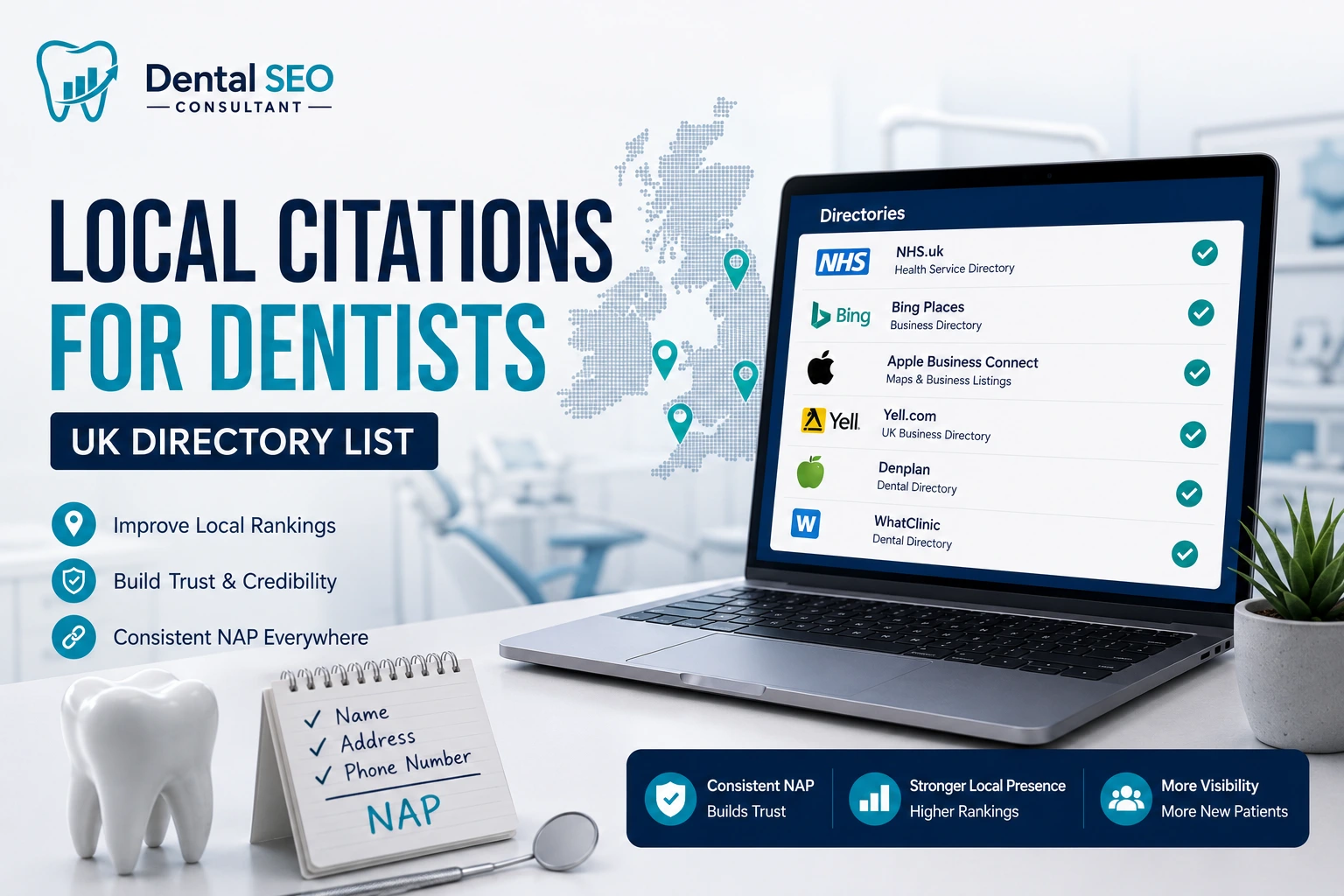
Local Citations for Dentists: UK Directory List
Local citations are online mentions of a dental practice’s name, address and phone number, usually in business directories. They help a practice rank in local search by confirming to Google that the business is real, established and consistent. For UK dentists, the key directories include the NHS website, Bing Places, Apple Business Connect, Yell, and dental listings like Denplan and WhatClinic. What matters most is that the details are identical everywhere.
Introduction
Citations are one of the quieter parts of local SEO, but they do real work. Every time a dental practice is listed accurately in a directory, it adds a small vote of confidence that tells Google the business is genuine and where it is located. Get them consistent and they strengthen local ranking. Get them wrong and they quietly hold it back.
This guide explains what local citations are, why they matter for dentists, and which UK directories to list on, with a practical directory list you can work through. It also covers how to build citations correctly and how to fix the inconsistent ones most practices already have.
What Are Local Citations for Dentists?
A local citation is any online mention of a practice’s core business details: its name, address and phone number, often shortened to NAP. Most citations appear in business directories, but they can also show up on local websites, professional listings and social profiles.
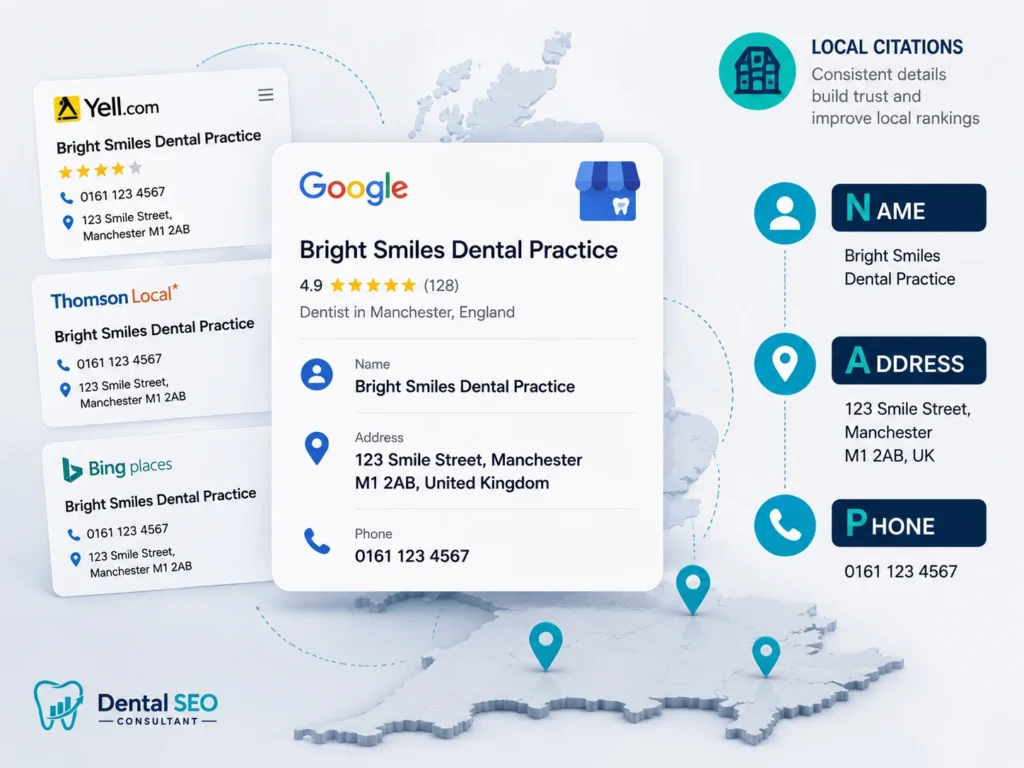
Citations do not always include a link to your website. Their value is in the mention itself, confirming that the practice exists, where it is, and how to contact it. For a dental practice, that means the exact practice name, the full address, and the phone number patients call, presented the same way each time.
Building consistent citations is a foundational part of any local SEO effort, and it works alongside the website rather than on it. Because they are relatively simple to build and control, citations are one of the earliest things a practice can tackle when improving its local visibility.
Why Citations Matter for Dental Practices
Citations matter because they feed the trust and prominence signals Google uses to rank local businesses. A practice mentioned consistently across trusted directories looks more established than one that barely appears, or one whose details conflict.
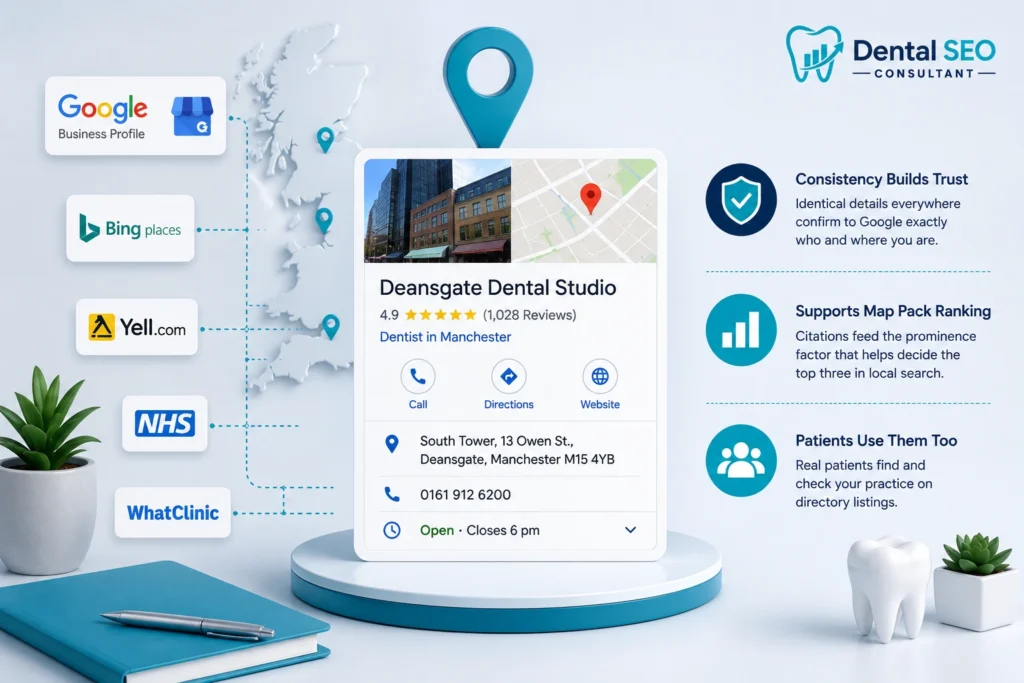
Three reasons they count:
- Consistency builds trust. Identical details everywhere confirm to Google exactly who and where the practice is.
- They support map pack ranking. Citations feed the prominence factor that helps decide the top three, as covered in the guide to the map pack. Google lists prominence among its local ranking factors.
- Patients use them too. Directory listings are places real patients find and check a practice, not just ranking signals.
Citations work hand in hand with the profile itself. A strong Google Business Profile is the anchor, and consistent citations reinforce it across the rest of the web.
Structured and Unstructured Citations
Citations come in two forms, and a healthy local presence has both.
- Structured citations are listings in business directories, where your details sit in a defined format. The directory list below is mostly structured citations.
- Unstructured citations are mentions of your practice on other websites, such as a local news article, a community page or a blog, where the details appear in ordinary text.
Structured citations are easier to build and control, which is why they form the base of most citation work. Unstructured citations are harder to earn but often carry more weight, because they usually come from genuine local relevance rather than a directory form. A practice that has both looks established in a way that directory listings alone cannot achieve. For most practices, the sensible order is to get the structured citations right first, then let unstructured ones grow naturally through genuine local involvement.
The Best UK Directories for Dentists
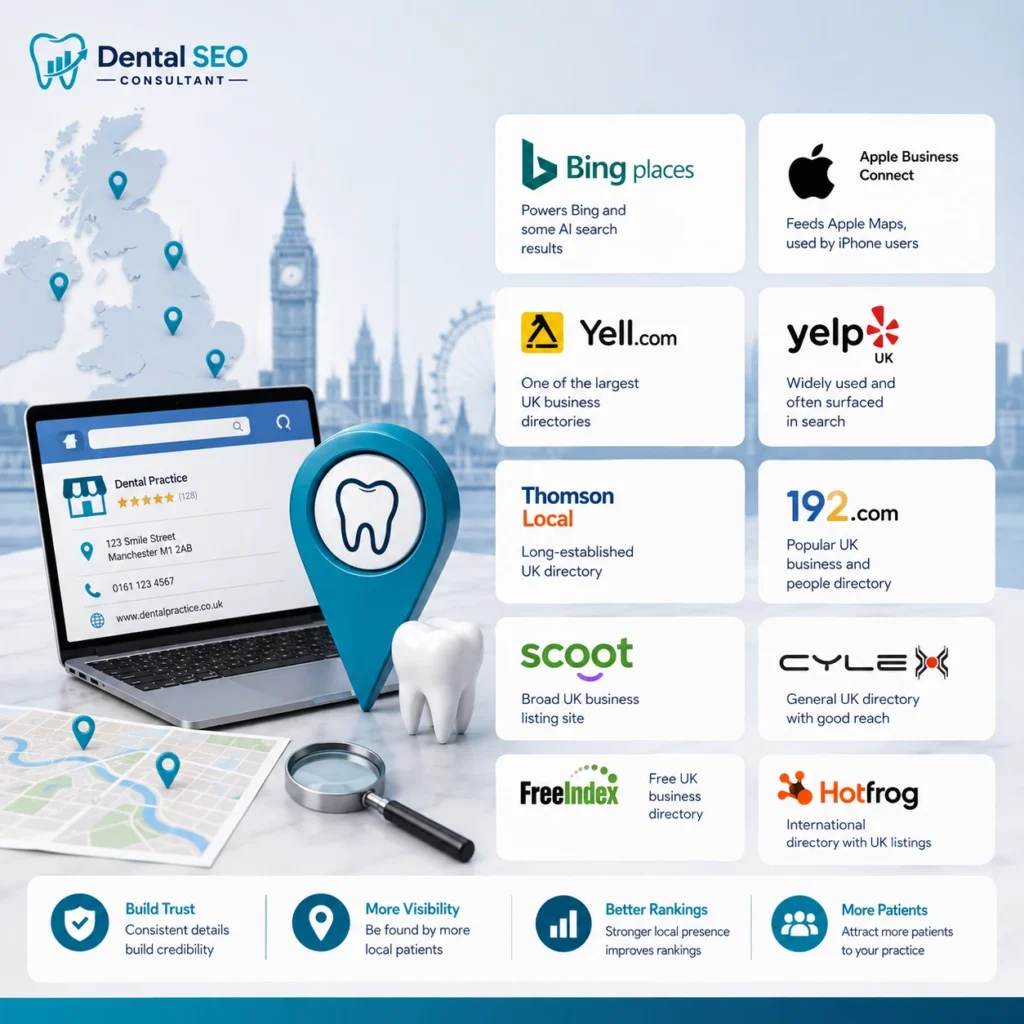
This is the practical part: where to list a UK dental practice. The directories below are grouped by type. List on the core general ones first, then the dental and health directories, then local sources. Use identical details on every one.
Core General Directories
These are the major directories every UK practice should be listed on, as they carry the most weight and reach.
| Directory | Notes |
|---|---|
| Bing Places | Powers Bing and some AI search results |
| Apple Business Connect | Feeds Apple Maps, used by iPhone users |
| Yell | One of the largest UK business directories |
| Yelp UK | Widely used and often surfaced in search |
| Thomson Local | Long-established UK directory |
| 192.com | Popular UK business and people directory |
| Scoot | Broad UK business listing site |
| Cylex UK | General UK directory with good reach |
| FreeIndex | Free UK business directory |
| Hotfrog | International directory with UK listings |
Dental and Health Directories
These are specific to dentistry and healthcare, so they carry strong relevance for a dental practice.
| Directory | Notes |
|---|---|
| NHS website | Essential for NHS and mixed practices, trusted source |
| Denplan | Widely used dental plan directory |
| Bupa dental finder | Health-brand directory patients trust |
| WhatClinic | Popular clinic comparison directory |
| Doctify | Healthcare review and listing platform |
You can list an NHS or mixed practice through the NHS website, which is one of the most trusted directories Google recognises for dental practices.
Private and cosmetic practices should also consider listings aimed at patients researching treatments. Clinic comparison and healthcare review platforms sit in this group, and they matter because patients seeking higher-value work like implants or cosmetic dentistry often research on them before choosing. The rule is the same as everywhere else: only list where the directory is genuine and relevant, and keep the details identical.
Local Directories and Sources
Local listings tie the practice to its area, which is exactly what local SEO is about.
- Local council business directories, where available.
- Local chamber of commerce listings.
- Local news and community websites that list businesses.
- Local sponsorship pages, if the practice supports community events.
Quality and relevance matter more than quantity here. A few genuine local citations often outweigh a long list of generic ones, because they tie the practice to the specific area it serves, which is exactly the signal local search rewards.
How to Build Citations Correctly
Building citations is simple in principle but easy to get wrong. The golden rule is consistency: your name, address and phone number must be identical on every listing, down to the formatting.
Follow this process:
- Decide your exact NAP format first, matching your website and Google Business Profile precisely.
- Work through the directory list above, creating or claiming each listing with those exact details.
- Use the same business name, without adding keywords or locations that do not belong in it.
- Keep a record of every directory you list on, so you can update them all if details change.
Getting the format right at the start saves hours of cleanup later. This groundwork sits alongside the technical side of a site, which is covered under website SEO.
Free vs Paid Directory Listings for Dentists
Many directories offer both a free listing and a paid upgrade. For citation purposes, the free listing is usually all a practice needs. The ranking benefit comes from the consistent mention of your details, not from paying for a premium placement.
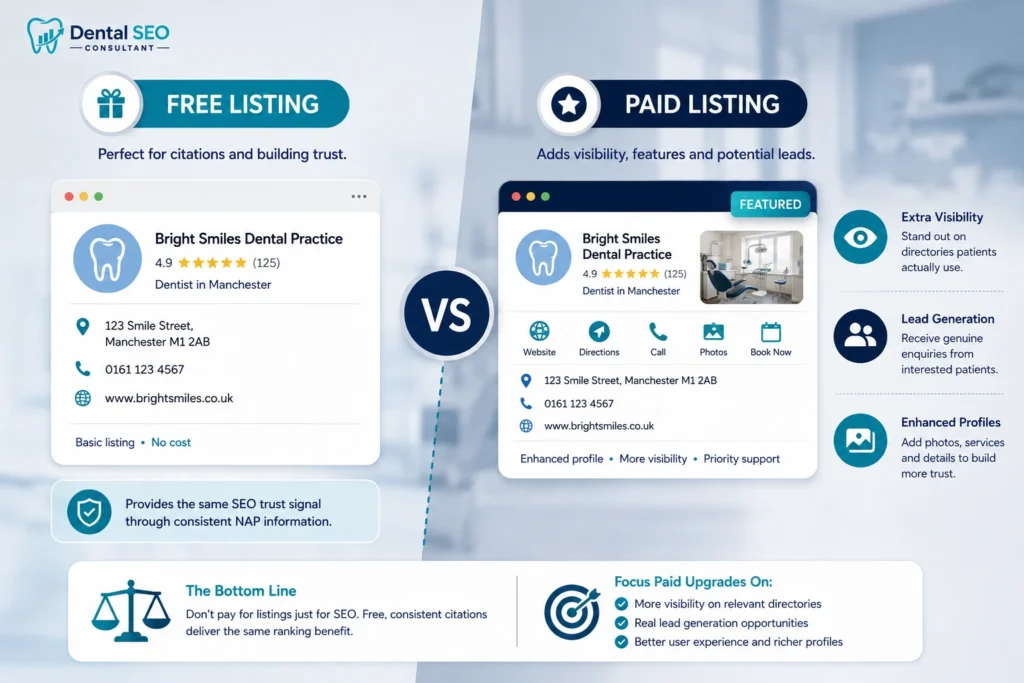
Paid listings can still be worth it in some cases, but for different reasons:
- Extra visibility on a directory patients actually browse, such as a busy clinic comparison site.
- Lead generation, where a directory sends genuine enquiries, not just a listing.
- Enhanced profiles with photos and richer information on relevant platforms.
The mistake is paying for listings purely to boost SEO. That is rarely worth it, since a free, consistent citation delivers the same trust signal. Treat paid upgrades as a marketing decision about visibility and leads, not as a ranking purchase. Consistent citations are one foundation of a wider dental SEO approach, not a shortcut on their own.
How to Audit and Clean Up Existing Citations
Most established practices already have citations, and many are inconsistent. An old phone number here, a former address there, or a duplicate listing can all weaken Google’s trust. Cleaning them up is often more valuable than adding new ones, because you are removing signals that are actively working against the practice rather than simply adding new ones on top. Practices that have moved premises, changed their name, or switched phone systems almost always have outdated listings somewhere.

To audit and fix them:
- Search for your practice name, old names, and phone numbers to find existing listings.
- Note every inconsistency, such as wrong addresses, old numbers or name variations.
- Correct or claim each listing so it matches your chosen NAP exactly.
- Remove or merge duplicates, which confuse Google and split your signals.
Inconsistent details are one of the most common hidden reasons a practice underperforms locally, and understanding how Google weighs these trust signals is covered in the guide to how Google ranks dental websites.
How Often Should You Review Your Citations?
Citations are not a one-off task. Details drift over time, and old listings resurface. A light review keeps them accurate without much effort.
A sensible routine:
- Check whenever details change, such as a new phone number, address or practice name, and update every listing straight away.
- Do a full audit once or twice a year, searching for new or duplicate listings that have appeared.
- Watch for auto-generated listings, which some directories create without your input and which may carry wrong details.
The biggest risk is a change that gets updated on the website and Google Business Profile but not on the directories, leaving conflicting details across the web. A simple record of every listing makes these updates quick. Keeping citations current is a small habit that protects the trust they build.
Citations, Reviews and the Bigger Local Picture
Citations do not work in isolation. They are one of several signals that build a practice’s local prominence, alongside reviews and links. Together they tell Google the practice is established and trusted in its area.
This is why citation work pairs naturally with earning reviews, and why both sit within a broader practice SEO strategy rather than standing alone. A practice with consistent citations, steady reviews and a strong profile covers the main prominence signals at once.
Common Citation Mistakes Dentists Make
The same errors undermine citation efforts again and again. Avoid these:
- Inconsistent NAP details, the single most damaging mistake.
- Duplicate listings on the same directory, which split and confuse signals.
- Adding keywords to the business name in listings, which breaches directory and Google rules.
- Chasing volume over quality, listing on spammy directories that add no value.
- Listing once and forgetting, so details go stale when the practice changes.
- Ignoring the NHS and dental directories, which carry the most relevance for a practice.
Most of these come down to a lack of consistency or a rush for quantity. Careful, accurate listings on the right directories beat a large number of careless ones.
FAQ
What are local citations for a dental practice?
Local citations are online mentions of a practice’s name, address and phone number, usually in business directories. They help Google confirm the practice is real, established and consistently located, which supports local ranking. Examples include the NHS website, Yell, Bing Places and dental directories like Denplan and WhatClinic.
Which directories should a UK dentist be listed on?
Start with core general directories like Bing Places, Apple Business Connect, Yell and Yelp. Add dental and health directories such as the NHS website, Denplan, Bupa dental finder, WhatClinic and Doctify. Then include local council, chamber of commerce and community listings. Use identical details on every one.
Do citations still help dental SEO?
Yes, though consistency matters more than volume now. Citations remain a trust and prominence signal for local search, helping confirm a practice is genuine and established. The value comes from accurate, consistent listings on relevant directories, not from listing on as many sites as possible.
What is NAP consistency and why does it matter?
NAP stands for name, address and phone number. Consistency means these details are identical everywhere the practice is listed. It matters because conflicting details make Google less certain about the practice, which can weaken local ranking. Even small differences, like a formatting change, can undermine trust.
How many citations does a dental practice need?
There is no fixed number. A practice listed accurately on the main general, dental and local directories is in a strong position. Consistency and relevance matter far more than a high count. A handful of accurate citations on trusted directories outperforms dozens of inconsistent or low-quality ones.
Should I fix old citations or build new ones?
Usually fixing old ones first is more valuable. Inconsistent or outdated listings actively weaken Google’s trust, so correcting them removes a hidden brake. Once existing citations are accurate and consistent, adding new listings on relevant directories builds further prominence.
Can bad citations hurt my dental practice’s ranking?
Yes, indirectly. Inconsistent details, such as an old address or phone number across different listings, make Google less certain about the practice, which can weaken local ranking. Duplicate listings and citations on spammy directories can also cause problems. This is why cleaning up existing citations is often more valuable than adding new ones.
Conclusion
Local citations are a quiet but genuine part of dental local SEO. Consistent listings on the right UK directories, from the NHS website and Bing Places to dental platforms like Denplan and WhatClinic, confirm to Google that a practice is real, established and correctly located. The rule that matters most is consistency: identical details everywhere, on the directories that count.
Work through the list, fix any inconsistencies first, then build from there. Citations are rarely the flashiest part of local SEO, but they are one of the easiest to get right and one of the most common to get wrong, which makes them a genuine opportunity for practices willing to be thorough. To see how your practice’s citations and local visibility compare with competitors, start with a free audit, which shows exactly where your local signals are strong and where they need work.