GDC and ASA Compliant Dental Marketing: The UK Rules in One Place
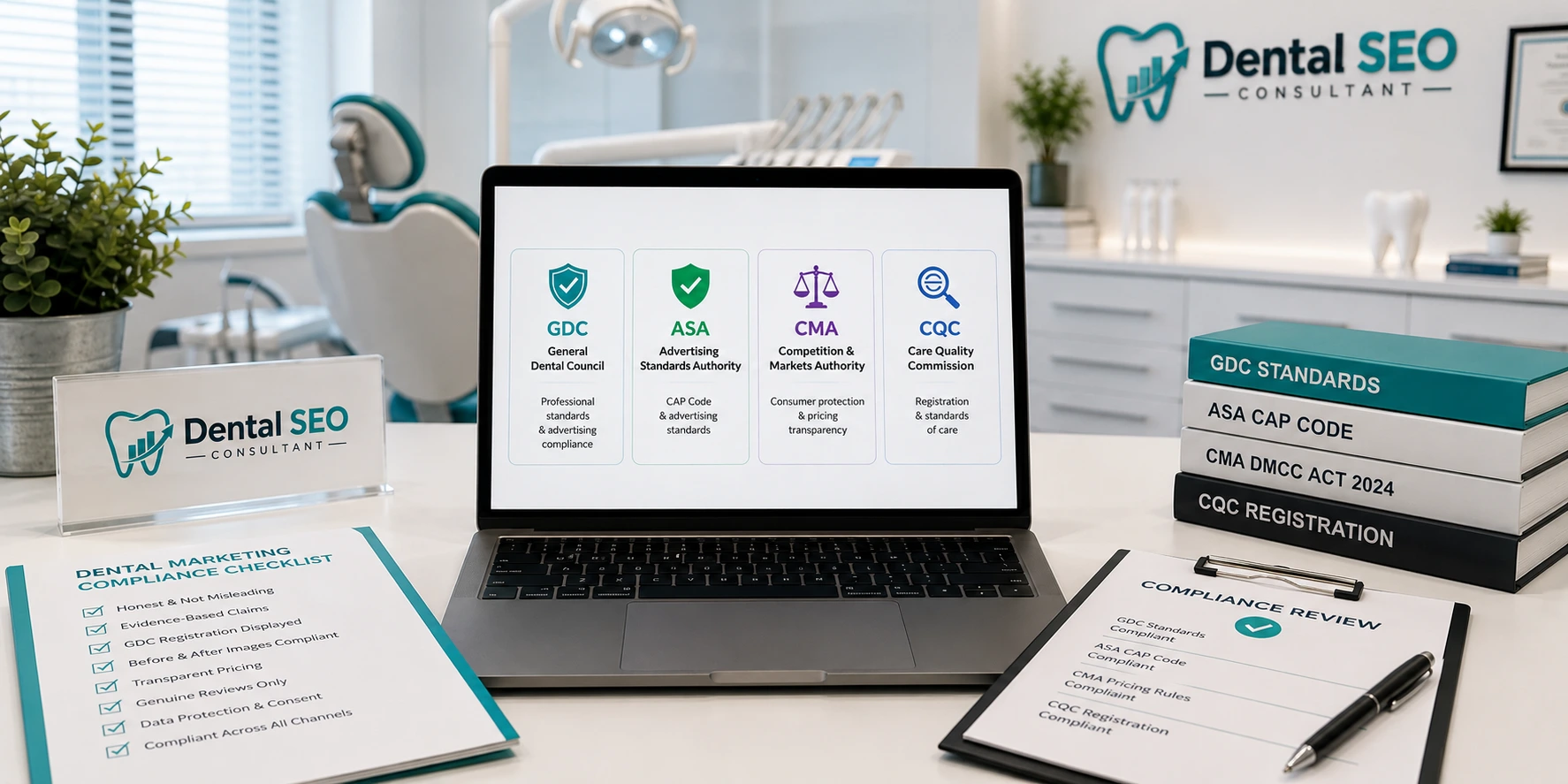
UK dental marketing is governed by four bodies. The GDC requires all advertising to be legal, decent, honest, truthful, and not misleading. The ASA enforces the CAP Code, which restricts misleading claims, unsubstantiated superlatives, and before-and-after images. The CMA, under the Digital Markets, Competition and Consumers Act 2024, now enforces pricing transparency and bans fake or incentivised reviews. The CQC requires practices to display their registration. In short, dental marketing must be honest, evidence-based, transparent about price, and never mislead a patient.
Introduction
Dental marketing in the UK is more tightly regulated than almost any other business advertising. A message that is perfectly legal for a plumber or a restaurant can breach professional standards and consumer law when a dentist says it. Many practices, and many marketing agencies, do not realise this until a complaint arrives.
This guide brings the rules together in one place. It covers what the GDC, the ASA, the CMA and the CQC each require, what dentists can and cannot say, and how to market a practice confidently without breaking the rules. It is written to be a practical reference, not legal advice, so a practice can check its marketing against it and know where it stands.
Who Regulates Dental Marketing in the UK?
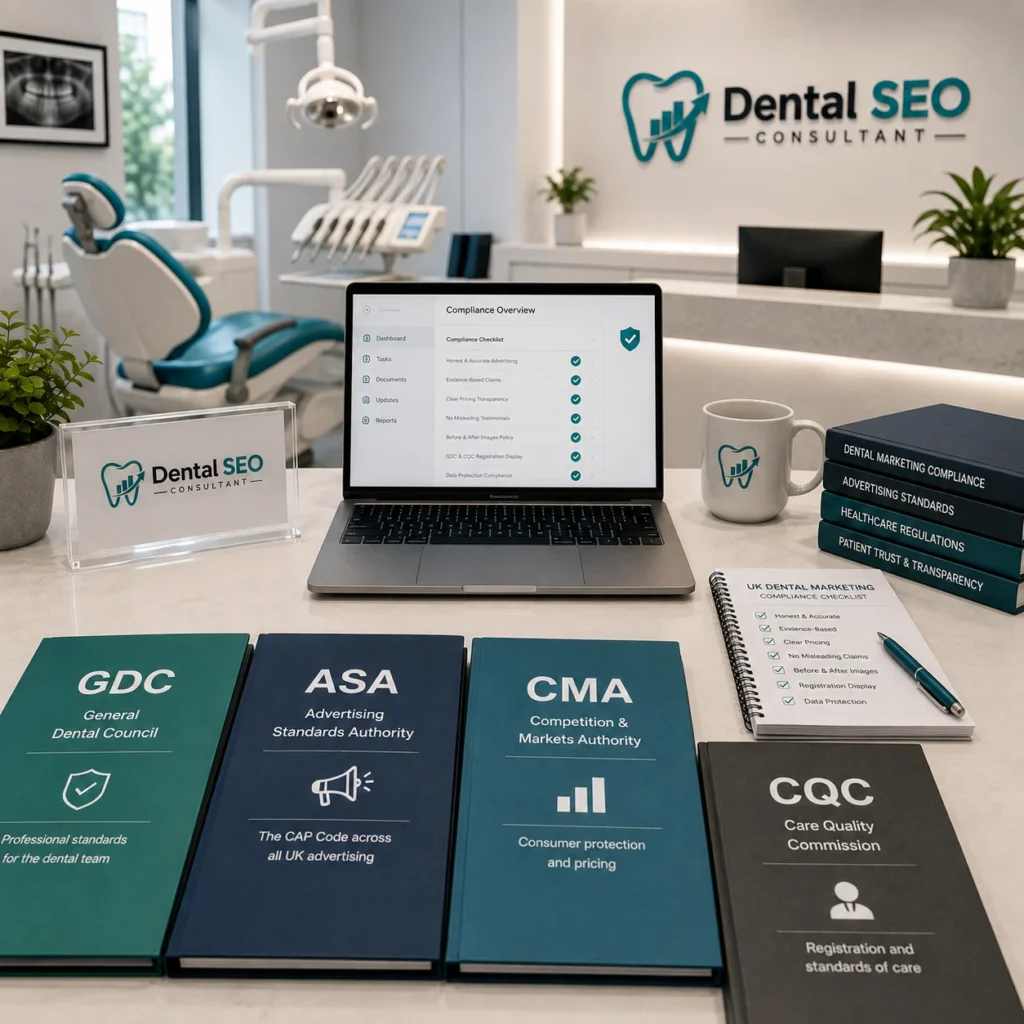
Four bodies shape what a UK dental practice can say in its marketing. Each covers a different angle, and a single advert or web page has to satisfy all of them at once.
| Regulator | What it governs | Main concern |
|---|---|---|
| GDC (General Dental Council) | Professional standards for the dental team | Honest, accurate, not misleading advertising |
| ASA (Advertising Standards Authority) | The CAP Code across all UK advertising | Misleading claims, evidence, before-and-after images |
| CMA (Competition and Markets Authority) | Consumer protection and pricing | Pricing transparency, hidden fees, fake reviews |
| CQC (Care Quality Commission) | Registration and standards of care | Displaying registration, transparency |
No single rulebook covers everything, which is why dental marketing is so easy to get wrong. The sections below explain each regulator’s rules in turn, while choosing the right dental SEO company can also help ensure your marketing approach supports compliant, accurate claims.
GDC Rules for Dental Marketing
The General Dental Council sets the professional standards for everyone on the dental team. Its “Standards for the Dental Team” and separate “Guidance on Advertising” require that any marketing a practice produces is legal, decent, honest and truthful, and never misleading. Advertising that misleads patients can trigger a fitness-to-practise investigation, and in serious cases can be a criminal offence.
Advertising Must Be Honest and Not Misleading
This is the foundation of every GDC rule. Marketing must put the patient’s interests first and give accurate information they can rely on. Exaggeration, implied guarantees, and anything that could give a false impression all fall foul of this principle, however small they seem.
The “Specialist” Restriction
The word “specialist” is protected. Only a dentist entered on the GDC’s specialist list for a recognised field, such as orthodontics or oral surgery, may describe themselves as a specialist in it. Using “specialist”, “specialises in”, or an invented field like “implant specialist” when the dentist is not on the relevant list is a clear breach.
Testimonials and Patient Reviews
This is the area practices get wrong most often. Patient testimonials carry serious risk under GDC and ASA rules, because they frequently contain claims that cannot be substantiated and can mislead. Many practices avoid publishing patient testimonials in their advertising altogether for this reason.
Genuine third-party reviews, such as Google reviews, are treated differently from testimonials a practice writes into its own adverts. A practice can encourage patients to leave honest reviews, but it cannot cherry-pick or edit them to mislead, and it must not offer incentives in exchange for them. When in doubt, the safe approach is to rely on genuine, unedited third-party reviews rather than curated testimonials.
Displaying Registration and Credentials
Practices must be transparent about who provides care. That means displaying that the practice is regulated by the GDC, showing each clinician’s GDC registration number, and stating qualifications accurately. These trust signals are both a professional requirement and a benefit to marketing, since they reassure patients and support search visibility.
ASA and the CAP Code: Advertising Rules for Dentists
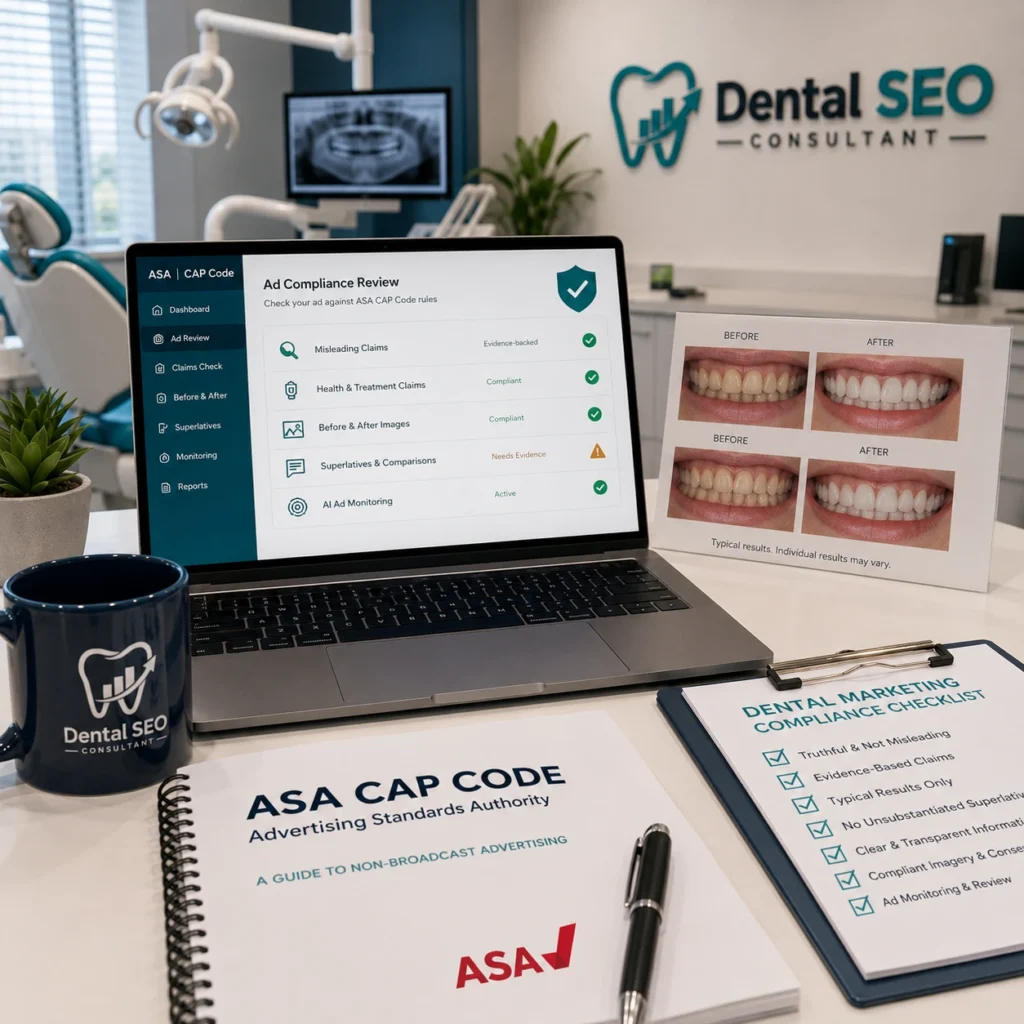
The Advertising Standards Authority enforces the CAP Code across all non-broadcast advertising, which includes websites, social media, Google Ads, leaflets and any promotional material. Several of its rules apply directly to dental marketing.
Misleading Claims and Substantiation
Two core rules matter most. The rule against misleading advertising means claims must not deceive, and the substantiation rule means any objective claim must be backed by evidence held before the advert runs. If a practice claims a result, it must be able to prove it.
Health and Treatment Claims
Dental treatment involves health claims, which the CAP Code scrutinises closely. Statements about what a treatment achieves must be accurate and evidence-based. Promising a specific outcome, a “painless” procedure, or implying results that are not typical are common ways practices breach this.
Before-and-After Images
Before-and-after photographs are allowed, but tightly controlled. They must represent typical, realistic outcomes rather than exceptional ones, must not be edited to exaggerate, and require the patient’s proper consent. Images that imply everyone will achieve the same result can be challenged. Note that some social platforms also restrict this kind of imagery in paid ads.
Superlatives and Comparisons
Claims like “the best dentist in the area” or “the leading implant clinic” need real, objective evidence to support them. Unsubstantiated superlatives are a frequent source of ASA complaints. If a practice cannot prove a claim with verifiable data, awards, or evidence, it should not make it.
AI-Powered Ad Monitoring
The ASA now uses AI-driven monitoring that can detect and investigate non-compliant adverts automatically, without waiting for a member of the public to complain. This means a practice’s ads can be flagged within days of going live, so compliance can no longer be treated as a low risk that only matters if someone objects.
CMA and the DMCC Act: Pricing Transparency Rules
This is the newest and least understood area, and the one most competitors ignore. The Digital Markets, Competition and Consumers Act 2024 came into force on 6 April 2025 and gave the Competition and Markets Authority powerful new consumer-protection tools, including the ability to impose fines of up to ten percent of global turnover without going to court.
For dental practices, the key requirements are:
- Pricing transparency. Practices must give patients enough pricing information to compare options before booking, not only reveal costs at the consultation.
- No drip pricing. Advertising a headline price and then adding compulsory fees later in the process is now specifically targeted.
- No fake or incentivised reviews. Fake reviews are illegal, and offering discounts or benefits for reviews without clear disclosure is a breach.
The CMA has shown direct interest in this sector, launching a market investigation into private dentistry in March 2026 that focuses on pricing transparency, hidden fees and misleading practices. Any practice advertising treatments should review how it presents prices in light of this, while ensuring its website SEO strategy supports clear and accessible information for patients. The specific costs a practice charges belong on its own pricing page, presented clearly and in full.
Other Rules: CQC, Data Protection and Finance
Three further areas complete the picture, each briefly:
- CQC. Practices must be registered with the Care Quality Commission and display that registration. It is both a legal duty and a trust signal.
- Data protection. Email and SMS marketing require consent under UK GDPR and the Data Protection Act, with a clear way to unsubscribe.
- Finance offers. Promoting “0% finance” or payment plans brings in Financial Conduct Authority rules, usually met by working through an FCA-authorised broker.
These sit alongside the GDC, ASA and CMA rules rather than replacing them, and a compliant practice keeps all of them in view.
How the Rules Apply Across Marketing Channels
The same rules apply everywhere a practice markets itself, but each channel raises its own compliance points. A message that passes on the website can still cause problems in a paid ad or a social post.
| Channel | Key compliance points |
|---|---|
| Website | Display GDC and CQC registration, credentials, clear full pricing, complaints procedure |
| Google Ads | Ad copy is advertising; no “specialist” misuse, no guarantees, honest claims |
| Social media | Same claim rules apply; platforms add their own limits on before-and-after images |
| Email and SMS | Consent required, clear unsubscribe, no misleading offers |
| Google reviews | Encourage genuine reviews only, no incentives, no editing or cherry-picking |
The mistake many practices make is assuming compliance is about the website alone. In reality, every touchpoint is advertising in the eyes of the regulators, and the ASA’s automated monitoring now covers paid ads and social posts as closely as web pages. A compliant practice applies the same standard consistently across all of them.
What Dentists Can and Cannot Say
The rules are clearest with examples. The table below shows common marketing messages and whether they are compliant, based on the principles above.
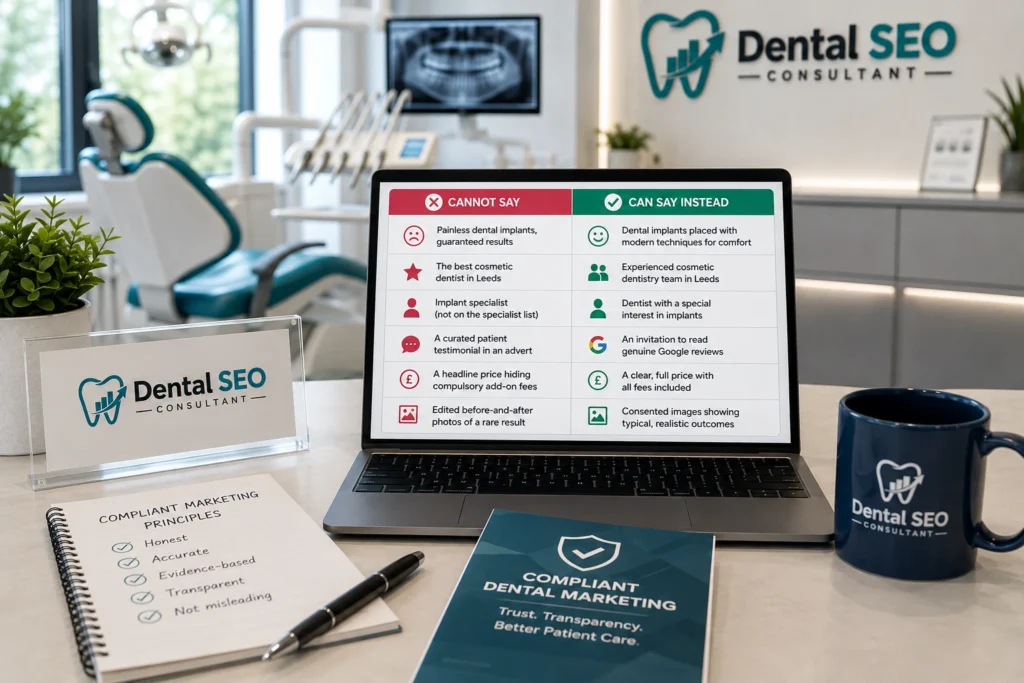
| Cannot say | Can say instead |
|---|---|
| “Painless dental implants, guaranteed results” | “Dental implants placed with modern techniques for comfort” |
| “The best cosmetic dentist in Leeds” | “Experienced cosmetic dentistry team in Leeds” |
| “Implant specialist” (not on the specialist list) | “Dentist with a special interest in implants” |
| A curated patient testimonial in an advert | An invitation to read genuine Google reviews |
| A headline price hiding compulsory add-on fees | A clear, full price with all fees included |
| Edited before-and-after photos of a rare result | Consented images showing typical, realistic outcomes |
The pattern is consistent. Factual, evidence-based, transparent language is safe. Superlatives, guarantees, hidden costs, and curated claims are not. These principles should also guide your dental practice SEO content.
A Dental Marketing Compliance Checklist
Use this checklist to review any advert, web page or social post before it goes live:
- Is every claim honest, accurate and not misleading?
- Can each objective claim be backed by evidence you already hold?
- Is “specialist” used only where the dentist is on the GDC specialist list?
- Are testimonials avoided, and genuine reviews used honestly and without incentives?
- Do before-and-after images show typical results, with patient consent?
- Are prices clear and complete, with no hidden or compulsory add-on fees?
- Are GDC registration, CQC registration, and clinician credentials displayed?
- Do email and SMS campaigns have consent and an unsubscribe option?
If any answer is no, the material needs fixing before it is published.
Why Compliance Is a Marketing Advantage, Not Just a Rule
It is easy to see these rules as constraints. In practice, they are an advantage for the practices that take them seriously. Most competitors, and most generic agencies, treat compliance as an afterthought, which leaves an opening.
Compliant marketing builds trust, and trust is exactly what a patient is looking for when choosing who to let treat them. Displaying credentials, being transparent about price, and relying on genuine reviews rather than hype signals a practice that is confident and honest. It also reduces real risk, from ASA rulings to CMA fines to fitness-to-practise investigations.
A practice that markets itself well within the rules ends up looking more credible than one making bolder but riskier claims. That credibility is part of what a specialist, compliance-led approach is built to protect, and it is central to how this practice approaches its work.
FAQ
Can dentists use patient testimonials in the UK?
Patient testimonials carry serious risk under GDC and ASA rules, because they often contain claims that cannot be substantiated and may mislead. Many practices avoid publishing them entirely. Genuine third-party reviews, such as Google reviews, are treated differently and can be used, provided they are not edited, cherry-picked or incentivised.
Can dentists use patient testimonials in the UK?
Patient testimonials carry serious risk under GDC and ASA rules, because they often contain claims that cannot be substantiated and may mislead. Many practices avoid publishing them entirely. Genuine third-party reviews, such as Google reviews, are treated differently and can be used, provided they are not edited, cherry-picked or incentivised.
What are the GDC rules on dental advertising?
The GDC requires all dental advertising to be legal, decent, honest, truthful and not misleading, and to put patients’ interests first. It restricts the use of “specialist” to dentists on the GDC specialist list, and requires practices to display GDC registration and accurate credentials. Misleading advertising can trigger a fitness-to-practise investigation.
Can dentists use before-and-after photos?
Yes, but with strict conditions. Before-and-after images must show typical, realistic outcomes rather than exceptional ones, must not be edited to exaggerate, and must have the patient’s consent. Images implying everyone achieves the same result can be challenged by the ASA. Some social media platforms also restrict this imagery in paid adverts.
What does the DMCC Act mean for dental pricing?
The Digital Markets, Competition and Consumers Act 2024, in force since April 2025, requires clear pricing and bans drip pricing, where compulsory fees are hidden until later. It also makes fake and undisclosed incentivised reviews illegal. The CMA can now fine businesses up to ten percent of global turnover without going to court, and is actively investigating private dentistry.
Do dental marketing agencies need to know these rules?
Yes. A generic marketing agency that does not understand GDC, ASA, and CMA rules can create content that breaches them, and the practice, not the agency, carries the professional risk. This is why dental practices should use marketing help that understands healthcare regulation, not just general SEO.
Is compliant dental marketing less effective?
No, it is usually more effective. Compliant marketing builds patient trust through honesty, transparency, and genuine reviews, which is exactly what patients look for in a healthcare provider. It also avoids the cost and reputational damage of ASA rulings, CMA action or GDC investigations. Compliance and results work together, not against each other.
What happens if a dental practice breaks the advertising rules?
The consequences depend on which rule is breached. The ASA can rule against an advert and require it to be withdrawn, and its decisions are public. The GDC can open a fitness-to-practise investigation, which is serious for the clinician involved. The CMA can now impose large fines directly, without going to court. Beyond the penalties, a public ruling or investigation damages the trust a practice depends on.
Conclusion
Dental marketing in the UK has to satisfy four regulators at once. The GDC demands honesty and accuracy, the ASA restricts misleading claims and images, the CMA now enforces pricing transparency and bans fake reviews, and the CQC requires visible registration. Together they rule out hype, guarantees, hidden costs and curated testimonials, and reward factual, transparent, evidence-based marketing.
Getting this right is not just about avoiding penalties. It is a genuine advantage, because compliant marketing builds the trust that wins patients. To see how a compliance-led approach shapes everything this practice does, read more on the About page, or start with a free dental SEO audit to check your current marketing against the rules.