
Keyword Research for Dentists
Quick Answer
Keyword research for dentists means finding the actual words and questions patients type when they look for a dentist or treatment, then choosing which to target. Good research looks at four things: what patients search, how many search it, how hard it is to rank, and what they want when they search. The goal is to match each keyword to the right page, so the practice ranks for searches that bring real patients.
Introduction
Every piece of SEO starts with a simple question: what are patients actually searching for? Guessing wastes effort on words nobody types, or on terms so competitive a local practice cannot win them. Keyword research replaces the guess with evidence.
This guide explains how to do keyword research for a dental practice, from finding seed terms to mapping keywords to pages. It covers the types of dental keywords, how to read search intent, which free tools to use, and the mistakes to avoid. The aim is a practical method you can follow, not a theory lecture.
What Is Keyword Research for Dentists?
Keyword research is the process of finding and choosing the search terms a dental practice should target. It answers what patients search, how often, how competitive each term is, and what the searcher actually wants.
Done well, it points your content and pages at searches that bring patients, rather than at vanity terms that bring none. It is the starting point for the whole strategy covered in what dental SEO involves, because everything else builds on choosing the right targets first. Get the research right, and every later step has a clear aim; get it wrong and even excellent content is pointed at the wrong searches.
Why Keyword Research Matters for Dental Practices
Without research, a practice optimises blindly. It might chase a term with no searches, or one dominated by national brands it cannot outrank, and see no return. Research makes the effort count.

Three reasons it matters:
- It targets real demand. You build pages for searches patients actually make, not ones you assume they make.
- It matches effort to opportunity. You can pick winnable terms rather than burning time on the impossible ones.
- It shapes the whole site. The keywords you find decide which pages and content you need.
This is why research sits at the front of any dental SEO marketing plan. Skip it, and the rest of the work is aimed at a target you never checked. It is the cheapest step in SEO and the one that saves the most wasted effort later, because every page, article, and optimisation that follows depends on having chosen the right terms in the first place.
The Types of Dental Keywords
Dental keywords fall into a few groups, and a practice needs a mix. Knowing the types helps you research systematically rather than randomly.
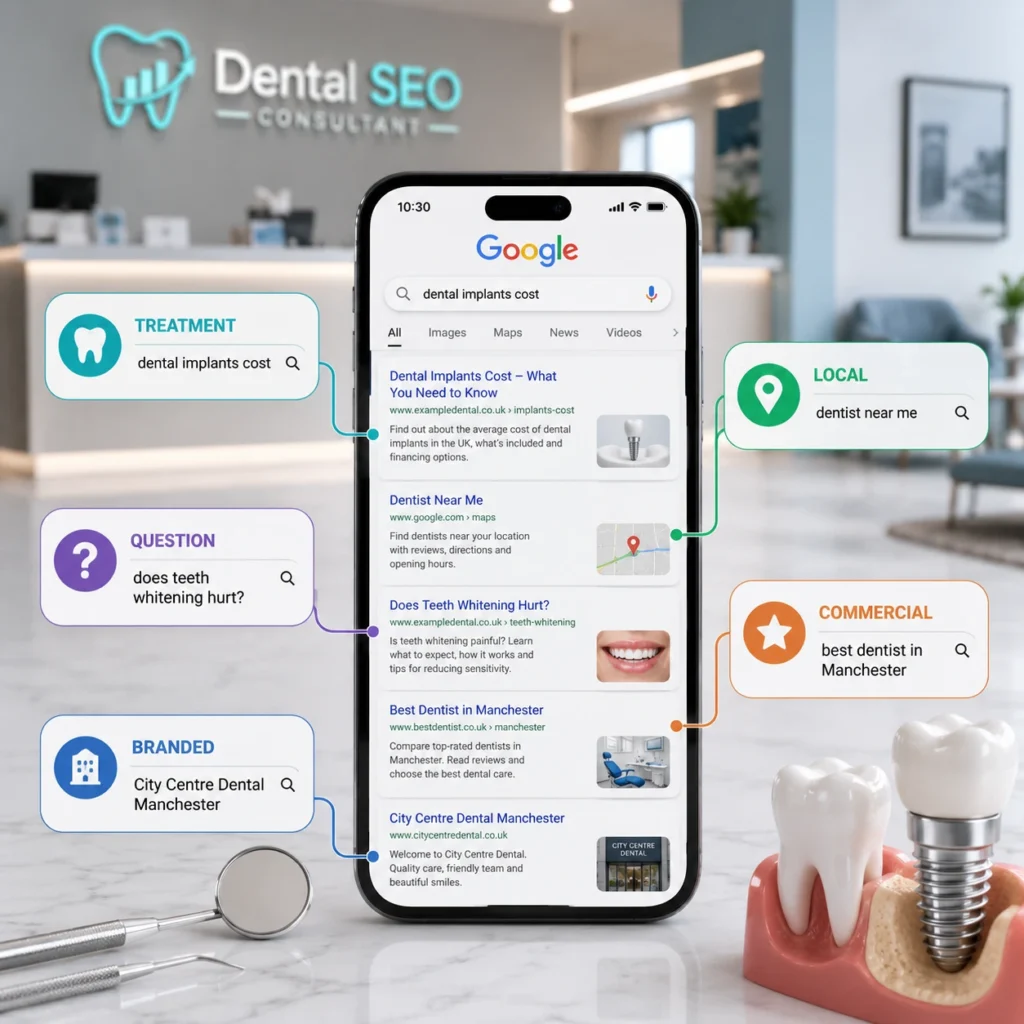
| Keyword type | Example pattern | What the searcher wants |
|---|---|---|
| Treatment | “dental implants cost” | Information on a specific treatment |
| Local | “dentist near me”, “dentist in [town]” | A nearby practice to visit |
| Question | “does teeth whitening hurt” | An answer, often before deciding |
| Commercial | “best dentist in [town]” | To compare and choose a practice |
| Branded | “[practice name]” | A specific practice they know |
Treatment and local keywords usually drive the most patients, question keywords build authority and feed AI answers, and commercial keywords capture people close to booking. A healthy strategy covers all of them. Most practices over-focus on a couple of obvious treatment terms and miss the local and question keywords that are easier to win and often convert better.
Search Intent: The Most Important Part
Volume and difficulty matter, but intent matters more. Search intent is what the person actually wants, and matching it is what makes a page rank and convert.
Someone searching “how much do implants cost” wants information, so an informative page fits. Someone searching “implant dentist [town]” wants to book, so a treatment or location page fits. Put the wrong type of page against a keyword, and it will not rank, however good it is. This is why intent, not just the keyword, decides where a term belongs, a principle that runs through on-page SEO too. Read the intent first, then choose the page.
A quick way to check intent is to search the term yourself and look at what already ranks. If Google shows service pages, the term is commercial. If it shows articles and guides, it is informational. Matching what Google already rewards for that term is far safer than guessing.
How to Do Keyword Research for a Dental Practice
Here is a practical, repeatable process. It moves from broad ideas to a final list mapped to pages.
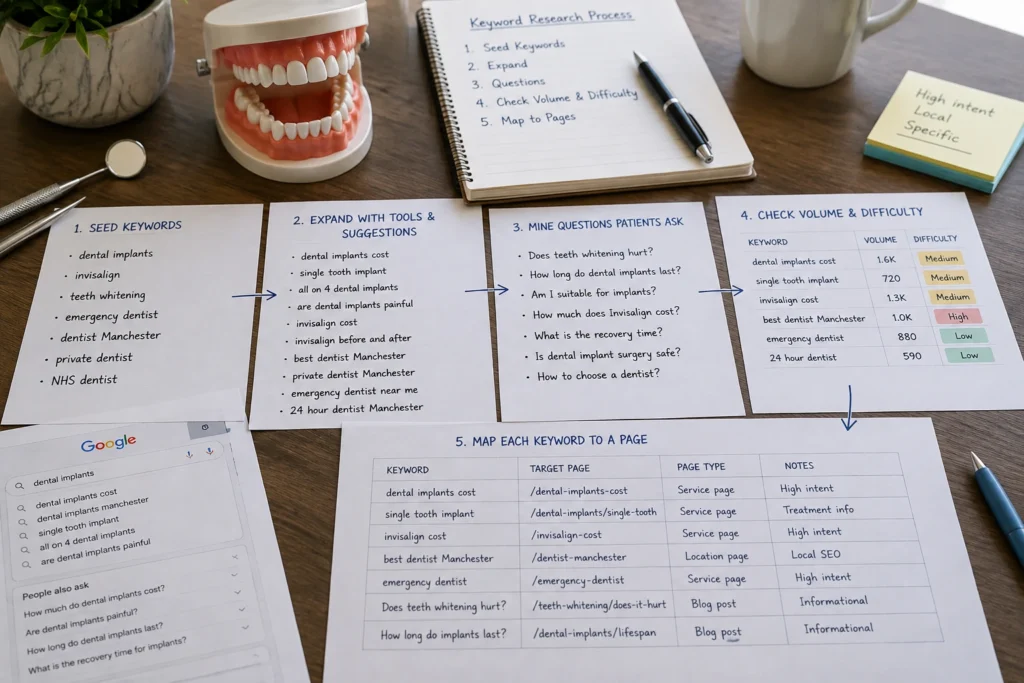
Start With Seed Keywords
Begin with the obvious terms: your treatments and your area. Implants, Invisalign, teeth whitening, emergency dentist, and your town names are all seeds. These are the roots the rest of the research grows from. You already know most of them from your own practice, so this step costs nothing but a few minutes of listing what you offer and where.
Expand With Tools and Suggestions
Take each seed and expand it. Google’s own autocomplete and “related searches” suggest real variations, and keyword tools generate more. This is how one seed like “dental implants” becomes dozens of specific terms patients actually use, from “dental implants cost” to “single tooth implant” to “are dental implants painful”. Each variation is a potential page or section.
Mine Questions Patients Ask
Questions are gold for dental content. Pull them from Google’s People Also Ask, from Answer the Public, from Google Business Profile reviews, and from forums like Reddit and Quora where patients speak plainly. These feed both content and AI answers, which is central to AI search visibility. Building this into the process is part of a wider practice SEO approach. The language patients use in reviews and forums is especially useful, because it is the real wording they type, not the polished terms a practice might assume they use.
Check Volume and Difficulty
For each candidate, look at roughly how many people search it and how hard it is to rank. A local practice usually wins more from specific, lower-competition terms than from broad, fiercely contested ones. Do not ignore low-volume keywords, since a handful of high-intent local searches can be worth more than a big generic one. A term like “emergency dentist [town]” may show modest volume but bring patients ready to book that day, which is worth far more than a high-volume term with no local or buying intent behind it.
Map Each Keyword to a Page
Finally, assign each keyword to one page. This is where research becomes strategy, and it is covered in its own section below because it is where most practices slip up.
Free and Paid Keyword Research Tools
You do not need expensive tools to start. A mix of free and paid options covers most needs.

| Tool | Use | Cost |
|---|---|---|
| Google Keyword Planner | Volume and keyword ideas | Free |
| Google Trends | Compare interest over time | Free |
| Google Search Console | See terms you already rank for | Free |
| People Also Ask | Find real questions | Free |
| Answer the Public | Question and phrase ideas | Free tier |
| Ahrefs or Semrush | Deep volume, difficulty, competitors | Paid |
Start with the free tools. Google Trends shows whether interest in a treatment is rising or seasonal, and Google Search Console reveals the searches already bringing you visitors, which are often the easiest to build on.
Dental SEO Keywords to Target
Rather than a fixed list, think in categories and research your own versions of each. The examples below show the kinds of terms most practices should look into, adapted to their treatments and area.
- Treatment terms: dental implants, Invisalign, teeth whitening, veneers, dentures, emergency dentist.
- Local terms: dentist plus your town, “dentist near me”, “private dentist [area]”, “NHS dentist [area]”. These matter most for a practice, since they tie directly to the local SEO that brings nearby patients.
- Cost and comparison terms: treatment plus “cost”, “price”, or “vs”, which capture people deciding.
- Question terms: “does it hurt”, “how long does it last”, “am I suitable for”, and similar.
Research the real volume and competition for your own versions before committing. The point is to find the specific terms that fit your treatments, your area, and your patients, not to copy a generic list.
How to Map Keywords to Your Dental Website
This is the step that turns research into results, and the one practices most often get wrong. Each keyword should have one clear home, and no two pages should chase the same term.
The mapping rules:
- One primary keyword per page, so pages do not compete with each other.
- Commercial and local terms go to service and location pages that can convert.
- Question and informational terms go to blog posts that inform and build authority.
- Avoid keyword cannibalisation, where two pages target the same term and both suffer.
Mapping keywords properly is what stops a site competing with itself, and it decides which searches each page can win, feeding directly into how Google judges relevance, as covered in how Google ranks dental sites. Local terms in particular should map cleanly, which ties into the local SEO checklist. A simple spreadsheet, listing each keyword against the one page that owns it, is all most practices need to keep this straight.
How Often Should You Redo Keyword Research?
Keyword research is not a one-off. What patients search changes over time, new treatments appear, competitors shift, and Google Search Console keeps revealing terms you did not expect to rank for.
A sensible rhythm:
- A full review once or twice a year, to catch new terms and changing demand.
- A quick check whenever you add a treatment or open a new location.
- An ongoing eye on Search Console, which shows real searches bringing visitors, often including terms worth building on.
The Search Console habit is the most valuable, because it is based on your own real data rather than estimates. Terms you already rank for on page two are frequently the easiest wins, and they only show up if you look. Treating research as a living process, not a one-time task, keeps a practice ahead as searches evolve.
Common Keyword Research Mistakes
Practices tend to trip on the same issues. Avoid these:
- Chasing volume alone, ignoring intent and competition.
- Targeting terms that are too broad for a local practice to win.
- Ignoring local and long-tail terms, which often convert best.
- Mapping several pages to one keyword, causing cannibalisation.
- Forgetting search intent, so the page type does not match the search.
- Never revisiting the research, as search behaviour and competition change.
Most of these come from picking keywords in isolation rather than as a mapped strategy. Research, then map, then build.
FAQ
What is keyword research for dentists?
Keyword research is finding and choosing the search terms a dental practice should target. It looks at what patients search, how often, how competitive each term is, and what the searcher wants. The result guides which pages and content the practice builds, so it ranks for searches that bring real patients rather than for terms nobody uses.
How do I find keywords for my dental practice?
Start with your treatments and area as seed terms, then expand them using Google autocomplete, related searches and keyword tools. Mine questions from People Also Ask, reviews and forums. Check volume and difficulty for each, favouring specific local terms, then map each keyword to one page. Free tools are enough to begin.
What are the best keywords for a dental website?
The best keywords are specific, local and high-intent, such as a treatment plus your town, or “dentist near me” style searches. These bring patients ready to act. Broad terms like “dentist” are usually too competitive for a local practice. The right keywords depend on your treatments, area and competition, which is why research matters.
Do low-volume keywords matter for dentists?
Yes, often a lot. A local practice can win specific, low-volume terms that national brands ignore, and these searches frequently carry high intent. A handful of people searching “emergency dentist [town]” can be worth more than many searching a broad, generic term. Do not dismiss a keyword just because its volume looks small.
What is keyword intent and why does it matter?
Search intent is what the person actually wants: information, comparison, or to book. It matters because the page type has to match. An informational question needs a helpful article, while a booking-ready search needs a service page. Matching intent is what makes a page both rank and convert, so it guides where each keyword belongs.
How many keywords should a dental page target?
Each page should have one primary keyword, plus closely related variations that mean the same thing. Targeting several unrelated keywords on one page weakens it, and using the same primary keyword on multiple pages makes them compete. One clear focus per page, supported by natural related terms, works best.
Do I need paid tools like Ahrefs for dental keyword research?
Not to start. Free tools like Google Keyword Planner, Google Trends, and Search Console, plus People Also Ask, cover the basics well. Paid tools like Ahrefs or Semrush add deeper data on difficulty and competitors, which helps as you scale, but a practice can do genuinely useful research without them.
What is keyword cannibalisation in dental SEO?
Keyword cannibalisation happens when two or more pages target the same keyword, so they compete with each other, and both rank worse than one strong page would. It is common on dental sites with several similar location or treatment pages. Mapping one primary keyword to one page is how you avoid it.
Conclusion
Keyword research is where dental SEO starts, and doing it well saves months of wasted effort. Find what patients actually search, understand what they want, check volume and competition, and map each term to one page. That mapped list becomes the plan for your whole site, from service pages to blog posts.
You can start today with free tools and your own knowledge of your treatments and area. Even an afternoon of proper research usually surfaces terms a practice had never thought to target, and rules out ones it was about to waste effort on. To turn that research into a full strategy, mapped to the right pages and aimed at the patients you want, a free dental SEO audit will show which keywords your practice should own and where the gaps are.