NHS vs Private Dental SEO: What’s Different?
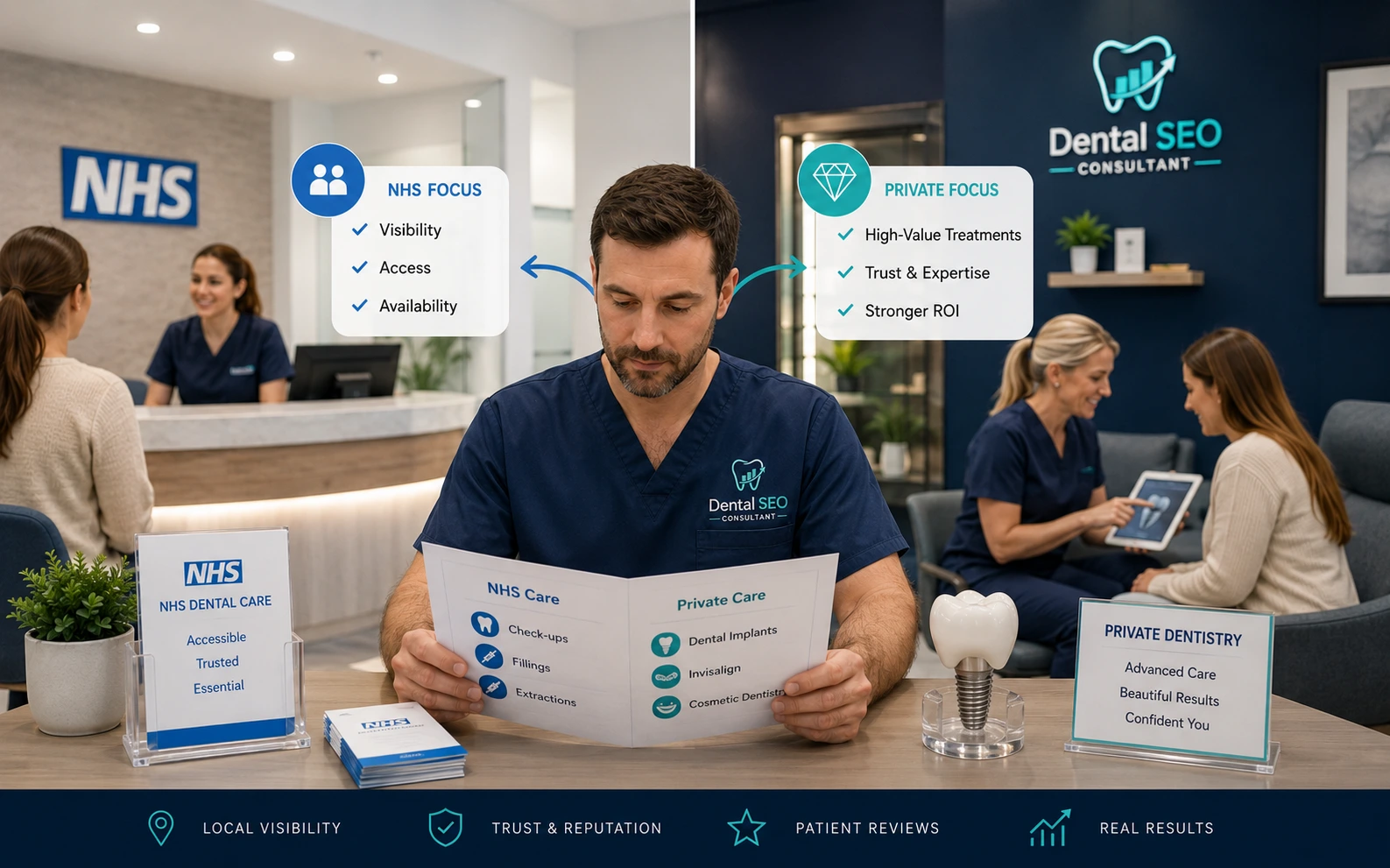
NHS and private dental practices need different SEO because they want different things. NHS practices often have more demand than capacity, so their SEO focuses on visibility and any private treatments they offer. Private practices compete hard for higher-value treatments like implants and cosmetic work, so their SEO leans on trust, competitive keywords, and return on investment. The local foundations, though, are the same for both.
Introduction
Not all dental practices need the same SEO. An NHS practice with a waiting list has a very different problem from a private practice trying to fill its implant diary. Treating both the same way wastes effort and misses what each actually needs.
This guide compares NHS and private dental SEO. It covers why they differ, what each type should focus on, how their keywords and competition vary, and what stays the same for both. Most UK practices are a mix of the two, so it also covers how to balance the two sides. The goal is to help you aim your SEO at what your practice really needs, rather than following generic advice that may fit neither.
NHS vs Private Dentistry: A Quick Recap
Before the SEO, a quick reminder of how the two differ, because that difference drives everything.
NHS dentistry is funded by the government, with patients paying fixed band charges set by the NHS. Demand usually outstrips supply, and many practices are not taking on new NHS patients. Private dentistry is paid for directly by the patient, priced per treatment, and covers everything from routine care to high-value cosmetic work. The economics of the two are completely different, and that is what changes the SEO. An NHS place is a low-margin, high-demand slot the practice may struggle to fill capacity for, while a private treatment is a higher-margin service the practice has to compete to win. This sits within the broader picture of what dental SEO involves for any practice.
Why SEO Differs for NHS and Private Practices
The core reason SEO differs comes down to two things: demand and margin. NHS treatment is in high demand but low margin, while private treatment is higher margin but must be actively won.
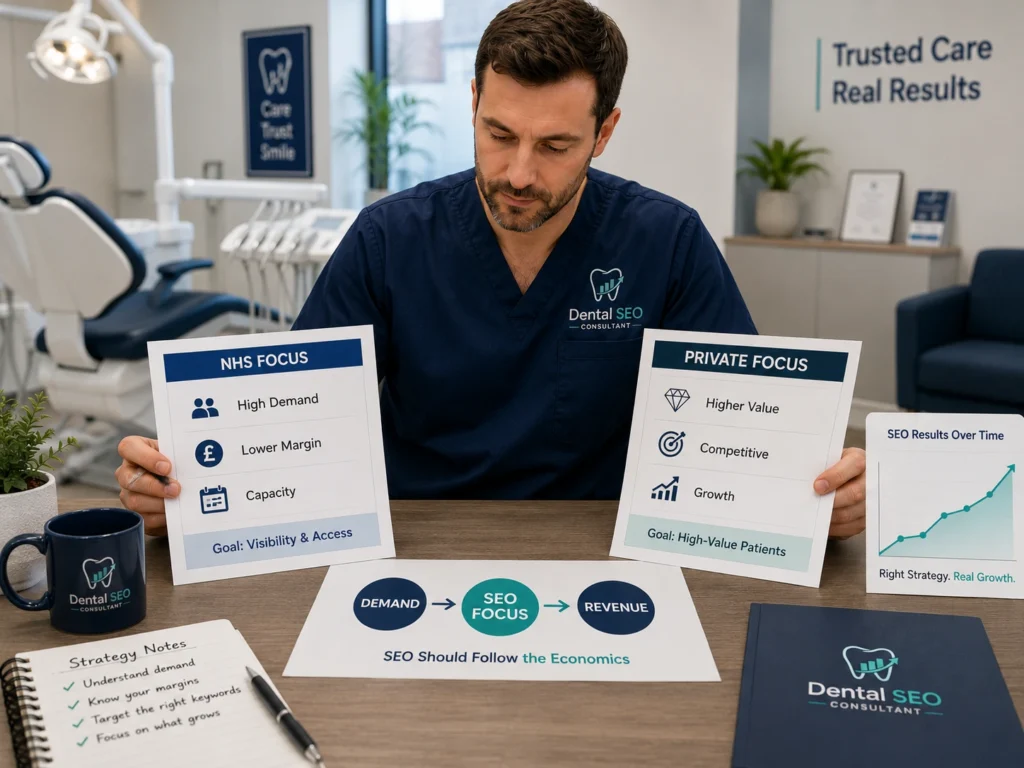
This changes the goal. For a fully NHS practice already at capacity, generating more NHS demand may not help, since it cannot take the patients. For a private practice, every extra high-value patient is worth chasing, because the return justifies the effort. SEO should follow the economics, which is why the same local SEO programme gets pointed at different goals depending on the practice.
It is worth being blunt about this, because a lot of generic dental SEO advice ignores it. Advice written for a private cosmetic practice can actively waste money for a busy NHS one, and advice written for an NHS practice can leave a private one competing far too gently. The starting question is not “how do I do dental SEO” but “what does my particular practice need from it”. That is where keyword research for dentists helps identify the searches that actually align with your practice and its commercial priorities.
NHS vs Private Dental SEO Compared
Here is how the two differ across the factors that matter for SEO. Most practices sit somewhere between these two columns.
| Factor | NHS focus | Private focus |
|---|---|---|
| Main goal | Visibility, fill private slots | Win high-value treatments |
| Demand | Usually exceeds capacity | Must be actively generated |
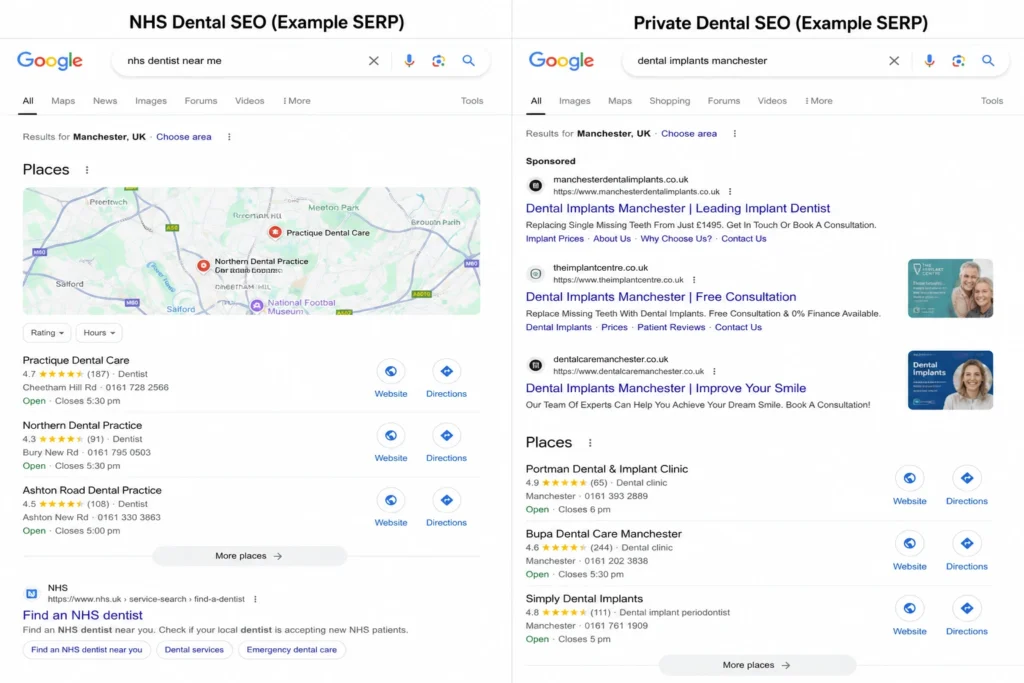
| Key keywords | “NHS dentist near me” | Treatment and cosmetic terms |
| Competition | Lower, demand-driven | High, especially cosmetic |
| ROI per patient | Low margin | High margin |
| Content focus | Access, availability | Trust, results, expertise |
The table shows why a one-size approach fails. The two ends of the market reward very different priorities, even though both practices are optimising the same kind of website. In practice, few sit fully in one column, but seeing the extremes clearly makes it easier to place your own practice somewhere sensible between them.
SEO for NHS Dental Practices
For an NHS-focused practice, SEO is less about generating demand and more about visibility, access, and channelling interest usefully.
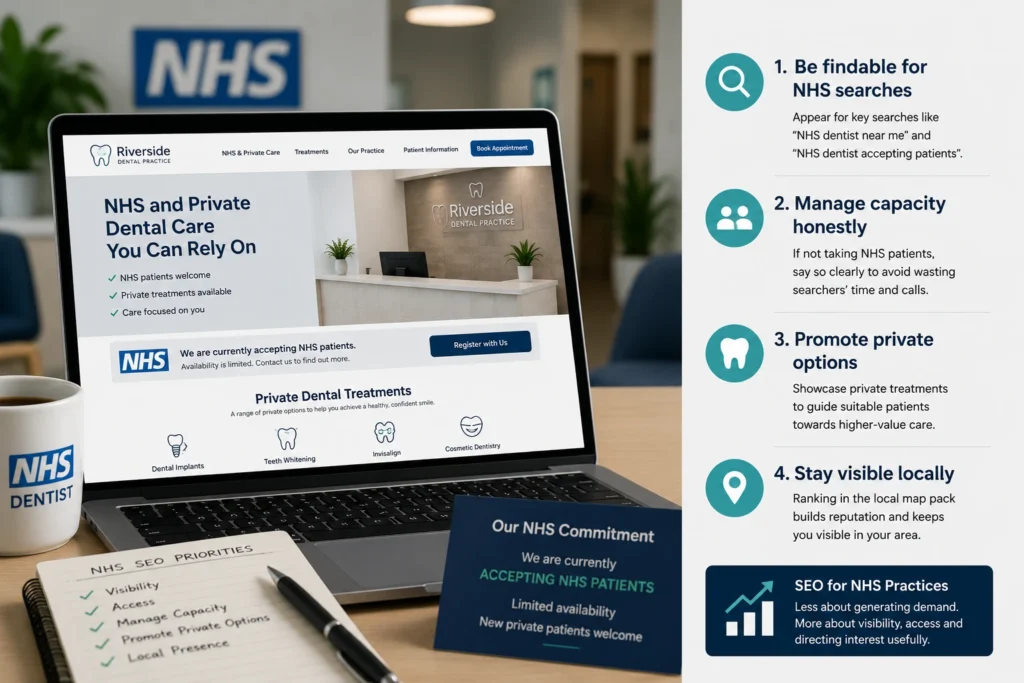
The priorities for NHS practices:
- Be findable for NHS searches. Terms like “NHS dentist near me” and “NHS dentist accepting patients” carry high volume, and appearing for them keeps the practice visible.
- Manage capacity honestly. If not taking NHS patients, the site should say so clearly, rather than frustrating searchers and generating wasted calls.
- Promote private options. Many NHS practices also offer private treatments, and SEO can steer suitable patients toward those higher-value services.
- Stay visible locally. Ranking in the map pack matters even when demand is high, because it shapes the practice’s reputation and reach.
The honest truth is that a busy NHS practice may get less direct return from aggressive SEO than a private one. The value is often in visibility, reputation and directing patients toward private treatments. That is not a reason to ignore SEO, but it is a reason to be realistic about what it will and will not do for a practice whose NHS list is already full.
SEO for Private Dental Practices
For a private practice, SEO is a genuine growth engine. Every high-value patient it brings can justify the investment many times over, so the effort is well rewarded. A practice that ranks well for implant or Invisalign searches in its area can add a level of revenue that dwarfs what the SEO costs.

The priorities for private practices:
- Target high-value treatment keywords. Implants, Invisalign, veneers, and cosmetic terms are where the return is, and they deserve dedicated, well-optimised pages.
- Compete on trust and expertise. Private patients are choosing to spend, so credentials, results and reputation carry huge weight, which is where strong E-E-A-T matters.
- Handle a competitive market. Cosmetic keywords are fiercely contested, so private practices need thorough content, technical strength, and authority to win them.
- Market compliantly. Cosmetic claims, before-and-after images and testimonials are tightly regulated, so private marketing must follow the advertising rules carefully.
Private SEO is where the real commercial upside sits, and where a considered dental SEO marketing approach pays off most.
SEO for Mixed NHS and Private Practices
Most UK practices are neither purely NHS nor purely private. They offer NHS care alongside private treatments, which means their SEO has to serve both goals at once.
For a mixed practice, the sensible approach is to stay visible for NHS searches while actively promoting private treatments where the return is higher. The website should make both offerings clear, with strong pages for private treatments and honest information about NHS availability. Reviews help both sides, since a strong reputation reassures every kind of patient, which is why earning reviews matters whatever the mix. The balance depends on the practice’s own capacity and goals.
A common and effective pattern for mixed practices is to use NHS visibility as the front door and private treatments as the growth engine. Patients often arrive searching for NHS care, then convert to private treatments over time as they build trust with the practice. Good SEO supports that journey by being findable for NHS searches while clearly presenting the private options a patient might choose later.
Keywords: NHS vs Private
The clearest difference between NHS and private SEO shows up in keywords. They attract different searchers with different intent.
| Keyword type | NHS example | Private example |
|---|---|---|
| Access | “NHS dentist accepting patients” | “private dentist [town]” |
| Treatment | “NHS dental checkup” | “dental implants [town]” |
| Cosmetic | Rarely relevant | “veneers”, “smile makeover” |
| Intent | Find available NHS care | Choose and book private care |
The table shows why a one-size approach fails. The two ends of the market reward very different priorities, even though both practices are optimising the same kind of website. In practice, few sit fully in one column, but seeing the extremes clearly makes it easier to place your own practice somewhere sensible between them. Whichever model you follow, avoiding common technical SEO mistakes is essential to ensure your strategy is not undermined by problems with the website itself.
NHS keywords tend to be about access and availability, while private keywords are about specific treatments and choosing a provider. Researching and mapping these correctly is part of a sound practice SEO strategy, and it decides which searches each page targets. A useful check is the intent behind each term: NHS searchers often just want to find care they can access, while private searchers are comparing providers and treatments before spending, and the page each lands on should match that mindset.
Which Matters More: NHS or Private SEO?
For most practices, private SEO delivers the stronger return, simply because the margin per patient is higher. A single implant or Invisalign patient can be worth many routine NHS appointments.
That does not make NHS SEO pointless. Visibility, reputation and directing patients toward private options all have value. But when deciding where to invest, the economics usually favour the private side, because that is where SEO effort turns into meaningful revenue. This is the same return-on-investment thinking covered in whether dental SEO is worth it, applied to the NHS and private split. The right balance depends on your capacity, your goals, and how much private work you want to grow.
There is also a longer-term angle. Building visibility and reputation now, even for an NHS practice at capacity, pays off if the practice later shifts more toward private work, as many UK practices are doing. SEO built today becomes the foundation that private growth stands on tomorrow, so the NHS and private question is partly about where the practice is heading, not just where it is now.
What Stays the Same for Both
For all their differences, NHS and private practices share the same SEO foundations. The economics change the priorities, not the fundamentals.
Both need:
- Strong local SEO, since patients of every kind search locally, all covered in the local SEO checklist.
- An optimised Google Business Profile and a steady flow of genuine reviews.
- A fast, technically sound, mobile-friendly website.
- Compliant marketing that follows the General Dental Council and ASA rules.
- Accurate, useful content that answers what patients ask.
These foundations serve every practice. The difference is only in what you build on top of them and which searches you prioritise.
How to Decide Where to Focus Your Dental SEO
The right split between NHS and private SEO is a decision, not a default. A few honest questions point most practices to the answer.
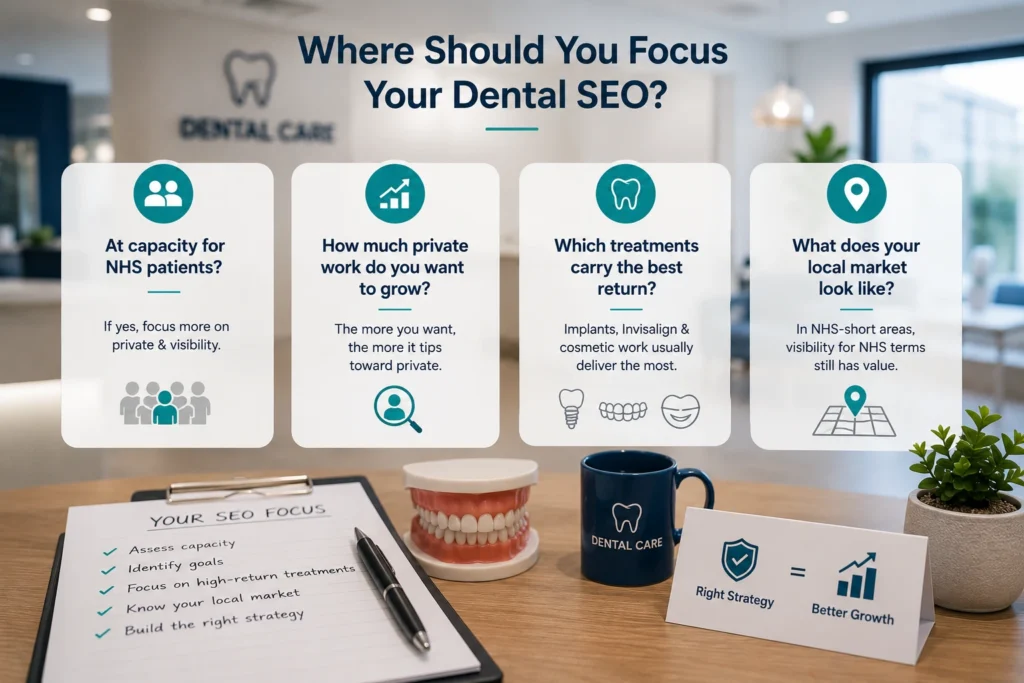
Ask yourself:
- Are you at capacity for NHS patients? If yes, generating more NHS demand adds little, so lean toward private and visibility.
- How much private work do you want to grow? The more you want, the more the balance tips toward private treatment keywords.
- Which treatments carry the best return? Implants, Invisalign, and cosmetic work usually justify the most SEO effort.
- What does your local market look like? In areas short of NHS dentists, being visible for NHS terms still has real value.
The answers rarely point to a pure NHS or pure private strategy. Most land on a mix, weighted toward whichever side matches the practice’s capacity and growth goals. Deciding this deliberately, rather than optimising for everything at once, is what makes the SEO effective. It is also worth considering AI search for dentists as search behaviour evolves beyond traditional Google results.
Common Mistakes with NHS and Private Dental SEO
Practices tend to slip up in predictable ways when their SEO ignores the NHS and private distinction:
- Generating NHS demand they cannot meet, wasting effort and frustrating patients.
- Hiding private treatments, missing the higher-return work SEO could bring.
- Treating cosmetic keywords casually, when they are the most competitive of all.
- Ignoring NHS availability messaging, leaving searchers confused about whether they can book.
- Applying the same strategy to a mixed practice without deciding where the priority sits.
Avoiding these comes down to being clear about what the practice actually wants from SEO, then aiming the effort there rather than spreading it thinly across goals that pull in different directions.
FAQ
What is the difference between NHS and private dental SEO?
NHS dental SEO focuses on visibility and access, since NHS practices often have more demand than capacity. Private dental SEO focuses on winning higher-value treatments like implants and cosmetic work, competing on trust and expertise. The local foundations are the same, but the goals, keywords, and return on investment differ significantly between the two.
Do NHS dental practices need SEO?
Yes, though the goal differs. An NHS practice at capacity may not need more NHS demand, but SEO still keeps it visible, protects its reputation, and channels suitable patients toward private treatments it offers. Even a busy NHS practice benefits from ranking locally and being easy to find, so SEO retains real value.
Is dental SEO more worth it for private practices?
Usually, yes. Private treatments carry higher margins, so each patient SEO brings is worth more, which makes the return on investment stronger. A single implant or Invisalign patient can outweigh many routine NHS appointments. NHS SEO still has value for visibility and reputation, but the clearest financial return tends to come from the private side.
What keywords should an NHS dentist target?
NHS practices should target access and availability terms like “NHS dentist near me” and “NHS dentist accepting patients”, plus their local area. If they offer private treatments too, they should also target those treatment terms. The focus is on being found by patients looking for NHS care and steering suitable ones toward private options.
How should a mixed NHS and private practice approach SEO?
A mixed practice should stay visible for NHS searches while actively promoting its private treatments, where the return is higher. The website should clearly present both, with strong pages for private work and honest information on NHS availability. The exact balance depends on the practice’s capacity and how much private growth it wants.
Does local SEO matter for both NHS and private dentists?
Yes, strongly. Patients of every kind search locally, so ranking in the map pack and local results matters whether a practice is NHS, private or mixed. Local SEO, a strong Google Business Profile and genuine reviews are shared foundations that benefit every type of practice, regardless of how the rest of the strategy differs.
Should an NHS practice at capacity still invest in SEO?
It depends on the goal. If the aim is more NHS patients, there is little point when already full. But SEO still protects visibility and reputation, and it can steer suitable patients toward private treatments the practice offers. Many capacity-limited NHS practices use SEO mainly to grow their private side rather than their NHS list.
Are cosmetic dental keywords harder to rank for?
Generally yes. Cosmetic and high-value treatment terms like implants and veneers are among the most competitive in dentistry, because the return attracts serious marketing from many practices. Winning them takes thorough content, strong technical SEO, genuine authority, and trust signals. This is why private practices targeting cosmetic work usually need the most sustained SEO effort.
Conclusion
NHS and private dental SEO differ because the practices want different things. NHS practices lean on visibility, access, and steering patients toward private options, while private practices chase higher-value treatments through competitive keywords, trust, and expertise. Most UK practices sit in between and need to balance the two, deciding where the priority and the return really lie.
What stays constant is the foundation: strong local SEO, a solid website, genuine reviews, and compliant marketing serve every practice. The difference is only in where you aim that foundation and how hard you compete for the treatments that matter to your practice. To work out where your own practice should focus- NHS, private, or a mix a free dental SEO audit will show where your visibility stands and where the biggest opportunities are.