Link Building for Dental Practices (UK Guide)
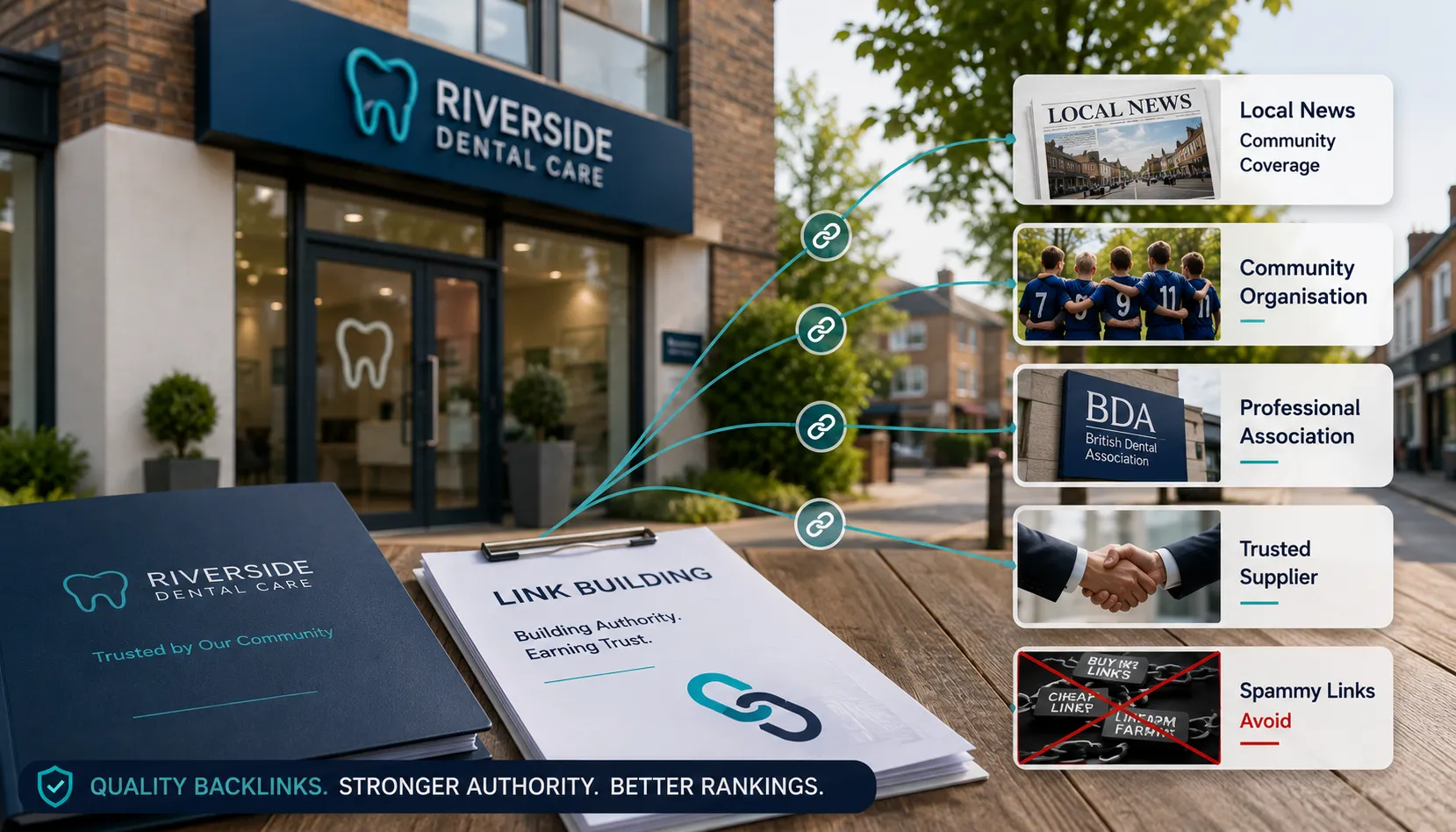
Link building for a dental practice means earning links from other websites back to yours, because Google treats these backlinks as votes of trust that help you rank. The best dental links come from relevant, trusted sources like local news, community organisations and professional bodies, earned naturally. Buying links or using schemes risks a Google penalty, so quality and relevance always beat quantity.
Introduction
Of the three parts of SEO, links are the one most practices ignore. On-page and technical work happen on your own site, but links come from other websites choosing to point to yours, which feels harder to control. That is exactly why they carry weight with Google.
This guide explains link building for dental practices in plain terms. It covers what backlinks are, why they matter, how they differ from citations, how to earn good ones, and which tactics to avoid because they cause more harm than good. The aim is a safe, realistic approach that builds authority over time rather than risking a penalty.
What Is Link Building?
Link building is the practice of getting other websites to link to yours. Each of those links, called a backlink, acts like a recommendation, telling Google that another site found your content worth pointing to.
It is the main part of off-page SEO, the work that happens away from your own website. Where on-page SEO is about your pages and technical SEO is about your site’s foundations, link building is about your reputation across the wider web. It is one of the three pillars that make up what dental SEO involves, and often the one that separates practices that rank from those that stall. It is also the slowest of the three, because you cannot simply switch it on; you have to earn it over time.
Why Backlinks Matter for Dental SEO
Google uses links as a core signal of authority and trust. A page with quality links pointing to it looks more credible than one with none, much like a paper cited by many others is taken more seriously.
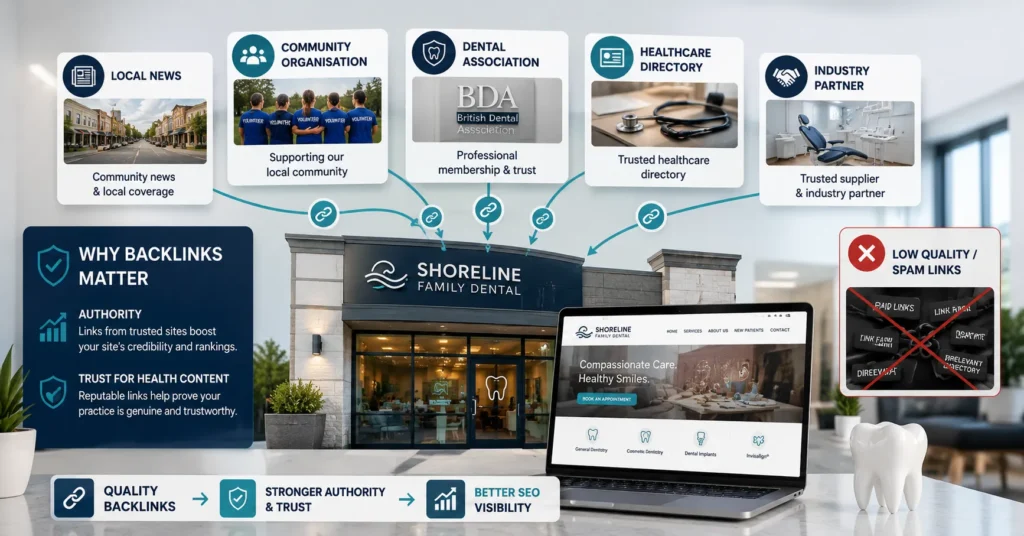
For a dental practice, this matters in two ways:
- Authority. Links from trusted sites raise your whole site’s credibility, helping it rank across the board.
- Trust for health content. Dentistry is health information, which Google treats cautiously, so links from reputable sources help prove a practice is genuine and trustworthy.
Links are one of the signals behind how a site earns its position, part of the wider picture of what a full practice SEO programme builds. Without any, even a well-optimised site can struggle to outrank established competitors. This is often why a practice with a great website still sits below an older, less polished rival: the rival has years of links behind it, and links take time to earn.
Backlinks vs Citations: What Is the Difference?
These two get confused often, and they are not the same thing. Both mention your practice elsewhere, but they do different jobs.
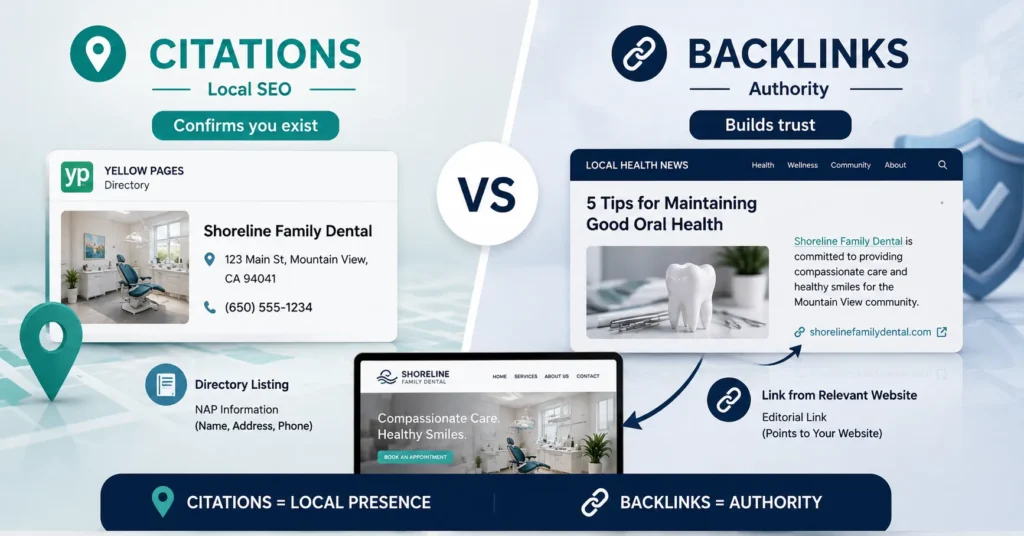
A citation is a listing of your practice’s name, address, and phone number, usually in a directory, and it mainly supports local SEO. A backlink is a link from another website to yours, and it mainly builds authority. Citations confirm you exist and where; backlinks vouch for your credibility. Both matter, but they are earned differently and serve different goals. The directory side is covered fully in the guide to local citations, while this article is about earning genuine editorial links. In short, a citation says “this practice is here”, while a backlink says “this practice is worth trusting”, and a healthy practice builds both.
What Makes a Good Dental Backlink
Not all links are equal. One link from a respected local news site is worth more than hundreds from spammy directories. Google judges quality, not just quantity.
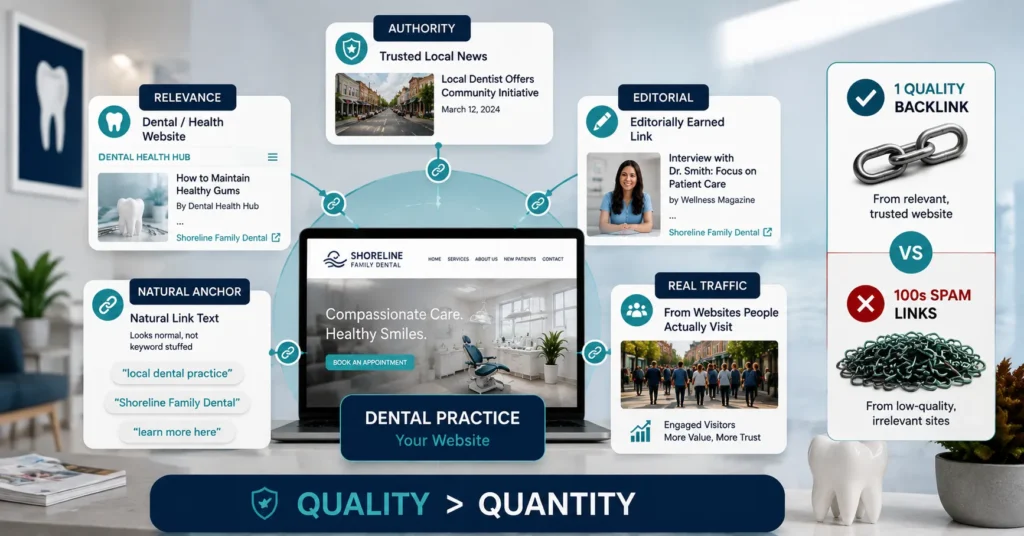
A strong dental backlink usually has these traits:
| Trait | Why it matters |
|---|---|
| Relevance | A link from a health, local, or dental source fits naturally |
| Authority | A trusted, established site passes more value |
| Editorial | The site chose to link, rather than being paid |
| Natural anchor | The link text reads normally, not stuffed with keywords |
| Real traffic | Links from sites people actually visit carry more weight |
The signals that make a link valuable overlap with the signals behind how Google ranks sites generally. Aim for links you would be glad to have even if SEO did not exist.
How to Build Links for a Dental Practice
Good link building for dentists is mostly local and relationship-based. It is slower than shortcuts, but it is safe and lasting. Here are the methods that work.
Local Sponsorships and Community Links
Sponsoring a local sports team, school event or charity often earns a link from their website, and it builds genuine goodwill in your area. These local links are highly relevant for a practice serving that community, and they support the same local goals as a strong local SEO programme. Local links also feature as a step on the wider local SEO checklist, since local relevance is exactly what a practice needs.
Local Press and Digital PR
Local newspapers and community websites often link to businesses they feature. A genuine story, a new treatment, a community initiative, a milestone, can earn coverage and a valuable link. These sites carry real local authority, which makes their links worth pursuing. Building a relationship with a local journalist or editor, rather than sending one-off requests, tends to earn more coverage over time.
Professional and Supplier Links
Dental associations, membership bodies, training providers and suppliers often list or link to practices. Being featured on a supplier’s “where to find us” page or a professional directory adds relevant, credible links, provided the source is genuine. These are among the easiest quality links for a practice to earn, because the relationships often already exist; they simply need to be turned into a link.
Content That Earns Links
Useful content can attract links on its own. A genuinely helpful guide, a local resource, or original information can be cited by others naturally. This is where link building overlaps with content and wider dental marketing, since the content does the earning for you over time. It is the most sustainable form of link building, because one strong resource can keep attracting links for years without further effort.
Guest Articles, Done Properly
Writing a genuine article for a relevant, reputable site can earn a fair link. The key word is genuine: real content on a real site that a real audience reads. Mass guest posting on low-quality sites for links is a scheme Google acts against, so quality and relevance are everything. One well-placed article on a respected industry or local site is worth more than dozens on sites that exist only to publish guest posts.
Link Building Tactics to Avoid
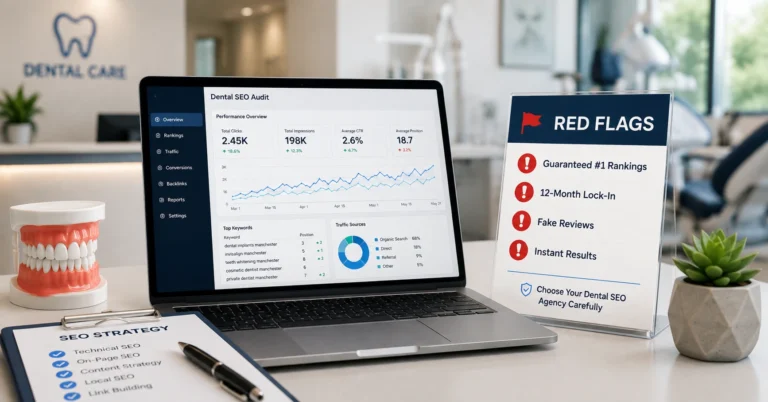
Some tactics promise fast links but risk a Google penalty that can wipe out your visibility. Avoid these entirely:
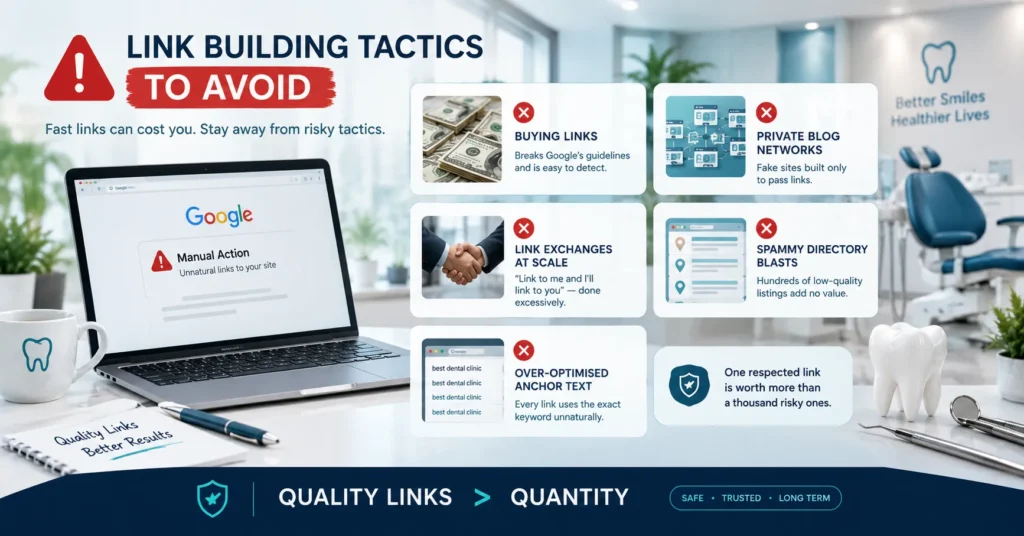
- Buying links, which breaches Google’s guidelines and is easy to detect.
- Private blog networks, networks of fake sites built only to pass links.
- Link exchanges at scale, the old “link to me and I’ll link to you” done excessively.
- Spammy directory blasts, hundreds of low-quality listings that add no value.
- Over-optimised anchor text, where every link uses the exact keyword unnaturally.
Google’s link spam policies explain what counts as manipulation, and the penalties are real. If a link is paid or sponsored in any legitimate way, it should be marked with the correct link attributes so it does not pass ranking value. A single respected link is worth more than a thousand risky ones, and it will not put your practice in danger.
Anchor Text: Getting It Right
Anchor text is the visible, clickable words in a link. It sends a signal about the linked page, so it matters, but forcing it is a common and damaging mistake.
Natural anchor text is varied. Real links use your practice name, your website address, plain phrases like “this dental practice”, and occasionally a relevant term. A link profile where every anchor is an exact-match keyword like “dental implants London” looks manipulated and can trigger problems. The goal is a natural mix that reads the way genuine links do. You want the anchors to look like something a real person wrote, because that is exactly what Google is checking for.
How Many Backlinks Does a Dental Practice Need?
There is no magic number, and chasing one is the wrong mindset. A handful of relevant, authoritative links usually outperforms hundreds of weak ones.
What matters more is the quality and relevance of the sites linking to you, and a natural pace of growth. A sudden flood of links looks unnatural, while a steady trickle of genuine ones builds authority safely. For most practices, the aim is a modest number of strong local and professional links, added consistently over time, rather than a big one-off push. Compare your link profile with local competitors rather than to an arbitrary target, because the number you need is simply enough to compete in your own area, not a figure from a generic guide.
Compliance in Dental Link Building
Link building for dentists carries the same regulatory duties as any dental marketing. Any content created to earn links- a guest article, a press feature, a resource page- must follow the GDC and ASA rules.
That means no misleading claims, no unverifiable statements, and care with anything resembling a testimonial. A guest article that makes exaggerated treatment claims is a compliance problem, however good the link is. Keeping outreach content accurate and within the advertising rules protects the practice while it builds authority. This is one more reason a dental specialist is safer than a generalist link builder who may not know the rules a practice has to follow.
How to Track Your Dental Backlinks
You cannot manage what you do not measure, and backlinks are worth keeping an eye on. Tracking them shows what is working and flags anything harmful.
A simple approach:
- Watch your referring domains, the number of separate sites linking to you, which matters more than the raw link count.
- Check new and lost links, so you know which efforts earn links and whether any disappear.
- Look for spammy links you did not build, since competitors or spam can occasionally point low-quality links at a site.
- Compare with local competitors to see whether your authority is keeping pace in your area.
Free tools like Google Search Console show many of the links pointing to your site, and paid tools give a fuller picture. In most cases, harmful links can safely be ignored, since Google discounts them automatically, and only a genuine unnatural pattern ever needs the disavow tool.
Common Link Building Mistakes
Practices tend to go wrong with links in predictable ways. Avoid these:
- Buying links or using schemes for a quick boost that risks a penalty.
- Chasing quantity over the quality and relevance of linking sites.
- Over-optimising anchor text with repeated exact-match keywords.
- Ignoring local opportunities, which are the most relevant links a practice can get.
- Building links to a weak site, when on-page and technical foundations are not yet in place.
- Forgetting compliance in guest and outreach content.
Most of these come from treating links as a numbers game rather than a reputation one. Earn links you would be proud of, and the SEO benefit follows.
FAQ
What is link building for a dental practice?
Link building is earning links from other websites to yours, which Google treats as signals of trust and authority. For a dental practice, the best links come from relevant local and professional sources, such as community organisations, local news and dental bodies. Strong links help a practice rank, especially in competitive areas.
Do backlinks still matter for dental SEO?
Yes. Links remain one of Google’s core signals of authority and trust. For health-related content like dentistry, which Google treats cautiously, links from reputable sources help prove a practice is credible. Quality and relevance matter far more than quantity now, but genuine backlinks are still a key part of ranking well.
What is the difference between citations and backlinks?
A citation is a listing of your name, address, and phone number, usually in a directory, and it mainly supports local SEO. A backlink is a link from another website to yours, and it mainly builds authority. Citations confirm you exist and where you are; backlinks vouch for your credibility. Both matter but do different jobs.
How do dentists get quality backlinks?
The best methods are local and relationship-based: sponsoring community events, earning local press coverage, being listed by dental associations and suppliers, creating genuinely useful content, and writing real guest articles for reputable sites. These earn relevant, credible links safely, unlike buying links or using schemes, which risk a Google penalty.
Is buying backlinks safe for a dental website?
No. Buying links breaches Google’s guidelines and can trigger a penalty that removes your visibility, which is slow and costly to recover from. It is also easy for Google to detect. Earning genuine links through local relationships, press, and useful content is safer and far more durable than any paid shortcut.
How many backlinks does a dental practice need to rank?
There is no fixed number, and quality matters more than quantity. A handful of relevant, authoritative local and professional links usually beats hundreds of weak ones. The right amount depends on your competition, so comparing your link profile with local rivals is more useful than aiming for an arbitrary total. Steady, natural growth is the goal.
What is anchor text and does it matter for dental links?
Anchor text is the clickable words in a link. It gives Google a hint about the linked page, so it matters, but forcing it backfires. A natural link profile uses varied anchors: your practice name, your web address, plain phrases, and occasionally a relevant term. If every link uses the same exact keyword, it looks manipulated and can cause problems, so variety is key.
Do I need to disavow bad backlinks to my dental site?
Usually not. Google is good at ignoring low-quality links automatically, so most practices never need the disavow tool. It is only worth considering if you have a genuine pattern of unnatural links, often from past bad SEO work, that is causing a problem. For everyday spammy links you did not build, the safest action is normally to leave them alone.
Conclusion
Link building is the part of dental SEO most practices neglect, which makes it a real opportunity for those who do it well. Earn relevant, trusted links from local news, community organisations, professional bodies, and genuinely useful content; keep the growth natural, and stay within the rules. Avoid bought links and schemes, because the penalty risk is never worth it.
Done patiently, link building compounds into the authority that helps a practice outrank its competitors. It is slow work, but it is some of the most durable in SEO, since a genuine link earned today can keep helping for years. To see how your practice’s links and overall authority compare, and where the safe opportunities are, start with a free dental SEO audit, or learn how a dental SEO consultant builds authority the compliant, white-hat way.