How to Get More Google Reviews for Your Dental Practice
To get more Google reviews as a dental practice, ask every patient at the right moment, make leaving a review effortless with a direct link or QR code, and build a simple team routine around it. Crucially, do it the compliant way: never offer incentives, never ask only happy patients, and never reveal patient details in your replies. Genuine reviews are one of the biggest levers for local ranking and patient trust, but the rules around them are strict.
Introduction
Reviews are the quiet engine of local dental marketing. They shape whether a practice appears in Google’s top three, and they are often the last thing a patient checks before booking. A practice with fifty recent, genuine reviews beats one with five, almost every time.
Yet getting reviews is where many practices either do too little or, worse, break the rules without realising. This guide shows how to earn more Google reviews steadily and how to do it within the GDC, Google and consumer-protection rules that apply to UK dentists. Done right, reviews build both your ranking and your reputation. Done wrong, they create real risk, from a Google penalty to a breach of professional standards.
Why Google Reviews Matter for Dental Practices
Google reviews do three jobs at once for a dental practice: they lift local ranking, they win patient trust, and they increasingly feed AI answers. Ignoring them means leaving all three on the table.
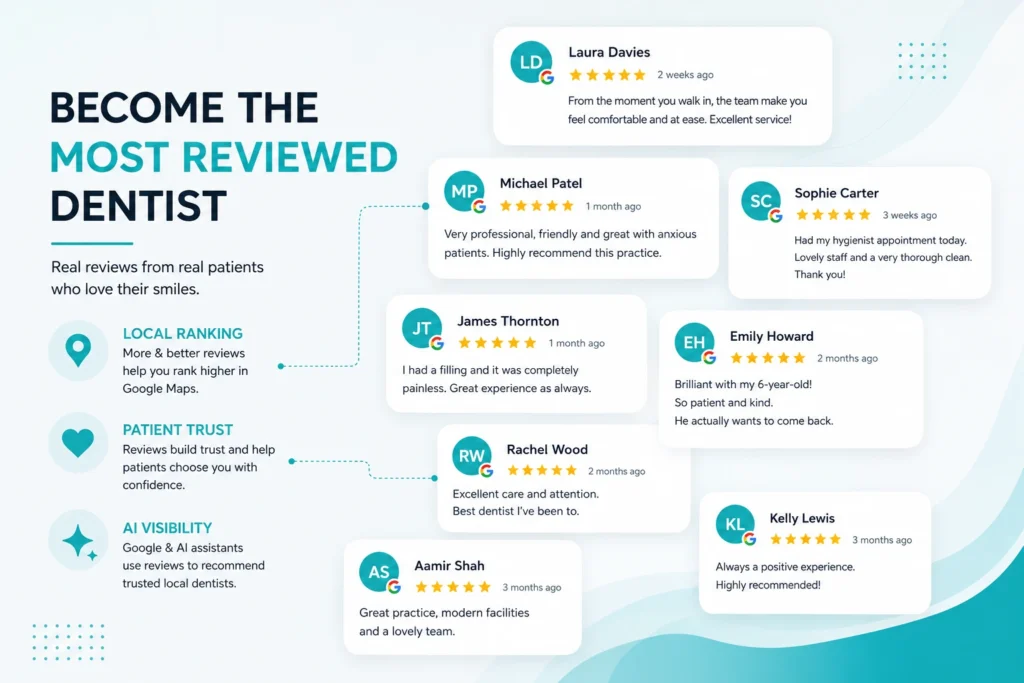
The three reasons reviews matter:
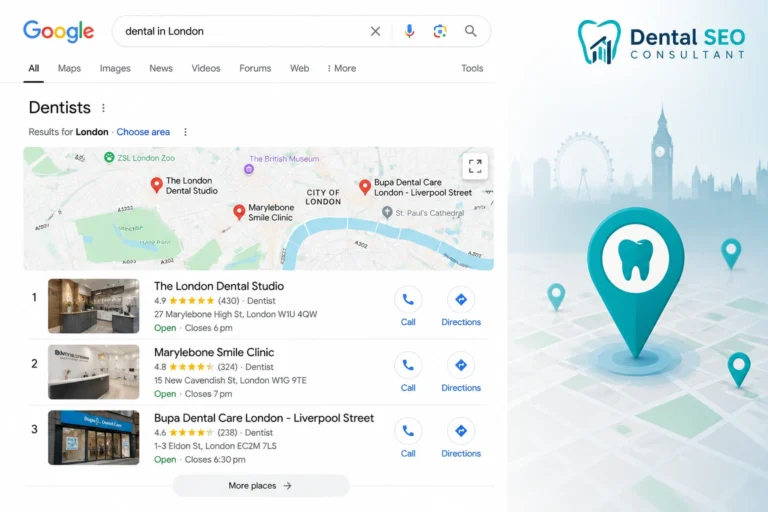
- Local ranking. Reviews are a major prominence signal, one of the factors that decide which three practices appear in the map pack. Their number, rating and recency all count, as explained in how dentists rank in the Google map pack.
- Patient trust. Reviews are often the deciding factor when a patient chooses between practices. A strong, recent set of reviews reassures them before they ever call.
- AI answers. When patients ask an AI assistant to recommend a dentist, reviews are part of what shapes the answer, as covered in optimising for AI search.
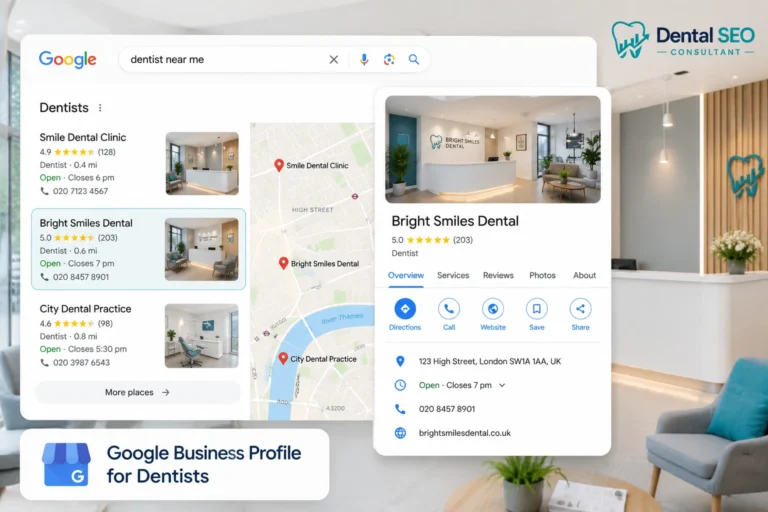
Reviews live on your Google Business Profile, so they work hand in hand with a well-optimised listing. Getting the profile right is a separate task, covered in the guide to the Google Business Profile for dentists, while this guide focuses on earning the reviews themselves.
The Rules First: What Dentists Can and Cannot Do with Reviews
Before asking for a single review, a UK dental practice has to know the rules, because several common review tactics are now against them. This is where generic advice gets practices into trouble.
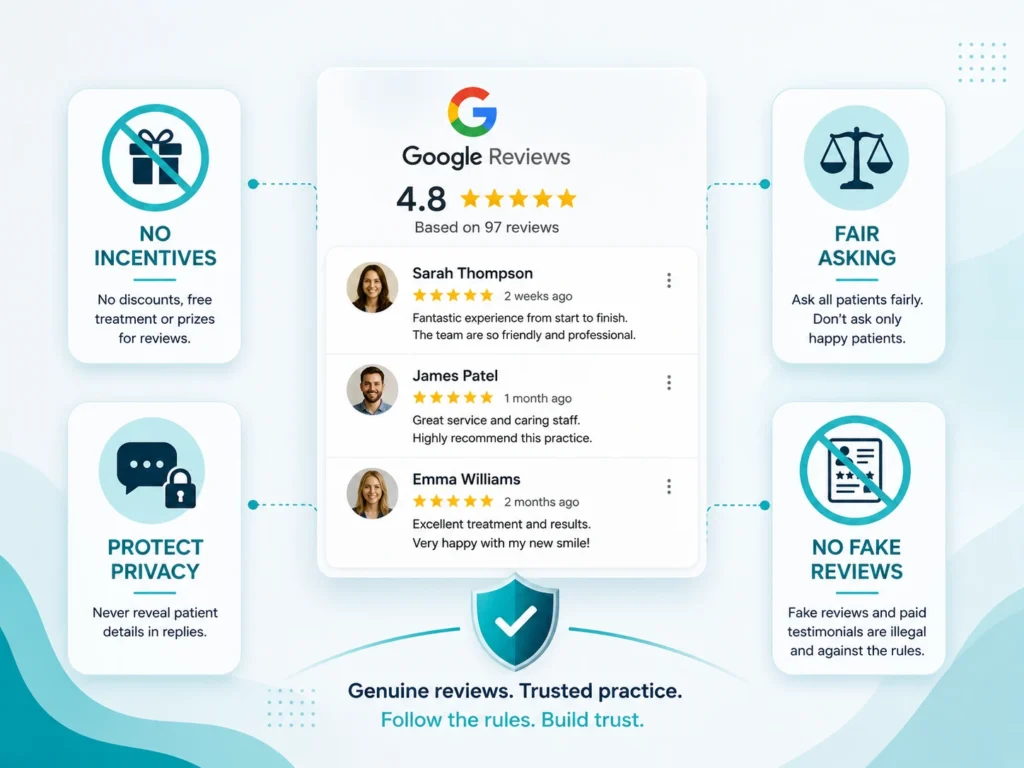
Never Offer Incentives for Reviews
Offering a discount, free treatment, entry to a prize draw or any benefit in exchange for a review is not allowed. Under the Digital Markets, Competition and Consumers Act 2024, incentivised reviews without clear disclosure are illegal, and the CMA can act on them. Google’s own policies also prohibit it. Ask for honest feedback, never buy it.
Never Ask Only Happy Patients
Selecting only satisfied patients to ask, sometimes called review gating, is against Google’s policies. You must ask patients fairly, not filter for those likely to leave five stars. A genuine spread of feedback is both the rule and, in the long run, more convincing to patients.
Protect Patient Confidentiality in Replies
Responding to reviews is good practice, but a reply must never reveal that someone is a patient or disclose any treatment detail without consent. GDC confidentiality duties, set out by the General Dental Council, apply in public replies just as they do in the surgery. A careless response can breach confidentiality even while thanking someone.
Never Use Fake or Written Testimonials as Adverts
Fake reviews are illegal. Separately, publishing curated patient testimonials as advertising carries risk under GDC and ASA rules. Genuine third-party Google reviews are the safe route, which is why they are the focus here. The full set of rules is covered in the guide to GDC and ASA dental advertising rules, and this compliance-led approach runs through everything, as set out on the about page.
How Many Google Reviews Does a Dental Practice Need?
There is no fixed target, but the honest answer is enough to look established and current next to local competitors. A practice with a similar or higher review count and rating than the practices around it is in a strong position. One with far fewer looks less trusted, whatever the quality of its dentistry.
Two things matter as much as the total:
- Rating. A steady stream of genuine reviews naturally produces a strong average. A suspiciously perfect score from very few reviews is less convincing than a high score across many.
- Recency. Reviews from the last few weeks and months carry more weight than old ones, both for ranking and for patient trust. A practice whose newest review is a year old looks inactive.
The practical goal is not a magic number. It is to keep a consistent flow of recent, genuine reviews coming in, so the practice always looks active, trusted, and ahead of its local competition. That flow matters more than any one-off total.
How to Ask Patients for Google Reviews
With the rules clear, the single most effective thing a practice can do is simply ask, well and often. Most patients are happy to leave a review, but only if asked at the right time and made easy.
Ask at the Right Moment
Timing matters. The best moment is just after a positive experience, when the patient is pleased and it is fresh. That might be after a successful treatment, at a friendly check-out, or when a nervous patient tells you how relieved they feel. A genuine, warm ask in that moment works far better than a cold request weeks later.
Make It Effortless
Every extra step loses reviews. Give patients a direct link straight to your Google review form, which you can find and share from your Google Business Profile, send it by text or email, and display a QR code at reception that opens it in one tap. The easier you make it, the more reviews you get. If a patient has to search for your practice and hunt for the review button, most will not bother.
A Personal Ask Beats an Automated One
A request from the dentist or a familiar team member carries more weight than an anonymous automated message. Automation has its place for scale, but the warmth of a personal ask, followed by an easy link, is the highest-converting combination. Patients respond to being asked by someone they have just built trust with.
How to Set Up a Review System in Your Practice
Getting reviews consistently is about routine, not luck. A simple system turns occasional reviews into a steady flow without anyone having to remember.
The building blocks of a review routine:
- One short review link or QR code, saved and ready for the whole team to use.
- A clear moment in the visit when the ask happens, so it is not left to chance.
- A named person responsible for keeping the routine going and checking new reviews.
- A fair approach, asking patients across the board, not just the ones expected to praise you.
| Element | What it does |
|---|---|
| Direct review link | Removes friction so patients can review in seconds |
| Reception QR code | Captures reviews before the patient leaves |
| A set moment to ask | Makes the request consistent, not occasional |
| Team ownership | Keeps the flow steady rather than sporadic |
Built into the daily rhythm of the practice, this turns reviews from an afterthought into a reliable source of new ones every week.
Should Dentists Use Review Software?
Review software can automate reminders and send review links by text or email at scale. For a busy practice, it removes the risk of forgetting to ask and keeps the flow steady. Used well, it is a genuine time-saver.
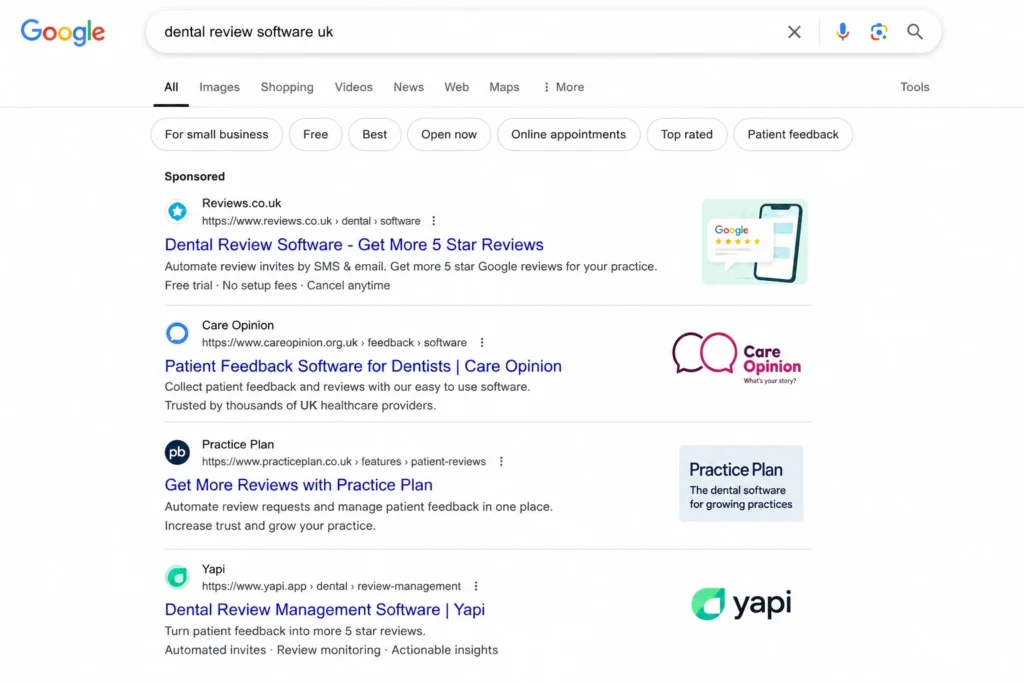
There are two cautions, though. First, automation must still respect the rules: it cannot be set up to filter out unhappy patients or to offer incentives, both of which breach Google and consumer-protection rules. Second, an automated message rarely converts as well as a warm, personal ask from the dentist or team.
The strongest approach usually combines both. Use software to handle scale, reminders and the review link, but keep a genuine personal ask at the heart of it. The technology should support the human moment, not replace it. Whatever tool a practice chooses, it should make asking easier without ever bending the compliance rules.
How to Respond to Google Reviews
Responding to reviews shows patients and Google that the practice is attentive, and it is a chance to reinforce trust. Every review deserves a reply, positive or negative, kept professional and within the confidentiality rules.
Responding to Positive Reviews
A short, warm thank-you is enough. Keep it genuine and avoid revealing any treatment detail. A simple acknowledgement that thanks the patient for their kind words and their trust does the job, and it signals to future patients that the practice values feedback. Personalising the reply slightly, without referring to any clinical detail, makes it feel human rather than copied and pasted.
Responding to Negative Reviews
Negative reviews need care. Reply calmly, do not become defensive, and never confirm clinical details or even that the person was treated, as that can breach confidentiality. Acknowledge the concern, apologise that they were unhappy, and invite them to contact the practice directly to resolve it. A measured, professional reply often impresses future readers more than the complaint itself.
How to Handle Negative Reviews
Every practice gets the occasional negative review. Handled well, it does little harm and can even build trust. Handled badly, it makes things worse.
A calm approach that works:
- Respond promptly and professionally, without emotion or defensiveness.
- Protect confidentiality, never disclosing treatment details in public.
- Move the conversation offline, inviting the patient to contact the practice to resolve it.
- Report clear policy breaches, such as fake reviews or abusive content, to Google, though genuine criticism cannot simply be removed.
The goal is not to win the argument in public. It is to show future patients that the practice responds to concerns with professionalism and care.
What Not to Do When Getting Dental Reviews
The fastest way to damage a practice’s reputation, or breach the rules, is to chase reviews the wrong way. Avoid these entirely:
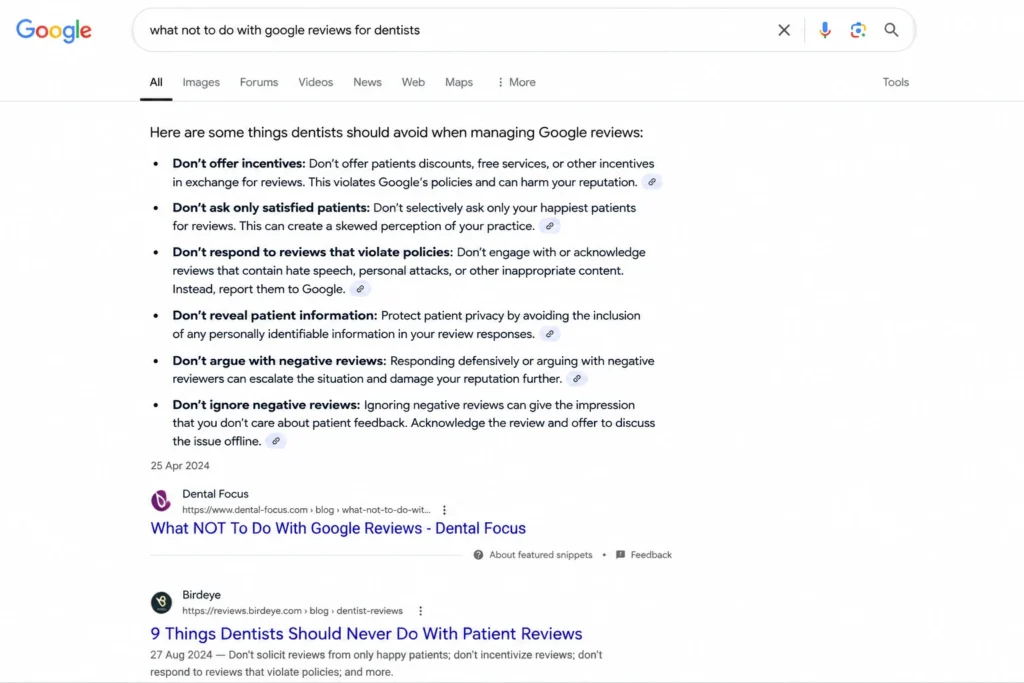
- Offering any incentive for a review, which is now illegal without disclosure.
- Review gating, asking only patients you expect to be positive.
- Buying reviews or posting fake ones, which is illegal and easily detected.
- Revealing patient information in public replies, breaching confidentiality.
- Arguing with negative reviewers, which damages the practice more than the review.
- Ignoring reviews entirely, which signals an inattentive practice.
Every one of these carries either a compliance risk or a reputational one. Genuine, well-asked reviews avoid all of them.
How Reviews Fit Your Wider Dental Marketing
Reviews are not a standalone task. They are one of the strongest levers within local SEO and reputation management, and they support almost every other channel. A steady flow of genuine reviews lifts map pack ranking, improves conversion on the website, and strengthens the practice’s presence in AI answers.
This is why review generation sits at the heart of a proper local SEO for dentists programme, and why it features as a core channel in the wider guide to dental marketing for dentists. Treated as an ongoing habit rather than a one-off push, reviews compound into a lasting reputation advantage.
FAQ
How do dentists get more Google reviews?
Ask every patient at the right moment, usually just after a positive experience, and make it effortless with a direct review link or a reception QR code. A personal ask from a team member, backed by an easy link, works best. Build it into a simple routine so it happens consistently rather than occasionally.
Can dentists offer discounts for Google reviews?
No. Offering discounts, free treatment or any incentive for a review is not allowed. Under the Digital Markets, Competition and Consumers Act 2024, incentivised reviews without clear disclosure are illegal, and Google’s own policies prohibit it. Ask patients for honest feedback, never reward them for leaving it.
Is it against the rules to ask only happy patients for reviews?
Yes. Asking only patients you expect to be positive, known as review gating, breaches Google’s policies. Practices should ask patients fairly rather than filtering for likely five-star reviews. A genuine mix of feedback is both required and more credible to future patients.
How should a dentist respond to a negative review?
Reply promptly, calmly and professionally. Never confirm clinical details or even that the person was a patient, as that can breach GDC confidentiality. Acknowledge their concern, apologise that they were unhappy, and invite them to contact the practice directly. A measured reply often reassures future patients more than the complaint worries them.
Can dentists remove bad Google reviews?
Not usually. Genuine criticism cannot simply be deleted. You can report reviews to Google that breach its policies, such as fake reviews, spam or abusive content, and Google may remove those. For genuine negative reviews, the best response is a professional public reply and a private effort to resolve the issue.
Do Google reviews help a dental practice rank higher?
Yes, for local search. Review number, rating and recency are part of the prominence signal Google uses to rank the map pack, the top three local results. Reviews do not directly rank standard organic pages, but they strongly influence which practices appear in local results and which a patient chooses.
How often should a dental practice ask for reviews?
Little and often works best. Rather than a big one-off push, build a habit of asking suitable patients throughout each week, so new reviews arrive steadily. A consistent trickle of recent reviews looks more natural to both patients and Google than a sudden burst, and it keeps the practice looking active over time.
Conclusion
Google reviews are one of the biggest levers a dental practice has, shaping local ranking, patient trust and even AI recommendations. The way to build them is simple: ask every patient at the right moment, make it effortless, respond to every review, and do all of it within the rules. That means no incentives, no gating, no fake reviews and no breaches of confidentiality.
Treated as a steady habit, reviews compound into a reputation that keeps winning patients. To see where your reviews and local visibility stand today, start with a free dental SEO audit, or learn more about working with a dental SEO consultant who builds reviews into a compliant, local-first strategy.