E-E-A-T and YMYL for Dental Websites
E-E-A-T stands for Experience, Expertise, Authoritativeness, and Trustworthiness, the qualities Google uses to judge content quality. YMYL means Your Money or Your Life, the topics that can affect health, safety, or finances. Dental content is YMYL, so Google holds it to a higher standard. Practices show E-E-A-T by naming GDC-registered clinicians, keeping content accurate and compliant, and building genuine trust signals like reviews.
Introduction
Google is careful about health content, and for good reason. Bad dental information can genuinely harm someone, so Google works hard to rank content from sources it can trust. That is where E-E-A-T and YMYL come in, and why they matter more for a dental website than for most other kinds of sites.
This guide explains both in plain terms. It covers what E-E-A-T and YMYL mean, why dentistry falls under the strictest standard, and exactly how a practice can demonstrate the experience, expertise, authority, and trust that Google looks for. For a dental site, getting this right is not optional; it is the foundation of ranking at all, and it is one of the few areas where a genuine local practice can clearly outdo a generic competitor.
What Is E-E-A-T?
E-E-A-T is a framework Google uses to assess the quality of content. The letters stand for Experience, Expertise, Authoritativeness, and Trustworthiness, with trust sitting at the centre as the most important.
Here is what each part means:
| Element | What it means |
|---|---|
| Experience | First-hand, real-world experience of the subject |
| Expertise | Genuine knowledge and qualifications in the field |
| Authoritativeness | Being a recognised, respected source |
| Trustworthiness | Being accurate, honest and safe to rely on |
E-E-A-T is not a single score or a direct ranking factor. It is a concept Google’s quality systems approximate and its human raters use to judge whether content is high quality. Google’s guidance on creating helpful, people-first content puts these qualities at the heart of what it rewards. The signals behind it overlap with how Google ranks pages generally, but they carry extra weight for certain topics.
What Is YMYL, and Why Dentistry Counts
YMYL stands for Your Money or Your Life. It covers topics that could affect a person’s health, safety, financial stability, or wellbeing if the information is wrong. Google holds YMYL content to a much higher standard of E-E-A-T.
Dentistry sits squarely in this category. Advice about treatments, procedures, oral health, and costs can influence real decisions about someone’s body and money. Because the stakes are high, Google is far more cautious about which dental sites it trusts and ranks. This is why strong foundations matter so much, and why E-E-A-T is central to solid website SEO for any dental practice. The same page, with the same words, is judged more strictly on a dental site than it would be on a hobby blog, precisely because getting dental information wrong can cause real harm.
Why E-E-A-T and YMYL Matter for Dental Websites
For a dental site, E-E-A-T and YMYL are not abstract ideas. They decide whether Google trusts the site enough to rank it, and whether AI tools will cite it.

Three reasons they matter:
- Higher standard. As YMYL content, dental pages are judged more strictly, so weak E-E-A-T holds a site back more than it would in other industries.
- Trust drives ranking. Google favours sources it can trust for health topics, so demonstrating expertise and trust directly supports visibility.
- AI relies on it too. AI tools are cautious about health sources, so strong E-E-A-T improves the odds of being cited.
In short, a dental site cannot rely on technical SEO and keywords alone. Without visible expertise and trust, it will struggle against practices that show them clearly, which is part of what dental SEO has to deliver. This is often why a slick-looking dental site still ranks poorly: it looks professional but gives Google no proof of who is behind it or why they should be trusted.
The Four Parts of E-E-A-T for Dentists
Each part of E-E-A-T applies specifically to a dental practice. Understanding how helps you know what to show on your site.
Experience
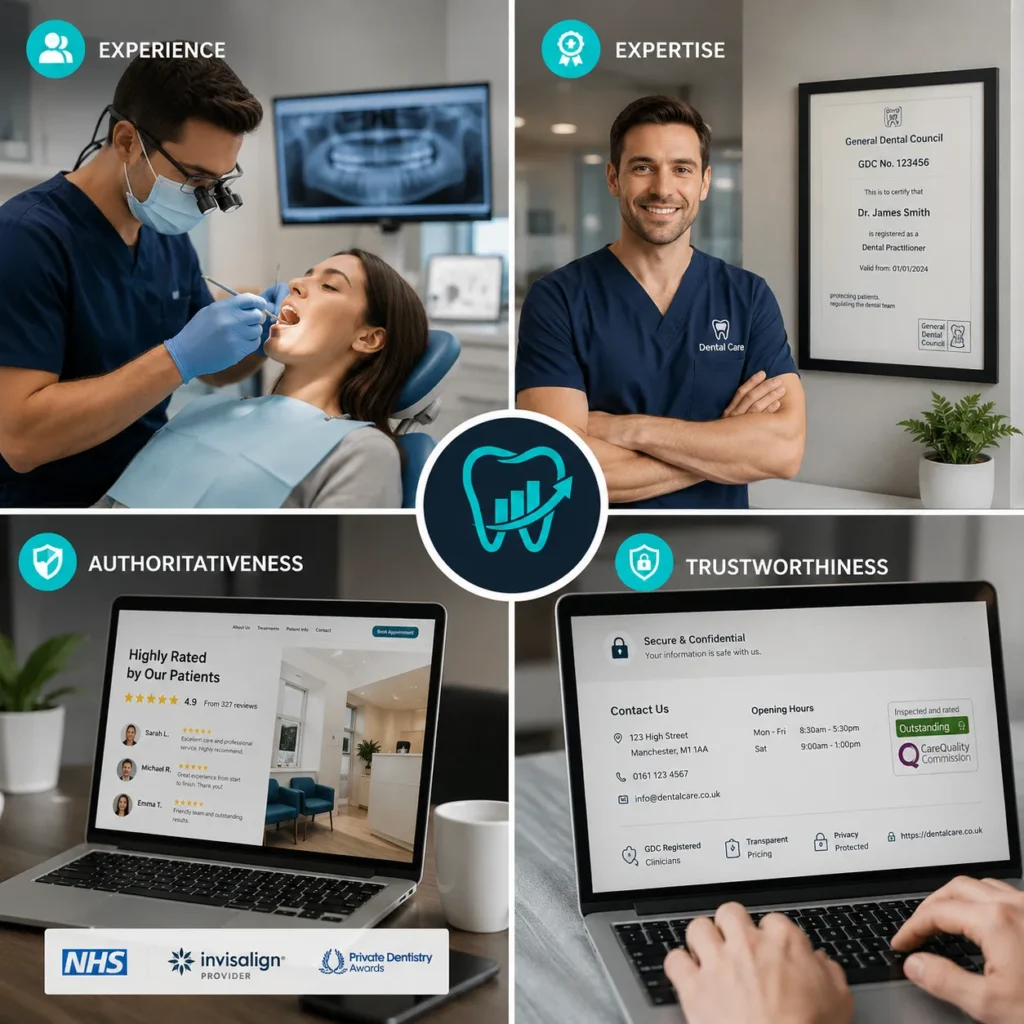
Experience is about first-hand, real-world involvement. For a dental site, this means content informed by actually treating patients, real practice photos, and genuine insight rather than generic articles copied from elsewhere. A page written by someone who does the work reads differently, and Google values that. It is also the newest part of the framework, added in 2022, and it rewards the very thing a real practice has that a content farm does not: actual hands-on experience with patients.
Expertise
Expertise is genuine, qualified knowledge. In dentistry, this is clear-cut: the clinicians are GDC-registered professionals with real qualifications. Showing who they are and their credentials is one of the strongest expertise signals a dental site can send. A dental site has a natural advantage here that many industries lack, because the expertise is formal, registered, and easy to prove.
Authoritativeness
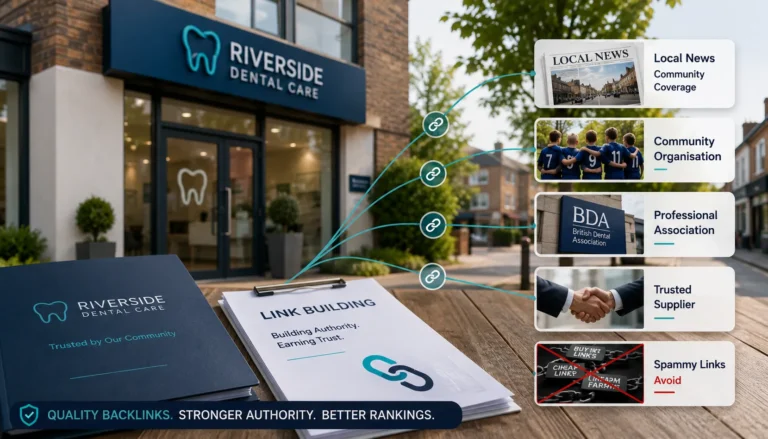
Authoritativeness is being a recognised, respected source. It builds through reputation, genuine reviews, mentions and links from trusted places, and a track record in the local community. A well-planned dental link building strategy can help strengthen these authority signals by earning relevant links from reputable websites. It is earned over time rather than claimed, which is why an established practice with a strong local reputation has an edge.
Trustworthiness
Trust is the most important part, and it ties the others together. It comes from accuracy, honesty, transparency, a secure site, clear contact details, genuine reviews, and content that never misleads. For a regulated field like dentistry, trust also means staying within the rules. Google treats trust as the centre of E-E-A-T, so a site can have expertise and still fail if it looks untrustworthy in any way.
How to Demonstrate E-E-A-T on a Dental Website
Knowing the theory is not enough. E-E-A-T has to be visible on the page. Here is how a dental practice shows it in practice.
Name Your Clinicians and Show Credentials
The single most important step is showing who is behind the content and the care. Name the dentists, display their General Dental Council registration numbers and qualifications, and make the practice’s registration clear. This proves real expertise, and it also supports staying within the advertising rules that govern how dentists present themselves.
Add Author Bios and Medical Review
Content should be attributed to a named, qualified person, with a short bio explaining their credentials. Where possible, show that clinical content has been written or reviewed by a dentist. This tells both readers and Google that the information comes from a genuine expert, not an anonymous writer. Marking this up with clinician details also connects to good schema markup. A visible “reviewed by” line from a named dentist is a simple, powerful trust signal on any health page.
Keep Content Accurate and Compliant
Every claim on a dental site should be accurate, honest and within professional rules. Avoid exaggerated promises, unverifiable statements and anything misleading. Accurate, careful content is a trust signal, and it protects the practice. This is a core part of good practice SEO, where quality and compliance go together.
Be Transparent About the Practice
A clear about page, full contact details, the practice address, opening hours and registration information all build trust. A site that hides who runs it or how to reach it fails the basic trust test. Openness reassures both patients and Google, and it is easy to get right, as reflected on a good about page.
Build Reviews and Reputation
Genuine reviews are a powerful trust and authority signal. A steady flow of real reviews shows patients trust the practice, which supports E-E-A-T directly, as covered in getting more reviews the right way. Reputation across the wider web reinforces the same message.
Get the On-Page Details Right
Author information, clear structure, accurate content and useful detail all sit on the page itself, which is why E-E-A-T overlaps with strong on-page SEO. A well-structured, credible page makes expertise and trust easy for Google to see, and easy for a patient to believe.
How to Improve E-E-A-T on an Existing Dental Site
If a practice already has a website, improving E-E-A-T is mostly about surfacing what is already true. The expertise exists, it just needs to be shown.
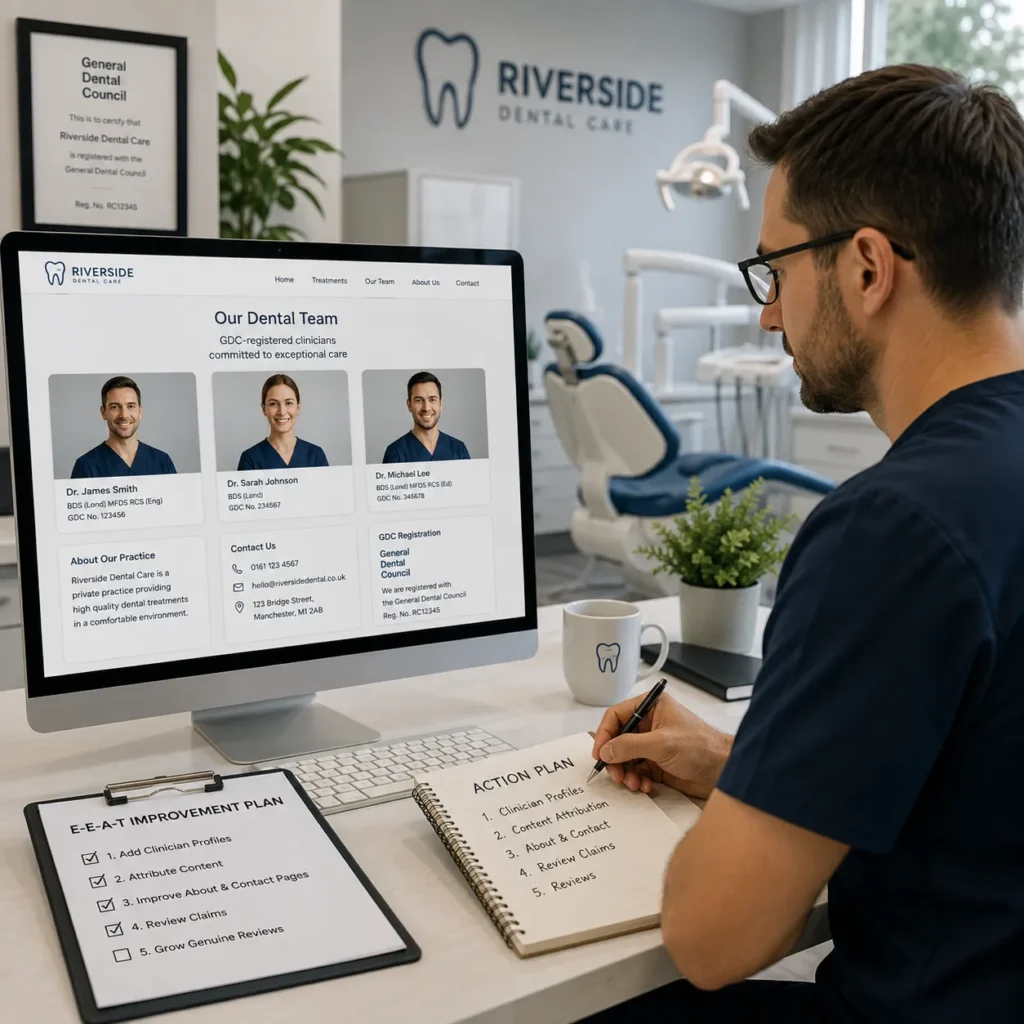
A sensible order to work through:
- Add clinician profiles first. Name every dentist, with GDC registration, qualifications and a photo. This is the biggest single win.
- Attribute your content. Put a named author and short bio on treatment pages and articles.
- Tighten your about and contact pages. Make the practice, its people and its registration easy to find.
- Review your claims. Remove anything exaggerated or unverifiable, and correct anything inaccurate.
- Grow genuine reviews. Build a steady, honest flow rather than a one-off push.
None of these need a redesign. They are content and presentation changes that a practice can make itself, and together they can lift a site noticeably because they address the exact standard Google applies to health content.
E-E-A-T Signals: A Quick Checklist
To make this practical, here are the signals a dental site should have in place. Each one is a small piece of proof that adds up to strong E-E-A-T.
| Signal | In place? |
|---|---|
| Named clinicians with GDC numbers | Expertise |
| Author bios on content | Expertise |
| Clinical content written or reviewed by a dentist | Trust |
| Clear about and contact pages | Trust |
| Practice and registration details visible | Trust |
| Genuine, recent reviews | Authority |
| Accurate, compliant claims | Trust |
| Secure HTTPS site | Trust |
| Real photos and first-hand content | Experience |
A practice that can tick most of these rows is sending Google strong quality signals. The gaps are where the quickest improvements usually lie, and most are simple to fix once identified.
E-E-A-T, YMYL and AI Search
E-E-A-T has become even more important as AI search has grown. AI tools answering health questions are cautious, and they lean toward sources that clearly show expertise and trust.
A dental site with named, credentialed clinicians and accurate content is far more likely to be cited by AI than an anonymous one making bold claims. The same signals that satisfy Google’s quality standards make a site a safer source for AI to quote, which is why E-E-A-T is central to appearing in AI search answers. For health topics especially, trust is the currency that decides who gets cited.
Common E-E-A-T Mistakes on Dental Websites
Dental sites tend to undermine their own E-E-A-T in the same ways. Avoid these:
- Anonymous content, with no named author or clinician behind it.
- Hiding credentials, so real expertise is invisible to readers and Google.
- Generic, copied content that shows no first-hand experience.
- Exaggerated or non-compliant claims that break trust and the rules.
- No about or contact transparency, leaving the practice looking faceless.
- Thin or inaccurate health information, which is especially risky for YMYL content.
Most of these are easy to fix, and fixing them often lifts a dental site more than any technical tweak, because it addresses the standard Google cares about most for health content. A practice that closes these gaps is not gaming anything, it is simply letting Google see the expertise and trust that were always there.
FAQ
What is E-E-A-T in SEO?
E-E-A-T stands for Experience, Expertise, Authoritativeness and Trustworthiness. It is a framework Google uses to judge content quality, with trust at the centre. It is not a single ranking factor, but a concept Google’s systems and human raters use to assess whether content is high quality and reliable, especially for important topics.
What does YMYL mean for a dental website?
YMYL means Your Money or Your Life: topics that can affect a person’s health, safety, or finances. Dental content is YMYL because it influences real decisions about health and money. This means Google holds dental websites to a higher standard of E-E-A-T and expects clear expertise and trust before ranking them well.
Why is E-E-A-T important for dentists?
Because dental content is health content, which Google treats cautiously. As YMYL material, dental pages are judged more strictly, so strong E-E-A-T is needed just to compete. Showing GDC-registered clinicians, accurate content, and genuine trust signals directly supports ranking, and it also makes a site more likely to be cited by AI tools.
How do you show E-E-A-T on a dental website?
Name your clinicians and show their GDC registration and qualifications, attribute content to a named expert with a bio, keep everything accurate and compliant, be transparent with a clear About and contact page, and build genuine reviews. Together, these prove experience, expertise, authority, and trust to both patients and Google.
Is E-E-A-T a ranking factor?
Not directly. E-E-A-T is a concept Google’s quality raters use, and its systems try to approximate, rather than a single measurable score. However, the signals that demonstrate E-E-A-T, such as named experts, accurate content, and genuine trust, do influence how Google assesses and ranks a site, particularly for YMYL topics like dentistry.
Does E-E-A-T matter for AI search?
Yes, a great deal. AI tools answering health questions favour sources that clearly show expertise and trust, because they are cautious about health information. A dental site with named, credentialed clinicians and accurate content is far more likely to be cited by AI than an anonymous one, so strong E-E-A-T supports AI visibility too.
How can a small dental practice improve its E-E-A-T?
Start with the easy wins: add named clinicians with their GDC registration and qualifications, put a short bio on each piece of content, and make sure the about and contact pages are clear and complete. Then keep content accurate and build genuine reviews. A small practice already has real expertise, so most of the work is making it visible.
Is E-E-A-T more important for dentists than other businesses?
Yes. Because dental content is health-related, it falls under YMYL, which Google judges more strictly. A local shop or blog can rank with modest E-E-A-T, but a dental site competes under a higher standard where expertise and trust are closely scrutinised. This makes E-E-A-T a bigger priority for dentists than for many other local businesses.
What is the difference between E-E-A-T and YMYL?
E-E-A-T is the set of qualities Google uses to judge content: Experience, Expertise, Authoritativeness and Trustworthiness. YMYL is a category of topics, Your Money or Your Life, that can affect health, safety or finances. They connect because Google expects stronger E-E-A-T from YMYL content. Dental sites are YMYL, so they need strong E-E-A-T.
Conclusion
E-E-A-T and YMYL explain why dental websites are held to a higher standard than most. As health content that affects real decisions, dental pages need to prove experience, expertise, authority, and trust before Google will rank them well. The good news is that a genuine practice already has these qualities; it just needs to make them visible.
Name your clinicians, show their credentials, keep content accurate and compliant, be transparent, and build real reviews. None of this requires exaggeration or tricks, only making genuine expertise and trust visible on the page. To see how your practice’s trust signals and overall quality measure up, and where the gaps are, start with a free dental SEO audit, which shows exactly what to strengthen first.