Technical SEO Mistakes on Dental Websites (and How to Fix Them)
The most common technical SEO mistakes on dental websites are pages that Google cannot crawl or index, slow loading on mobile, weak site structure, missing or duplicate title tags, thin or duplicated pages, and no proper tracking. Each one quietly stops good content from ranking. Fixing them is usually the fastest way to improve a dental site’s visibility, because it removes the barriers holding everything else back.
Introduction
A dental practice can have a beautiful website, strong content and genuine expertise, and still be invisible on Google. When that happens, the cause is almost always technical. Something under the surface is stopping Google from reading, trusting or ranking the site.
Technical problems are frustrating because they hide. The website looks fine to a visitor, so nobody suspects a broken setting is costing patients every week. This guide walks through the technical SEO mistakes that hurt dental websites most, explains why each one matters, and shows how to fix it. Work through them and you clear the path for everything else to rank.
What Is Technical SEO for a Dental Website?
Technical SEO is the work of making sure Google can find, read, understand and rank a website. It sits underneath content and links, and it decides whether the rest of your effort even has a chance to work.
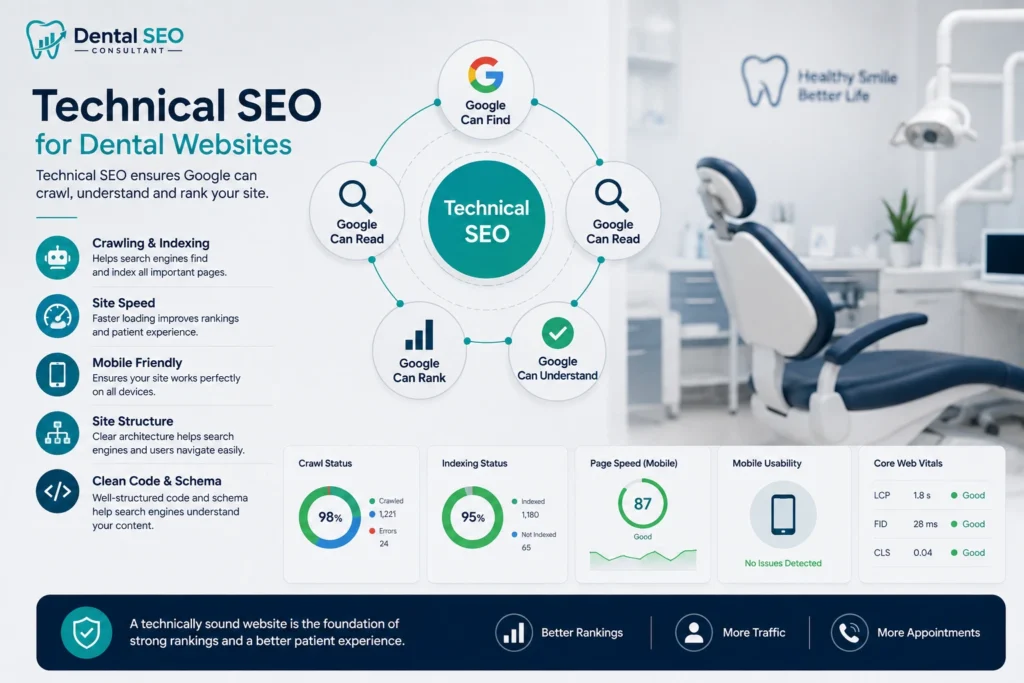
For a dental practice, technical SEO covers how the site is crawled and indexed, how fast it loads, how it behaves on mobile, how it is structured, and how cleanly the code is set up. It is one part of the broader picture of dental SEO, sitting alongside content and local signals. Get it right and Google can access everything. Get it wrong and even excellent treatment pages sit unseen. This is the foundation that proper website SEO is built on.
Why Technical Mistakes Hold Dental Practices Back
Google follows three steps before it ranks anything: it crawls a page, indexes it, then ranks it. A technical mistake can break any of those steps, and a page that fails at step one or two never reaches step three.
This is why a practice can publish great content and see nothing happen. If Google cannot crawl the page, or has been told not to index it, the quality of the writing is irrelevant. The full picture of how these stages work is set out in the guide to how Google ranks dental websites, and technical health is what lets a site clear all three.
The mistakes below are grouped by area. A quick reference table follows, then each area is explained.
| Mistake area | What it breaks | Typical fix |
|---|---|---|
| Crawling and indexing | Pages never enter Google | Remove noindex, fix robots.txt, add a sitemap |
| Speed and Core Web Vitals | Rankings and patient patience | Compress images, fix slow scripts |
| Mobile | The version Google ranks first | Use a responsive, fast mobile design |
| Site structure | How pages pass authority | Clean URLs, fix orphan pages and links |
| On-page technical | How Google reads each page | Unique titles, meta, one H1, alt text |
| Duplicate and thin content | Trust and ranking | Merge, expand or canonicalise pages |
| Schema | How clearly Google understands | Add valid Dentist and LocalBusiness data |
| Tracking | Your ability to see problems | Set up Search Console and analytics |
Crawling and Indexing Mistakes
If Google cannot crawl or index a page, nothing else matters. This is where the most damaging, and most invisible, mistakes live.
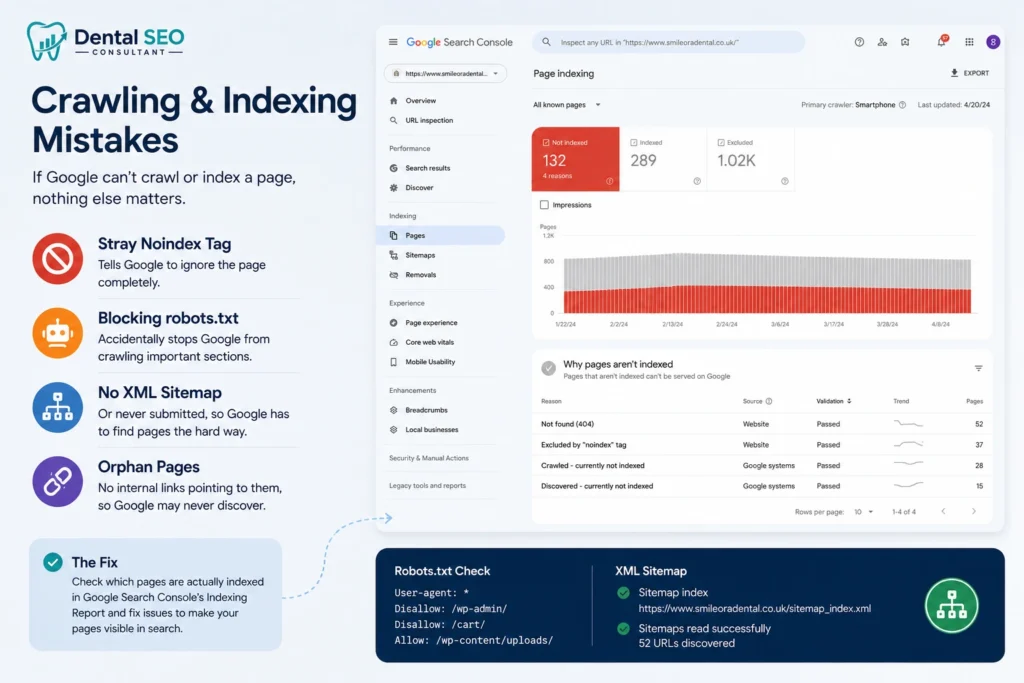
The common ones:
- A stray noindex tag, often left on after a site is built, which tells Google to ignore the page entirely.
- A blocking robots.txt file, accidentally stopping Google from crawling important sections.
- No XML sitemap, or one that is never submitted, so Google has to find pages the hard way.
- Orphan pages, with no internal links pointing to them, which Google may never discover.
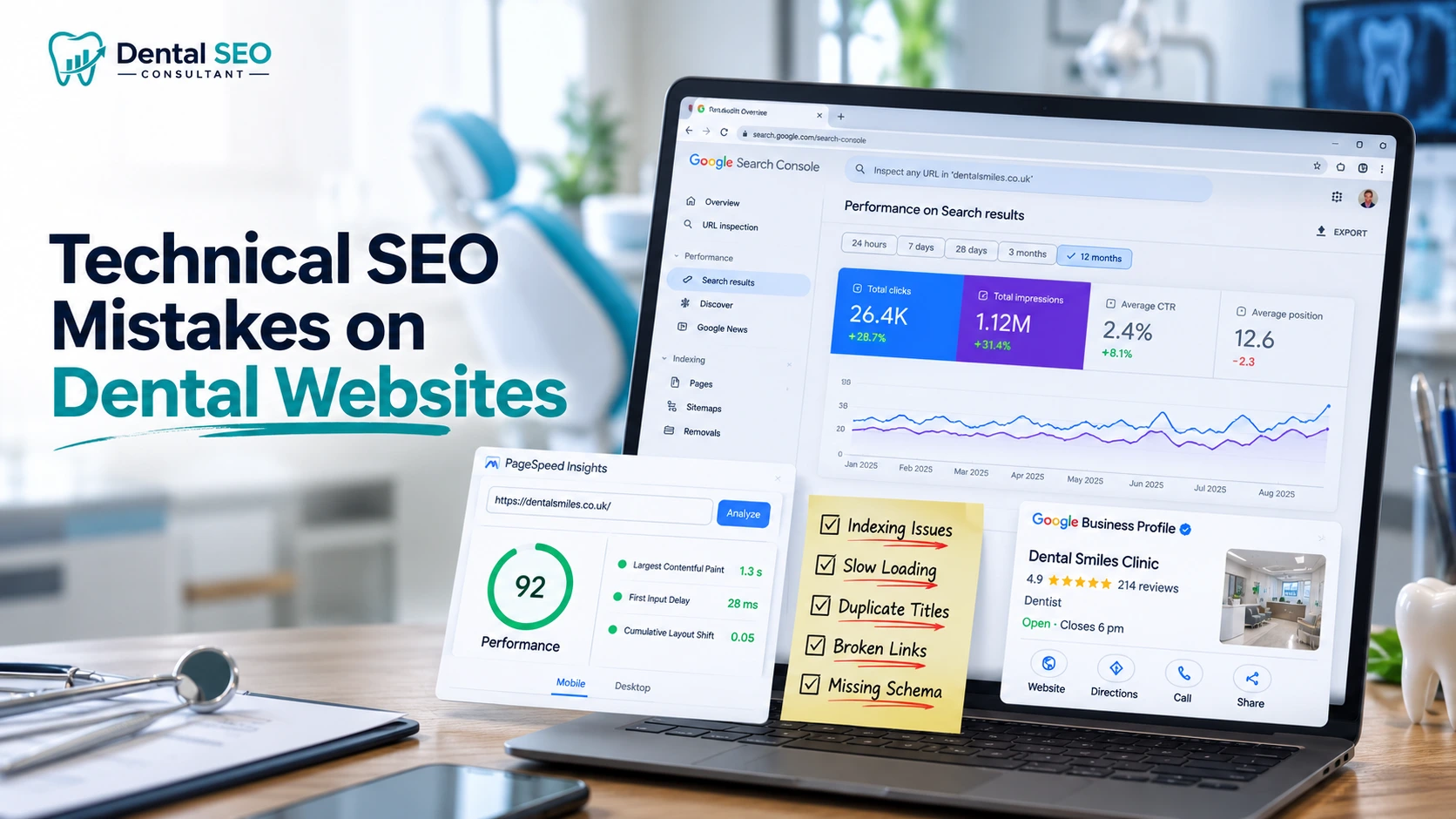
The fix starts with checking which pages are actually indexed. Google Search Console shows this in its indexing report, and its Search Console help explains how to spot and fix pages Google has skipped. If a treatment page is not indexed, that is always the first thing to correct, because it means the page is invisible to search no matter how good it is. Dental website speed is another technical factor to address once your important pages are being crawled and indexed.
Site Speed and Core Web Vitals Mistakes
Dental websites are often slow, and speed is both a ranking factor and a patient experience issue. A visitor who waits too long simply leaves and calls a competitor.
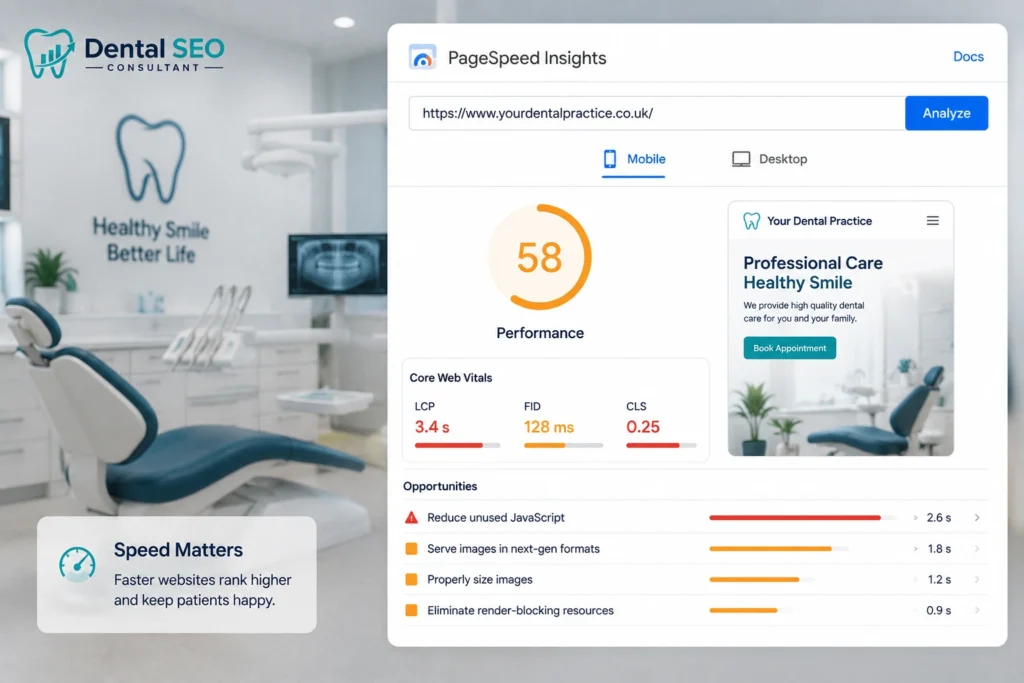
The usual culprits on dental sites:
- Large, uncompressed images, especially treatment galleries and team photos.
- Heavy booking widgets and third-party scripts that block the page from loading.
- No caching or optimisation, so every visit loads everything from scratch.
You can measure this with Google’s free PageSpeed Insights tool, which reports your Core Web Vitals and what is slowing the page down. Speed deserves its own deeper look, but as a technical mistake, an unoptimised, image-heavy site is one of the most common and most fixable.
Mobile Optimisation Mistakes
Most patients search for a dentist on a phone, and Google judges the mobile version of a site first through mobile-first indexing. A site that works on desktop but struggles on mobile is being scored on its weakest version.
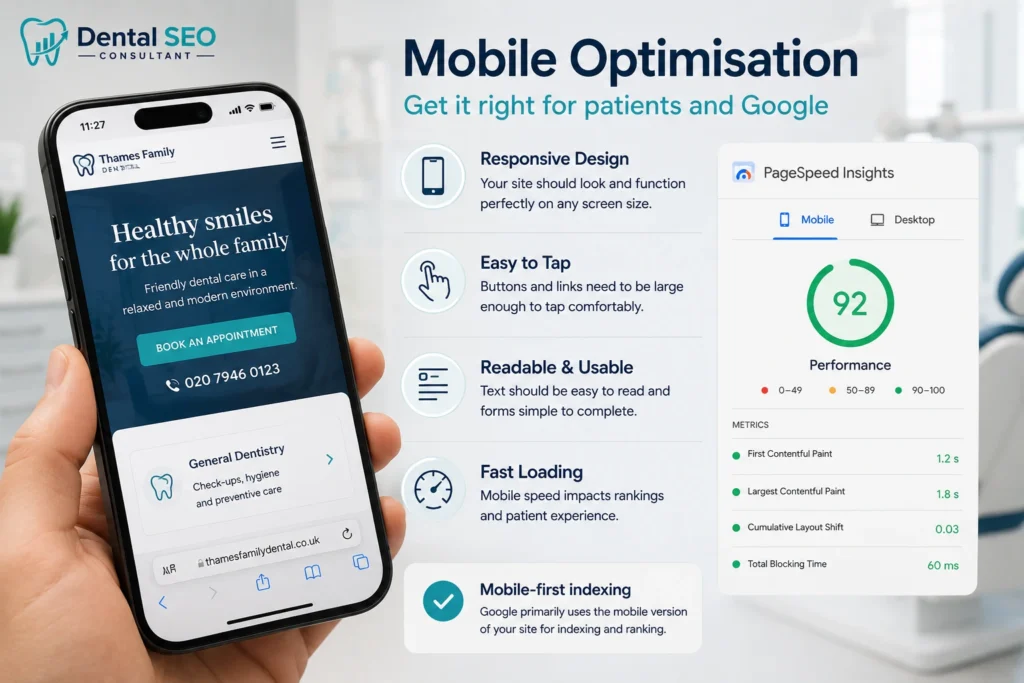
Watch for these mobile mistakes:
- A non-responsive design that does not adapt to smaller screens.
- Tiny tap targets, where buttons and phone numbers are hard to press.
- Text and forms that are awkward to read or complete on a phone.
- Slow mobile loading, which is often worse than desktop.
The fix is a genuinely responsive site that loads fast and is easy to use with a thumb. Test it on a real phone, not just a shrunk browser window, and try to book an appointment yourself to feel the friction a patient does. If the process is fiddly on your own phone, it is losing you patients every day.
Site Structure and Internal Linking Mistakes
How a website is organised affects both how Google crawls it and how authority flows between pages. Messy structure buries important pages and wastes the strength the site has.
The structural mistakes that hurt dental sites:
- Confusing URLs and navigation, making it hard for Google and patients to find pages.
- Weak internal linking, so treatment pages get little support from the rest of the site.
- Broken links and 404 errors, which frustrate patients and waste crawl effort.
- Redirect chains, where one URL bounces through several others before loading.
Fixing these means a clear, logical structure with clean URLs, sensible internal links between related pages, and no dead ends. Strong internal linking in particular helps your key pages rank, and it is a core part of a wider practice SEO strategy.
On-Page Technical Mistakes
These are the code-level details on each page that tell Google what it is about. They are quick to fix but often neglected across a whole dental site.
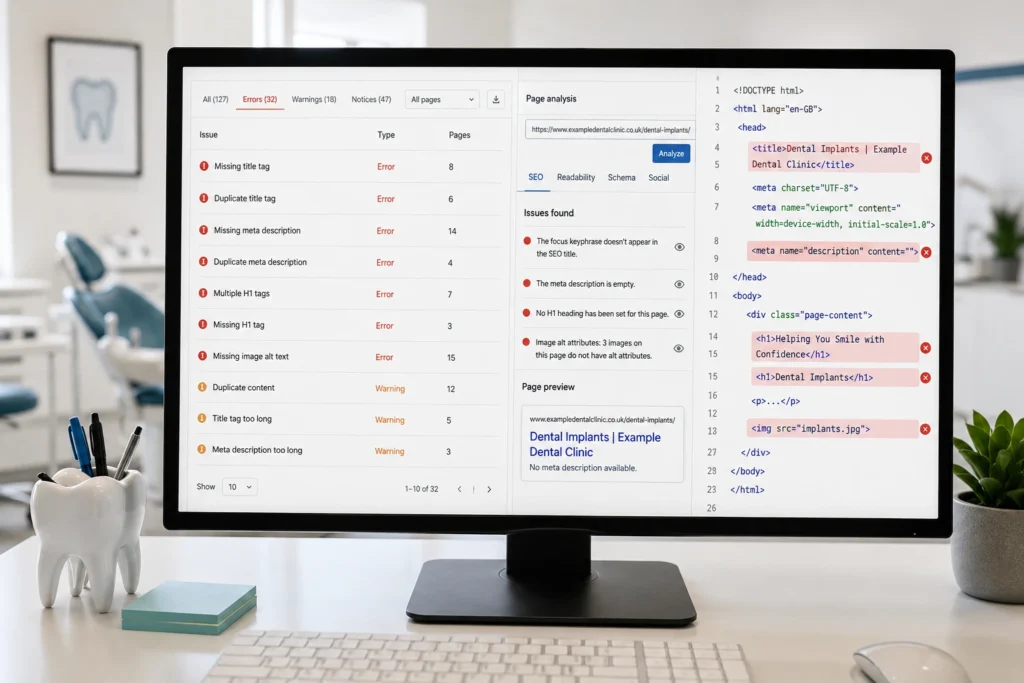
The frequent offenders:
- Missing or duplicate title tags, so pages compete or fail to describe themselves.
- Missing meta descriptions, which weakens click-through from search results.
- No H1, or several H1s, confusing the page’s main topic.
- Missing image alt text, which hurts accessibility and image understanding.
Each page should have one clear H1, a unique title tag and meta description, and descriptive alt text on its images. On a dental site, that means every treatment and location page is described accurately rather than left to a template.
Duplicate and Thin Content Mistakes
Google struggles with pages that are near-identical or too thin to be useful. Dental sites fall into this trap easily, especially with location and treatment pages.
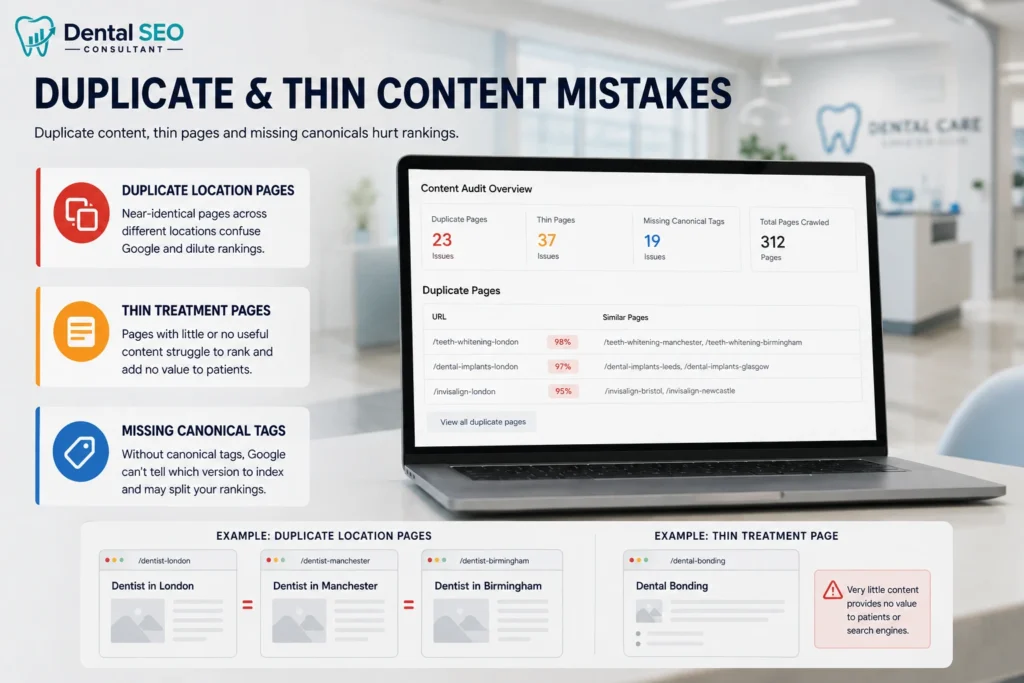
The common issues:
- Duplicate location pages, where several pages are copies with only the town name changed.
- Thin treatment pages that say too little for Google to rank them.
- No canonical tags, so Google cannot tell which version of similar pages to prioritise.
The fix is to make each page genuinely unique and useful, expand thin pages with real information, and use canonical tags correctly where similar pages must exist. Quality and distinctiveness matter more than the number of pages. A practice with ten strong, distinct treatment pages will outperform one with fifty near-identical location pages that Google sees as low value, and in some cases those thin pages can drag down the rest of the site.
Schema Markup Mistakes
Schema markup is code that helps Google understand what a page represents. Dental sites often miss it entirely, or add it incorrectly.
The typical mistakes are having no schema at all, using the wrong type, or adding markup that does not match the visible content, which can do more harm than good. At a minimum, a dental site benefits from Dentist and LocalBusiness structured data. Clean, accurate schema also helps a site appear in AI search answers, since it makes the page easier to understand. Schema deserves careful setup, so treat this as a flag to get it right rather than a quick add-on.
Tracking and Measurement Mistakes
The final mistake is not being able to see any of the others. Many dental practices run a website with no proper tracking, so technical problems go unnoticed for months.
The essentials every dental site needs:
- Google Search Console, to see indexing, errors and search performance.
- Analytics, to understand how patients use the site and where they drop off.
- Regular checks, so problems are caught early rather than after rankings fall.
Without these, a practice is flying blind. With them, most technical issues show up clearly, and you can watch improvements take effect. Because technical fixes take time to feed through, it helps to know how long SEO changes usually take to show results before judging them.
How to Audit Your Dental Website for Technical Mistakes
You do not need to guess which of these mistakes apply to your site. A structured check finds them.
A practical audit runs through:
- Indexing, checking Search Console for pages Google has skipped.
- Speed, running key pages through PageSpeed Insights.
- Mobile, testing the site on a real phone.
- Structure, looking for broken links, orphan pages and messy navigation.
- On-page, checking titles, meta, H1s and alt text.
- Tracking, confirming Search Console and analytics are set up.
Working through this list turns vague worry into a clear to-do list. It also overlaps with the wider local SEO checklist, since technical health underpins local visibility too. For a done-for-you version, a free audit pinpoints the exact technical issues holding your site back.
How to Prioritise Technical Fixes
Not every technical issue is equally urgent, and fixing them in the right order gets results faster. Some problems block everything else, while others simply add polish.
A sensible order:
- Indexing first. If pages are not indexed, nothing else can help them, so fix this before anything.
- Mobile and speed next. These affect both ranking and whether patients stay on the site.
- Structure and internal linking. Make sure authority flows to your key treatment pages.
- On-page details. Titles, meta descriptions, H1s and alt text across the site.
- Schema and tracking. Help Google understand the site and let you measure progress.
Start at the top. A page that is not indexed gains nothing from a faster load time, so indexing always comes first. Once the foundations are sound, the smaller on-page details are worth the attention.
FAQ
What are the most common technical SEO mistakes on dental websites?
The most common are pages Google cannot crawl or index, slow loading on mobile, weak site structure and internal linking, missing or duplicate title tags, thin or duplicated content, missing schema, and no proper tracking. Each one can stop good content from ranking, and most are quick to fix once found.
Why is my dental website not showing on Google?
The usual cause is technical. The page may carry a noindex tag, be blocked in robots.txt, or simply never have been indexed. Other causes include a brand new site Google has not trusted yet, or an orphan page with no internal links. Checking the indexing report in Google Search Console is the first step.
Does website speed affect dental SEO?
Yes. Site speed is a ranking factor through Core Web Vitals, and it strongly affects whether patients stay or leave. Dental sites are often slowed by large images and heavy booking widgets. A slow site on mobile, where most patients search, is one of the most common and damaging technical issues.
How do I know if my dental website has technical problems?
Set up Google Search Console and check its indexing and experience reports, run key pages through PageSpeed Insights, and test the site on a real phone. These free checks reveal most technical issues, from unindexed pages to slow loading and mobile problems. A professional audit goes deeper.
Can technical SEO mistakes stop good content from ranking?
Absolutely. If Google cannot crawl or index a page, its content cannot rank no matter how good it is. Slow speed, poor mobile usability and weak structure all suppress otherwise strong pages too. This is why technical fixes are often the fastest way to improve a dental site’s visibility.
How often should a dental website be checked for technical issues?
Check Google Search Console regularly, ideally monthly, for new indexing or experience errors. Run a fuller technical audit once or twice a year, and always after a website redesign or major change, since those often introduce new problems. Catching issues early prevents them from quietly costing patients.
Can a website redesign hurt a dental practice’s SEO?
It can, if handled carelessly. Redesigns often change URLs, remove content or introduce new technical errors, any of which can drop rankings. The risk is avoidable with proper redirects, preserved content and a technical check afterwards. Always audit a redesigned site before and after launch, and monitor Search Console closely in the weeks that follow.
Conclusion
Technical SEO mistakes are the hidden reason many dental websites underperform. Pages Google cannot index, slow mobile loading, messy structure, missing tags, thin content and no tracking all hold a site back long before content and links come into play. The good news is that these problems are findable and fixable, and clearing them often produces the fastest gains.
Start by checking which pages are indexed, test your speed and mobile experience, and make sure tracking is in place. If you would rather have the technical issues found and fixed for you, a dental SEO consultant can audit your site and clear the barriers holding it back.