How Fast Should a Dental Website Load?
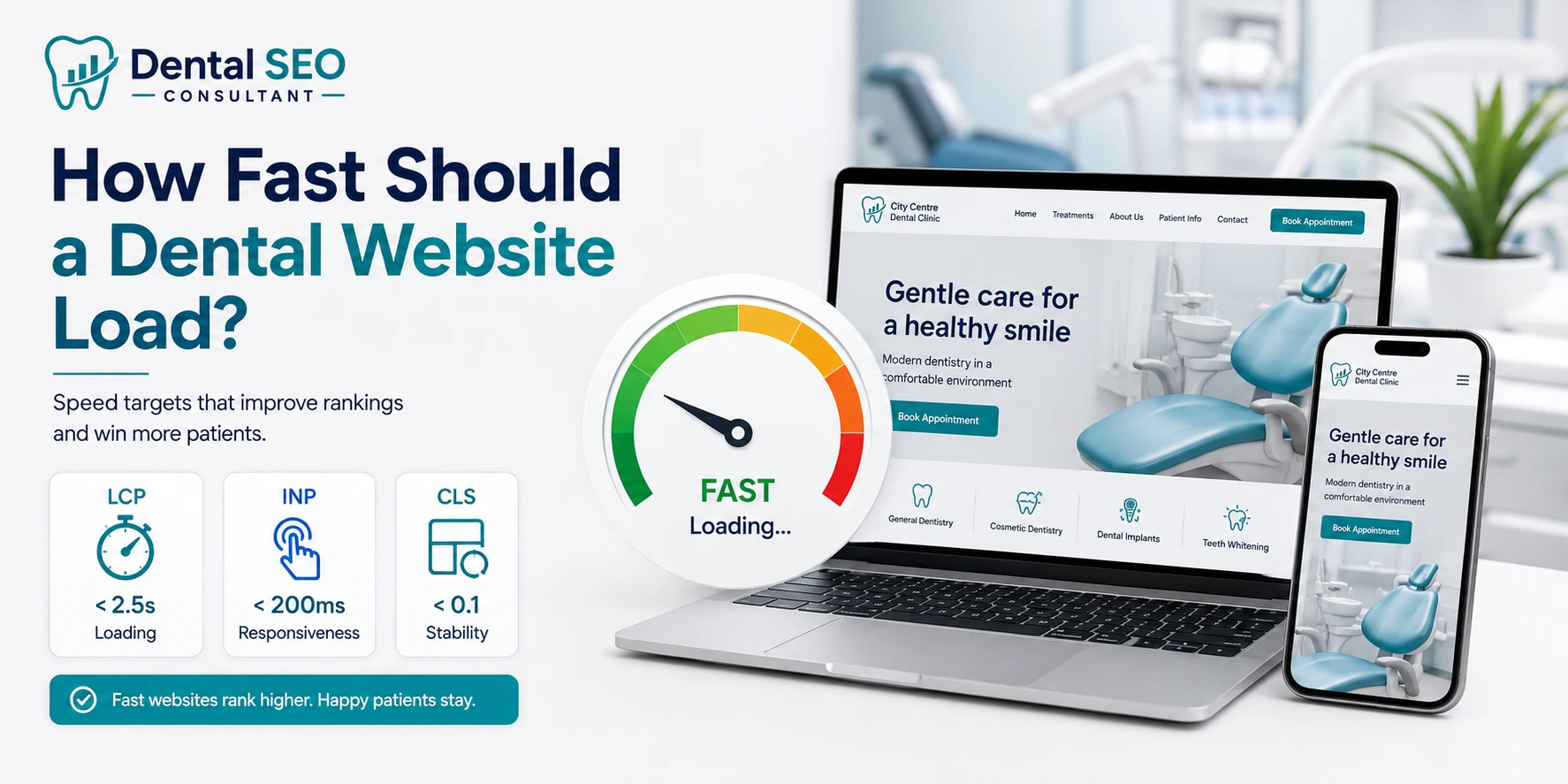
A dental website should load its main content within 2.5 seconds, respond to taps in under 200 milliseconds, and stay visually stable while loading. These are Google’s Core Web Vitals targets: LCP under 2.5 seconds, INP under 200 milliseconds, and CLS under 0.1. Speed is both a ranking signal and a patient experience issue, because a slow site loses visitors who simply leave and call another practice.
Introduction
Patients are impatient, and phones make them more so. Someone searching for a dentist in pain will not wait for a slow page to load. They tap the next result. That single behaviour, multiplied across every search, is why website speed quietly decides how many patients a practice wins or loses.
Speed is also something Google measures directly and uses to rank pages. This guide explains how fast a dental website should load, what the Core Web Vitals targets actually mean, what slows dental sites down, and how to fix it. The numbers are current for 2026, and the advice is practical rather than technical for its own sake.
How Fast Should a Dental Website Load?
The short answer is that the main content should appear within 2.5 seconds, and the whole page should feel usable almost immediately. Beyond that point, visitors start leaving, and the drop-off gets steeper with every extra second.
Google measures this precisely through Core Web Vitals rather than a single “load time” number, because how fast a page feels depends on more than raw speed. A page can show something quickly but be unusable, or look ready then jump around as it loads. The targets below capture all of that. Getting there is the job of solid website SEO, where speed sits alongside crawlability and mobile usability.
It is worth setting a realistic expectation. Very few dental sites need to be the fastest on the internet. They need to be fast enough that patients do not leave and Google does not penalise them, which the targets below define clearly.
What Are Core Web Vitals?
Core Web Vitals are three metrics Google uses to measure the real experience of loading a page. They come from actual Chrome users, not lab tests, and Google grades a page on the experience of most of its visitors.
| Metric | What it measures | Good target |
|---|---|---|
| LCP (Largest Contentful Paint) | How fast the main content loads | Under 2.5 seconds |
| INP (Interaction to Next Paint) | How quickly the page responds to a tap | Under 200 milliseconds |
| CLS (Cumulative Layout Shift) | How stable the layout stays while loading | Under 0.1 |
A page passes only when at least three-quarters of real visits hit all three targets at once. INP replaced the older First Input Delay metric in March 2024, and it is the one most sites fail, because it depends on how heavy a page’s code is. Google’s own Core Web Vitals documentation sets out these thresholds in full. Understanding these metrics is important when avoiding common technical SEO mistakes on dental websites.
Worth knowing: only around half of all websites pass all three Core Web Vitals, and the pass rate is lower on mobile than desktop. So a dental site that gets this right is ahead of a large share of its competitors, not just meeting a baseline. The gap is widest on phones, which is exactly where most dental searches happen.
Why Website Speed Matters for Dental Practices
Speed matters for two separate reasons: it affects rankings, and it affects whether visitors turn into patients. Both hit a practice’s bottom line.
- Rankings. Core Web Vitals are a confirmed part of Google’s page experience signals. They rarely outrank strong content on their own, but they act as a tiebreaker between similar pages, and a slow site is a disadvantage.
- Conversions. A faster site keeps more visitors. When a page loads slowly, people leave before it appears, and every one of those is a patient who went elsewhere.
- Mobile. Most dental searches happen on phones, often on slower connections, so speed matters most exactly where most patients are.
The way these signals feed into rankings is covered in the guide to how Google ranks dental websites. Local SEO citations can also support a practice’s local visibility, while a fast site gives the practice more chances to turn a search into a booking.
Does a Slow Website Lose Dental Patients?
Yes, and more than most practices realise. The damage is invisible, because the patients who leave never call, never email, and never appear in any report. They just quietly go to a competitor whose site loaded faster.
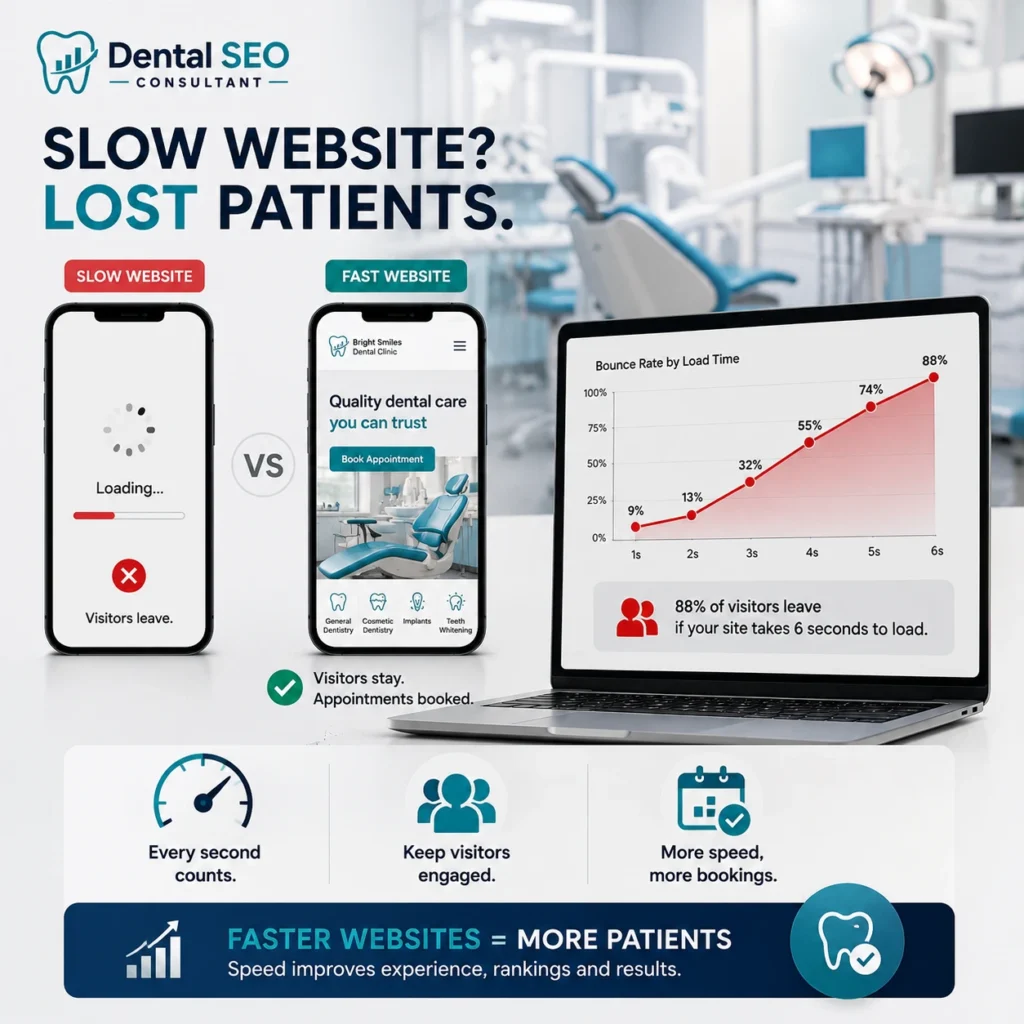
The pattern is well established. As a page gets slower, more visitors abandon it before it even finishes loading, and the rate climbs sharply after the first few seconds. On a phone, on mobile data, in a moment of need, patience is at its thinnest. A dentist could rank well, run ads, and earn great reviews, then lose the patient in the last two seconds because a page stalled. Technical elements such as dental schema markup can support search visibility, but they cannot compensate for a poor website experience.
This is why speed is not only a technical concern. It is a direct link between the traffic a practice works hard to earn and the bookings it actually gets. Every second shaved off loading time is a few more patients who stay long enough to choose you.
What Slows Dental Websites Down
Dental websites tend to be slow for a predictable set of reasons. Knowing them tells you where to look first.
- Large, uncompressed images. Treatment galleries, before-and-after photos, and team pictures are often huge files that drag down loading.
- Heavy booking widgets and third-party scripts. Booking tools, chat widgets and tracking scripts can block the page from becoming usable.
- Slow hosting. A cheap or overloaded server takes too long to respond before the page even starts loading.
- Unoptimised code. Bloated themes and excess JavaScript make the page heavier than it needs to be.
- Missing image dimensions. Images without set width and height cause the layout to jump, hurting stability.
Most dental sites suffer from the first two. Fixing images and taming heavy scripts often solves the bulk of the problem, and it is a core part of a wider practice SEO setup. The good news is that the biggest causes are also the easiest to fix, so a slow dental site is rarely slow for reasons that cannot be sorted.
How to Test Your Dental Website Speed
You do not have to guess how fast your site is. Free tools measure it and show what to fix.
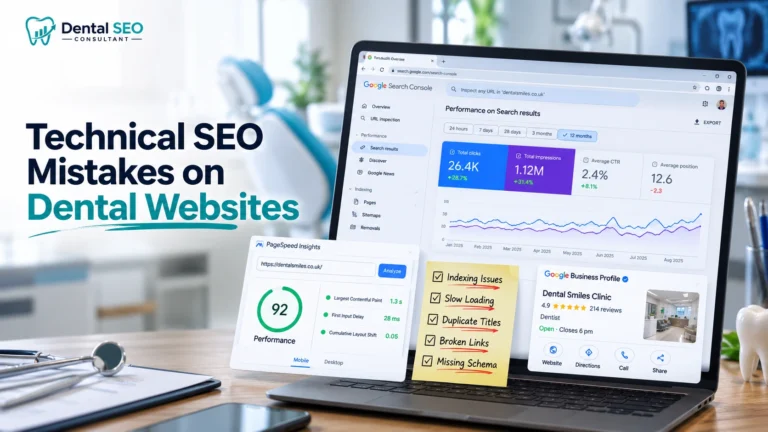
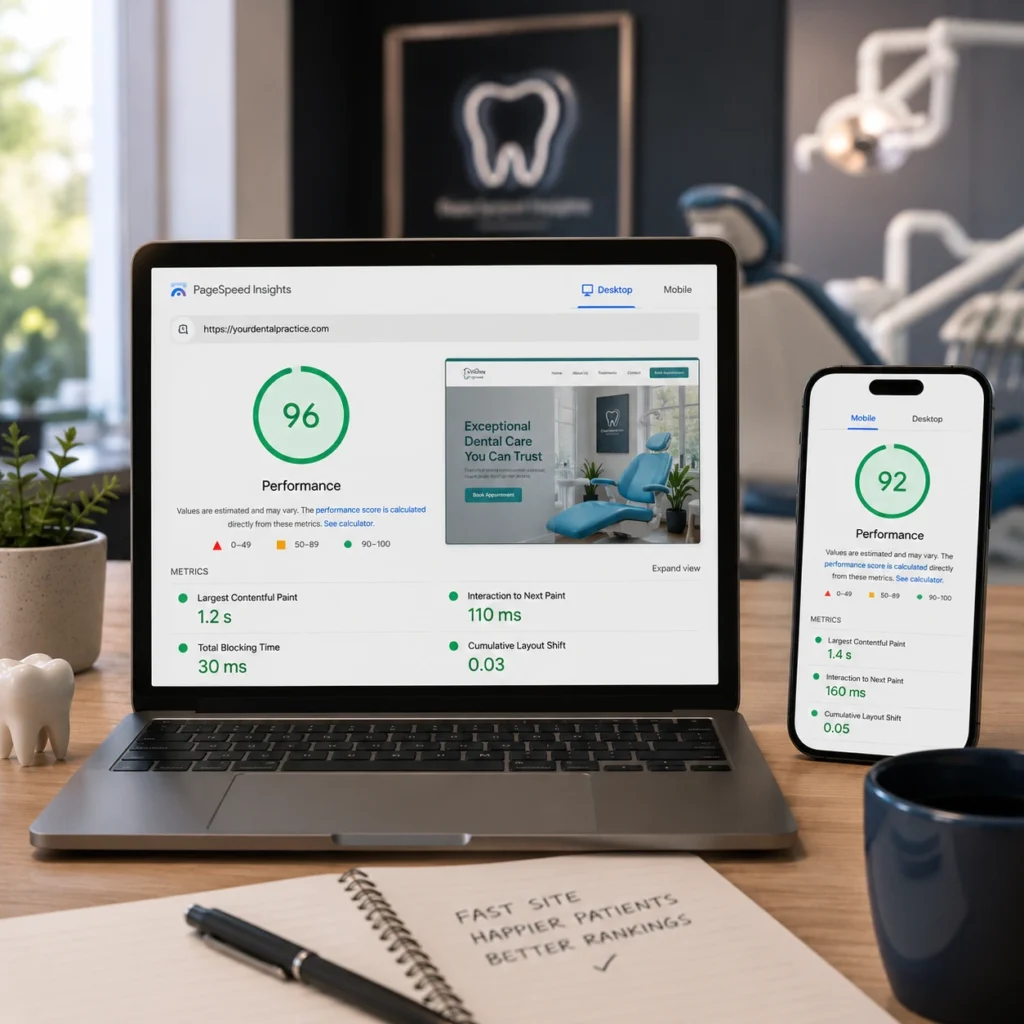
- PageSpeed Insights. Google’s free PageSpeed Insights tool reports your Core Web Vitals and lists the specific issues slowing a page down.
- Google Search Console. Its Core Web Vitals report shows how groups of pages perform across the whole site, using real visitor data.
- Real device testing. Load the site on an average phone on mobile data, not just office wifi, to feel what patients feel.
One thing to understand: the score from a lab tool like Lighthouse is a guide, not your grade. Google judges you on real user data, so a page can look fine in testing yet fail for real visitors on slower phones. The reverse happens too, where a lab score looks poor but real users are fine. Always trust the field data over a single lab test. This kind of testing belongs in any regular site review, alongside the wider local SEO checklist.
How to Improve Each Core Web Vital
Each metric has its own fixes. Tackle whichever is furthest from its target first.
Improving LCP (Loading)
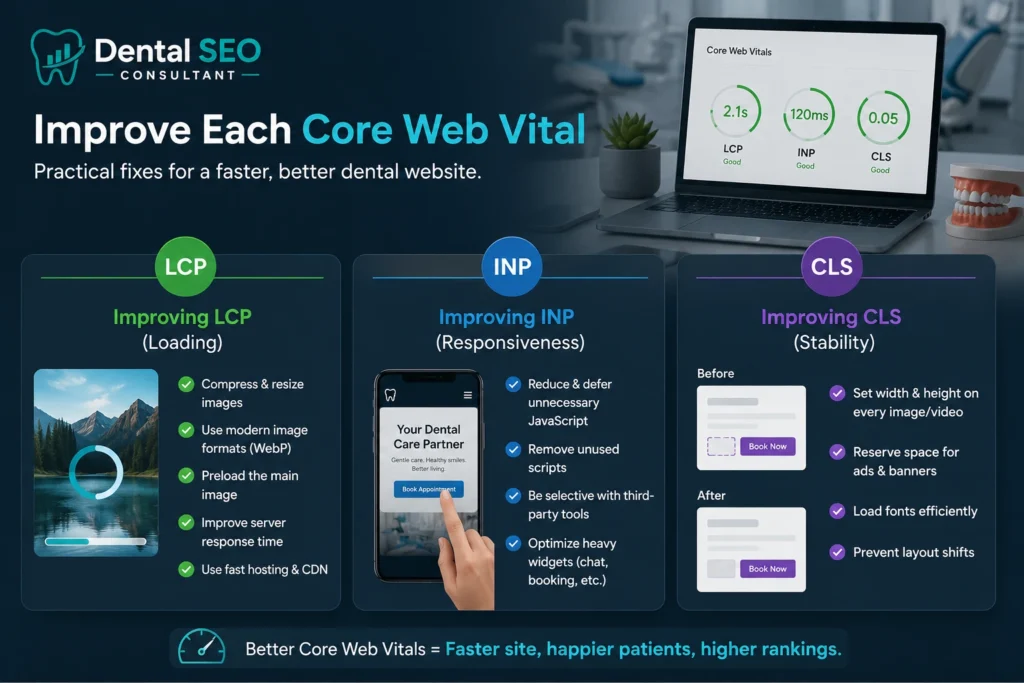
LCP is usually about the biggest thing on the page, often an image. Compress and correctly size images, use a modern format, preload the main image, and improve server response time. Faster hosting and a content delivery network help here too. On a typical dental homepage, the large hero image or a slider is often the LCP element, so optimising that one image can move the score noticeably.
Improving INP (Responsiveness)
INP is about how quickly the page reacts when someone taps. It is driven by heavy code running in the background. Reduce and defer unnecessary JavaScript, remove scripts you do not need, and be selective with third-party tools like chat and booking widgets that run on every page. INP is the hardest of the three to fix, because it is about how the code is built rather than a single file to compress, so it often needs a developer.
Improving CLS (Stability)
CLS is about the page not jumping around as it loads. Set explicit width and height on every image, video and embedded element, reserve space for ads or banners, and load fonts in a way that does not shift the text. These are small fixes that make a page feel far more solid. Patients rarely notice good stability, but they definitely notice a button that jumps just as they tap it, and on a dental site that button is often “book now”.
For a practice without the time or technical skill, this is exactly the kind of work a dental SEO consultant handles as part of a technical tune-up.
Quick Wins to Speed Up a Dental Website
Some speed improvements need a developer, but several are quick and deliver most of the gain. Start with these.
- Compress and resize every image. This alone fixes the biggest problem on most dental sites.
- Use modern image formats like WebP, which are far smaller than older ones.
- Enable lazy loading, so images below the fold load only when needed.
- Turn on caching, so returning visitors and repeat pages load faster.
- Remove unused plugins and scripts, especially old tracking or chat tools no longer in use.
- Review your booking widget, since a heavy one can slow every page it sits on.
- Check your hosting, and upgrade if the server is slow to respond.
Working through this list usually moves a dental site from slow to acceptable without a full rebuild. The heavier work, such as reducing JavaScript or restructuring the theme, comes after these basics are done.
Speed, Mobile and Local SEO
Speed and local visibility are linked more closely than they look. Most “dentist near me” searches happen on phones, and a slow mobile site both ranks worse and loses the patient once they arrive.
A fast, stable mobile experience supports the same local goals as a strong profile and good reviews. It helps convert the visitor a local search sends you, so the effort that goes into ranking in the map pack is not wasted at the final step. A slow site quietly undoes local SEO by turning hard-won visitors away.
How Long Do Speed Fixes Take to Show Results?
Speed improvements themselves are immediate. The moment you compress images or fix the code, the site loads faster for the next visitor. What takes longer is Google recognising it.
Because Core Web Vitals are scored on a rolling 28-day window of real user data, it usually takes a few weeks after a fix for the reported scores to update and for any ranking benefit to follow. This is normal, and it fits the wider pattern of how long SEO changes take to show. The patient experience improvement, though, is instant.
FAQ
How fast should a dental website load?
The main content should load within 2.5 seconds, the page should respond to taps in under 200 milliseconds, and it should stay visually stable while loading. These match Google’s Core Web Vitals targets. Beyond about three seconds, visitors start leaving, so faster is always better for both ranking and winning patients.
What are good Core Web Vitals scores for a dentist?
The good targets are LCP under 2.5 seconds, INP under 200 milliseconds, and CLS under 0.1, measured from real visitors. A page passes only when at least 75% of real visits meet all three at once. INP is the one most sites fail, because it depends on how heavy the page’s code is.
Does website speed affect Google rankings for dentists?
Yes. Core Web Vitals are part of Google’s page experience signals. Speed alone will not beat stronger content, but it acts as a tiebreaker between similar pages, and a slow site is a clear disadvantage. It also affects conversions, so a faster site both ranks and performs better.
Why is my dental website slow?
The usual causes are large uncompressed images, heavy booking or chat widgets and third-party scripts, slow hosting, and bloated code. On dental sites, images and scripts are the biggest culprits. Testing the site in PageSpeed Insights will show the specific issues rather than leaving you to guess.
How do I test my dental website’s speed?
Use Google’s PageSpeed Insights for a page-by-page report, and the Core Web Vitals report in Google Search Console for a site-wide view from real visitors. Also load the site on an average phone on mobile data. Remember that lab scores are a guide, while Google grades you on real user data.
Will making my dental website faster get me more patients?
It helps. A faster site keeps more visitors who would otherwise leave, which means more of the people who find you actually book. Combined with the small ranking benefit, speed improvements tend to pay off in both visibility and conversions, especially on mobile where most patients search.
What is a good page load time for a dental website?
Aim for the main content to appear within 2.5 seconds, which matches Google’s LCP target. Under two seconds is better still. Because Google measures the experience of real visitors on real devices, the goal is for the site to feel fast for most patients, not just to score well on a single test.
Do booking widgets slow down a dental website?
They can. Many booking and chat widgets load heavy third-party code on every page, which delays how quickly the page responds and sometimes how fast it loads. It is worth checking whether yours has a noticeable impact, and choosing a lighter option or loading it only where needed if it does.
Conclusion
A dental website should load its main content within 2.5 seconds, respond to taps almost instantly, and stay stable as it loads. Those Core Web Vitals targets are how Google measures speed, and hitting them helps a practice both rank and convert. Most dental sites fall short for the same reasons: heavy images and scripts, and both are fixable.
Test your site, fix the biggest problems first, and check the results after a few weeks. Speed is one of the few technical levers where the benefit is felt twice: patients get a better experience straight away, and Google rewards it over the following weeks. If you would rather have the speed and technical issues found and fixed properly, a free dental SEO audit will show exactly how your site performs and what to improve first.