On-Page SEO for Dental Websites
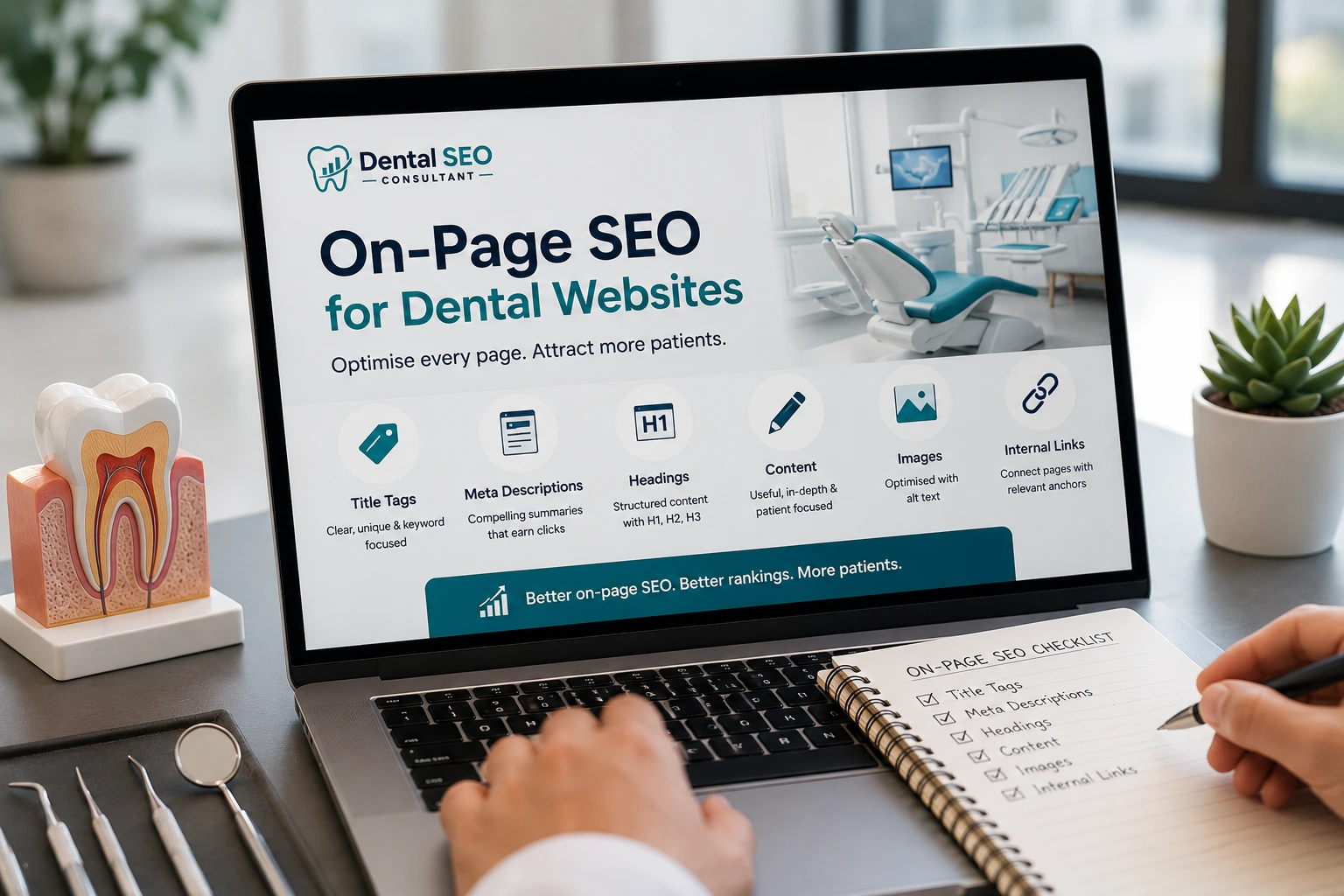
On-page SEO for a dental website means optimising everything on each page so Google and patients understand it: the title tag, meta description, URL, headings, keywords, content, images, and internal links. Done well, it helps each treatment and location page rank for the searches patients use, and it makes the page clearer, more useful and more likely to turn a visitor into a booking.
Introduction
On-page SEO is the part of SEO a practice has the most control over. Unlike rankings, which Google decides, or links, which others give you, the content and structure of your own pages are entirely yours to shape. That makes it one of the highest-value places to spend effort.
This guide covers on-page SEO for dental websites in practical terms. It works through each element of a well-optimised page, from the title tag to internal links, and shows how to get each one right. It focuses on what goes on the page itself, so it sits alongside the technical and off-page work rather than repeating it.
What Is On-Page SEO for a Dental Website?
On-page SEO is the practice of optimising individual pages to rank higher and serve patients better. It covers the visible content and the behind-the-scenes elements that describe each page, all within the page itself.
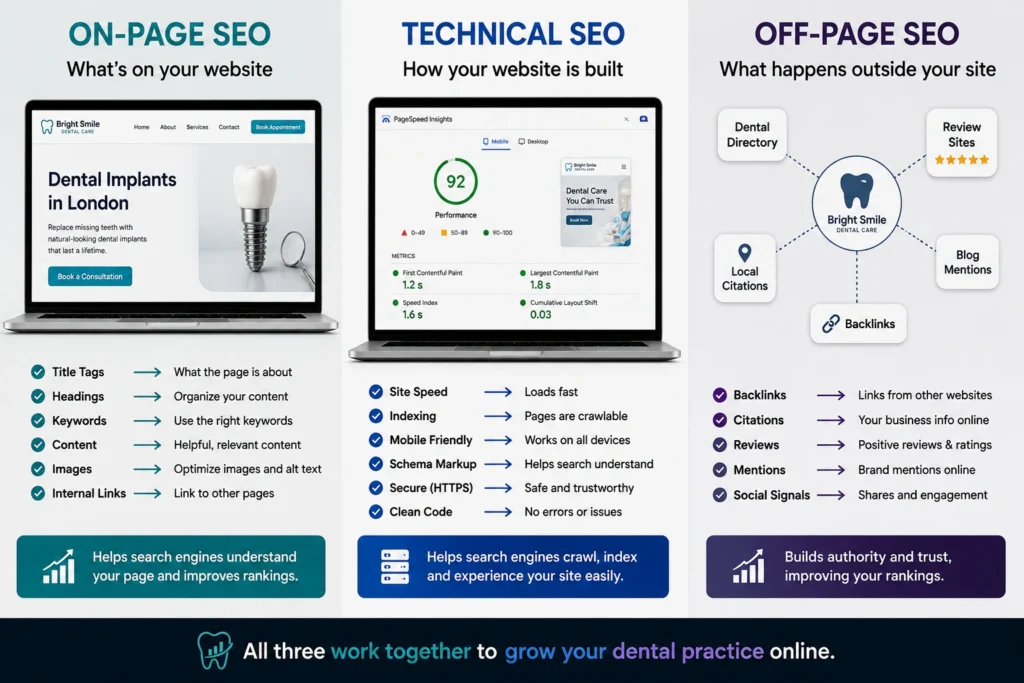
It is one of three parts of SEO. On-page is the content and structure of your pages. Technical SEO is how the site is built and crawled. Off-page SEO is what happens elsewhere, mainly links and mentions. All three matter, and on-page is where a practice can make the fastest direct improvements. It builds on the foundations covered in what dental SEO involves. The reason on-page is such a good place to focus first is simple: you do not need anyone’s permission or a developer to rewrite a title or improve a page’s content, so the results are yours to earn.
On-Page vs Technical vs Off-Page SEO
These three often get muddled, so it helps to separate them clearly. Each does a different job, and this guide is only about the first.
| Type | What it covers | Examples |
|---|---|---|
| On-page SEO | Content and elements on each page | Titles, headings, keywords, content, images |
| Technical SEO | How the site is built and crawled | Speed, indexing, mobile, schema |
| Off-page SEO | Signals from outside the site | Backlinks, citations, mentions |
This article stays on the first column. The technical side, such as speed and indexing, is a separate area handled through website SEO, and the two work together on any well-optimised dental page.
The On-Page SEO Checklist for Dentists
Here is the full set of on-page elements to optimise on a dental page. Each is explained in the sections that follow.
| Element | Goal |
|---|---|
| Title tag | Describe the page and include the key term |
| Meta description | Earn the click from search results |
| URL | Short, readable, keyword-relevant |
| Headings | Clear structure with one H1 |
| Keywords | Used naturally, matched to intent |
| Content | Deep, useful, credible and compliant |
| Images | Optimised with descriptive alt text |
| Internal links | Connect related pages with clear anchors |
A page that ticks every row is well optimised. Most dental pages miss several, which is where the opportunity sits. For practices targeting local patients, local citations for dentists can support this work by strengthening location and business signals beyond the website.
Optimising Title Tags and Meta Descriptions
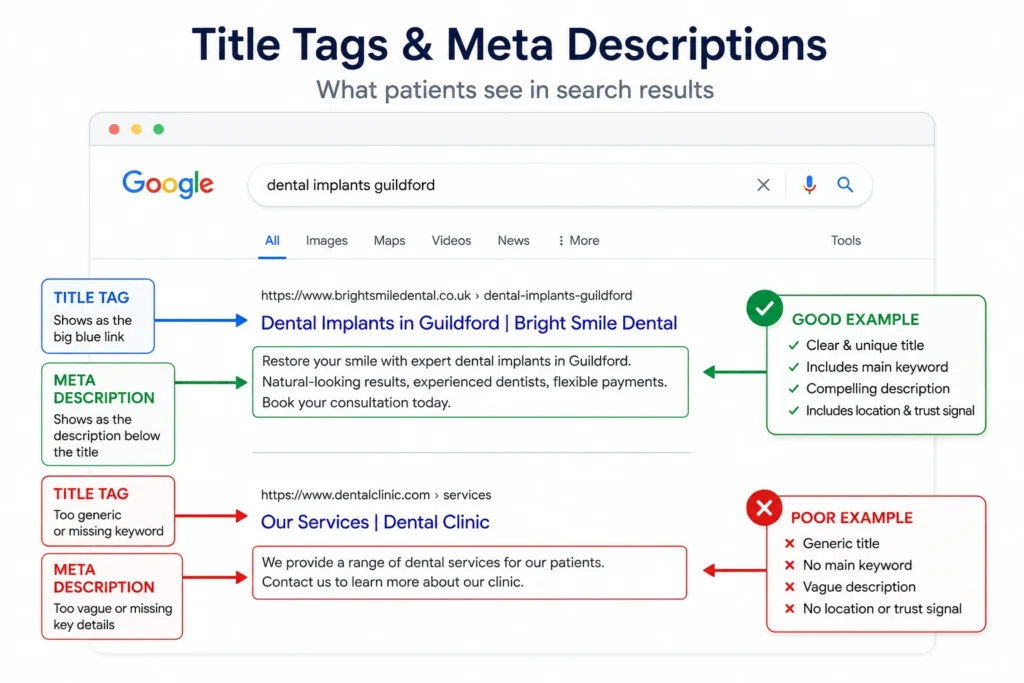
The title tag and meta description are what a patient sees in search results, so they do double duty: helping the page rank and earning the click.
Title Tags
The title tag is one of the strongest on-page signals. Each page needs a unique one that describes the page and includes its main term, ideally near the front. For a treatment page, something like “Dental Implants in Guildford” is clear to both Google and patients. Keep it concise so it does not get cut off. Google explains how it chooses and displays these in its title link guidance.
Meta Descriptions
The meta description does not directly affect ranking, but it heavily influences whether someone clicks. Write a unique one for each page that summarises what the patient will find and gives a reason to choose you. A flat or missing description wastes the chance to stand out in the results, and Google will often just pull a random line from the page instead. For a dental page, a good description hints at the treatment, the location, and a reason to trust the practice, all within the space search results allow.
URLs and Heading Structure
The URL and headings shape how both Google and patients understand a page’s content and organisation.
URL Structure
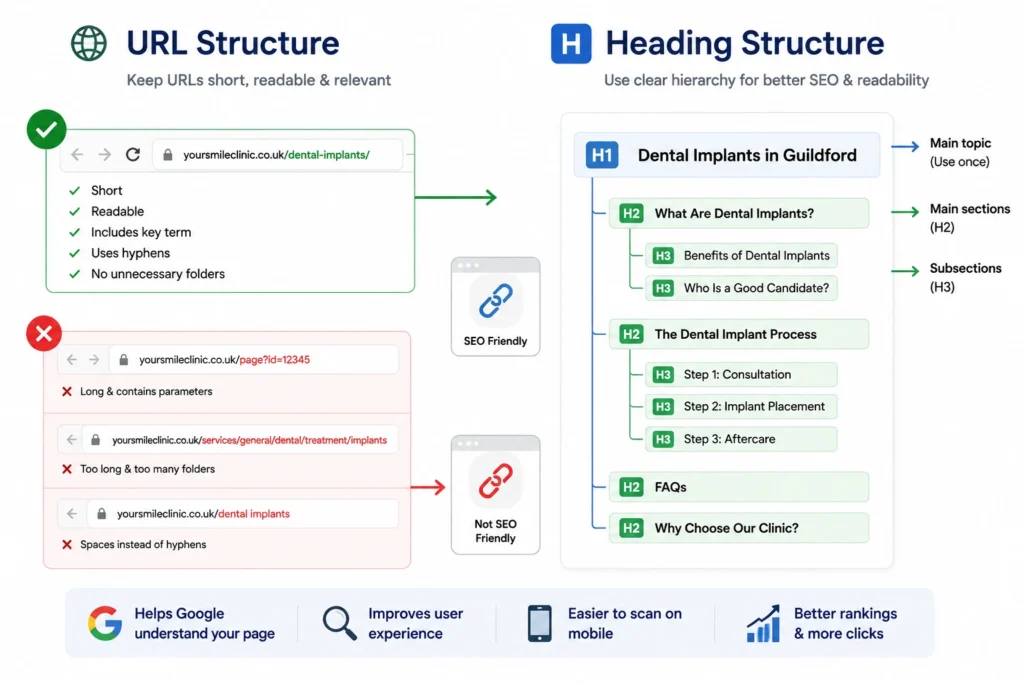
Keep URLs short, readable and relevant. A URL like /dental-implants/ is far better than a string of numbers or a long, messy path. Include the key term, use hyphens between words, and avoid unnecessary folders. Once set, avoid changing URLs without proper redirects. This is also important when optimising pages for dental website speed, as unnecessary URL changes can create additional technical issues.
Headings
Headings give a page structure. Use a single H1 that states the page’s main topic, then H2s and H3s to organise the sections beneath it in a logical order. Good heading structure helps Google understand the page and makes it easier for patients to scan, which matters most on mobile. A well-structured page reads clearly even if someone only skims the headings. Clear structure also feeds the signals covered in how Google ranks dental sites.
Keywords and Content on the Page
Keywords and content are the heart of on-page SEO. This is where a page proves it deserves to rank for what a patient searched.
Keyword Placement
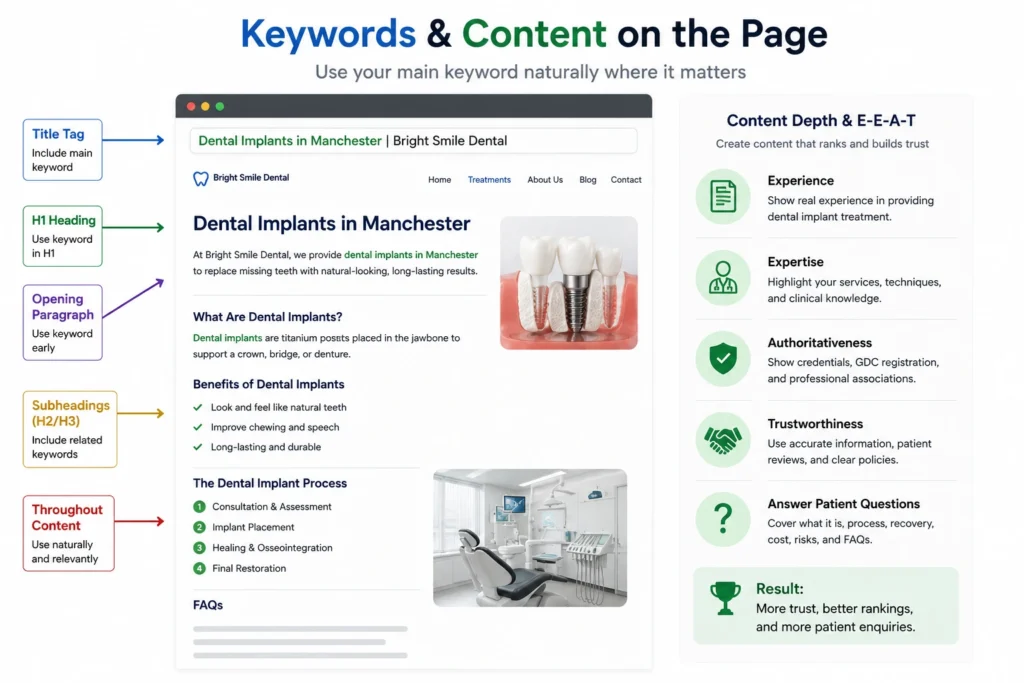
Use the page’s main term where it matters: the title, the H1, the opening paragraph, and naturally through the content. Include related terms and the local area too. What matters is natural, relevant use, not repetition. Keyword stuffing, the old habit of forcing a term in repeatedly, now works against you. This is about placement, not keyword research, which is a separate task. A good rule is to write for the patient first, then check that the key term and its variations appear where they naturally fit.
Content Depth and E-E-A-T
Google rewards content that genuinely answers the searcher. A treatment page should explain what the procedure involves, what to expect, recovery, and common questions, rather than a few marketing lines. For dental content, which Google treats as health information, credibility matters: name the clinicians, show their GDC registration, and keep claims accurate and compliant. Depth and trust together are what make a page rank and reassure a patient. A useful test is to ask whether the page answers the questions a nervous patient would have before booking. If it does, it is usually deep enough; if it only sells, it is too thin. These same principles can also help practices understand how to choose a dental SEO company that takes content quality and compliance seriously.
Images, Internal Links and AEO
Three more on-page elements round out a well-optimised dental page.
Images and Alt Text
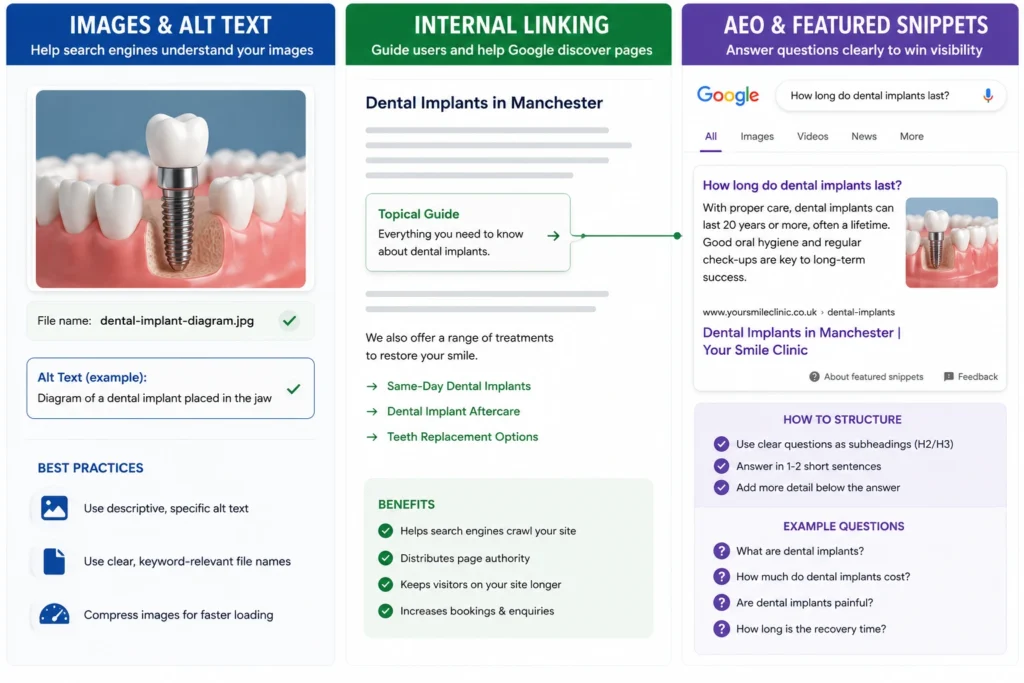
Every meaningful image should have descriptive alt text that explains what it shows, which helps accessibility and image understanding. Use sensible file names too, such as dental-implant-diagram rather than IMG_1234. Keeping images optimised also supports the page, though the loading side of that sits within technical SEO.
Internal Linking
Link related pages to each other with short, descriptive anchor text. A treatment page might link to a relevant guide, and a blog post might link to the treatment page it supports. For example, a page about paid search can link to a PPC for dentists guide when the topic is relevant. Good internal linking helps Google find and understand pages, and guides patients toward booking. Each link should feel natural and point somewhere genuinely useful.
Formatting for AI and Featured Snippets
Structuring content as clear questions and direct answers helps a page win featured snippets and get picked up by AI search. Lead a section with the question a patient asks, answer it plainly, then add detail. This is central to optimising for AI search, and it makes pages easier for everyone to read.
Local On-Page Signals for Dentists
For a dental practice, on-page SEO has a local dimension. The pages themselves should signal where the practice is and who it serves.
Include the town or area naturally in titles, headings, and content on relevant pages, show the full address and contact details, and build dedicated pages for the treatments and locations that matter. These on-page local signals support the practice’s visibility in the map pack and work alongside the wider local SEO effort. On-page and local SEO reinforce each other, because the same page that ranks organically for “dental implants [town]” also signals to Google where the practice serves, which feeds local results too.
How to Optimise a Dental Treatment Page Step by Step
Bringing it together, here is how the elements apply to a single page, using a dental implants page as the example.
- Title tag: something like “Dental Implants in [Town] | [Practice Name]”.
- URL: keep it clean, such as /dental-implants/.
- H1: Dental Implants in [Town], stated once and clearly.
- Opening lines: answer the main question straight away, such as what implants are and what to expect.
- Body: cover the procedure, who it suits, recovery, cost factors, and common questions, organised with H2s and H3s.
- Trust: name the treating dentist, show GDC registration, and keep every claim accurate and compliant.
- Images: real photos of the practice or process, with descriptive alt text.
- Internal links: link to related pages with short, natural anchors.
- Local: mention the area naturally and show the address and contact details.
Do this for each high-value treatment and you build a set of pages that each rank for their own search. Google’s SEO Starter Guide covers these fundamentals in general terms, and the steps above are how they apply to a dental page in particular.
Common On-Page SEO Mistakes
Dental pages tend to fall down on the same on-page issues. Avoid these:
- Duplicate or missing title tags, so pages fail to describe themselves.
- One generic services page instead of a dedicated page per treatment.
- Thin content that says too little to rank or reassure.
- Keyword stuffing, which now harms rather than helps.
- Missing alt text and unhelpful image file names.
- No internal links, leaving pages isolated.
- Ignoring the local angle, so pages never mention the area served.
Most of these are quick to fix once spotted, and fixing them lifts pages that are otherwise held back for no good reason. For issues beyond the page itself, it is also worth checking for technical SEO mistakes that may affect how Google crawls and indexes the site.
How On-Page SEO Fits with the Rest of SEO
On-page SEO is powerful, but it is one part of a whole. A perfectly optimised page still needs a technically sound site to sit on and some authority behind it to compete.
Think of on-page as making each page the best it can be, then technical SEO as making sure Google can access it, and off-page as building the trust to outrank rivals. On-page is usually the best place to start, because it is fully in your control and it appears as a core part of the wider local SEO checklist and a full practice SEO strategy.
FAQ
What is on-page SEO for a dental website?
On-page SEO is optimising the elements on each page so Google and patients understand it. It includes the title tag, meta description, URL, headings, keywords, content, images and internal links. For a dentist, it is what helps each treatment and location page rank for the searches patients use, and it is the part of SEO you control most directly.
What are the most important on-page SEO elements for dentists?
The title tag, headings and content matter most, because they tell Google and patients what a page is about. Unique, descriptive titles, a clear heading structure, and deep, credible content on each treatment do the heavy lifting. Internal links, image alt text, and local signals then reinforce them.
How is on-page SEO different from technical SEO?
On-page SEO is about the content and elements on each page, such as titles, headings and text. Technical SEO is about how the site is built and crawled, such as speed, indexing and mobile usability. Both matter and work together, but they are separate areas. On-page is usually easier to improve directly.
Does keyword placement still matter for dental SEO?
Yes, but naturally rather than by force. Using the main term in the title, H1, opening and through the content, along with related and local terms, helps a page rank for the right searches. Keyword stuffing, repeating a term unnaturally, now works against a page, so the goal is relevant, natural use.
How much content should a dental treatment page have?
Enough to genuinely answer the patient, which usually means more than a few marketing lines. Cover what the treatment involves, what to expect, recovery, cost factors and common questions. Depth helps ranking and reassures patients, but padding does not. Quality and usefulness matter more than hitting a specific word count.
Can I do on-page SEO myself for my dental practice?
Much of it, yes. Writing unique titles, structuring headings, improving content and adding internal links are all within reach for a practice. The trickier parts, such as matching pages to search intent and keeping health content compliant, benefit from experience, but on-page is the most accessible place to start improving your own site.
How many pages should a dental website have for SEO?
There is no fixed number, but each high-value treatment should have its own page rather than being lumped onto a single services page. A typical practice needs pages for its main treatments, key locations, the team, and supporting content. Quality matters more than quantity, so build genuinely useful pages rather than thin ones to hit a total.
Does on-page SEO help with Google rankings?
Yes, directly. On-page elements like titles, headings, and content are among the clearest signals Google uses to understand and rank a page. Because they are fully in your control, improving them is often the fastest way to lift a page. On-page works best alongside a technically sound site and some authority behind it.
Conclusion
On-page SEO is where a dental practice has the most direct control and often the quickest wins. Optimising each page’s title, headings, content, images and internal links, with the local angle built in, helps every treatment and location page rank for the patients searching for it. None of it is complicated, but it does need doing thoroughly, page by page.
Start with your most important pages, fix the elements in this guide, and build from there. On-page work is rarely dramatic on any single page, but across a whole dental website it adds up to the difference between pages that rank and pages that sit unseen. To see which of your pages are well optimised and which are holding you back, a free dental SEO audit will show exactly what to improve first.